Sea holly stars in a Shakespeare play as well as garden plots
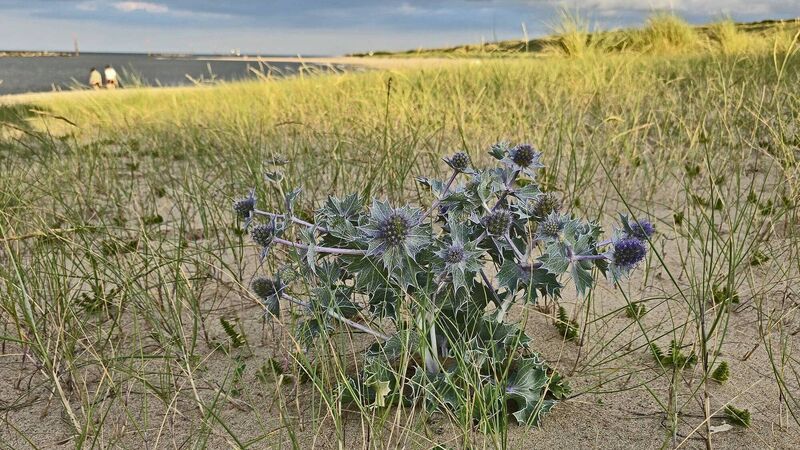
Sea holly (Eryngium maritimum) growing on coastal sand dunes. File picture
Sea holly (Eryngium maritimum) is native to Ireland and a once common sight in the wild on sand dunes and other areas of our coast. Unfortunately, it is not as common anymore as it used to be.
There aren't too many native Irish plants that have made it into a Shakespeare play: “Let the sky rain potatoes; let it thunder to the tune of Greensleeves, hail kissing comfits and snow eringoes, let there come a tempest of provocation" (Falstaff, Act 5, Scene V, , William Shakespeare).
The eringoes refer to our sea holly, a flower said to represent independence and attraction. Indeed, for many years the roots of Eryngium were ground and used as a potent aphrodisiac. Who knows, perhaps many are still at it but do please first seek medical advice before trying any herbal concoction!
In the garden it is a truly special plant, thriving in a very sandy and free-draining soil in full sun. It’s native to coastal areas which are the most horticulturally challenging of all.
Don’t spoil this beauty in your own garden by giving it nutrient-rich soil with lots of lovely humus and water. You will quite quickly kill it with kindness. No, plant it in a part of the garden with poor soil and lots of exposure, where only the strongest survive, for this is what Eryngiums love.
It has waxy-coated, shiny and spiny leaves, thorny to the touch. It's not to be confused with true holly plants, ilex, with which it shares a common name as it is not related at all, merely similar in the fact that they both have spiny leaves.
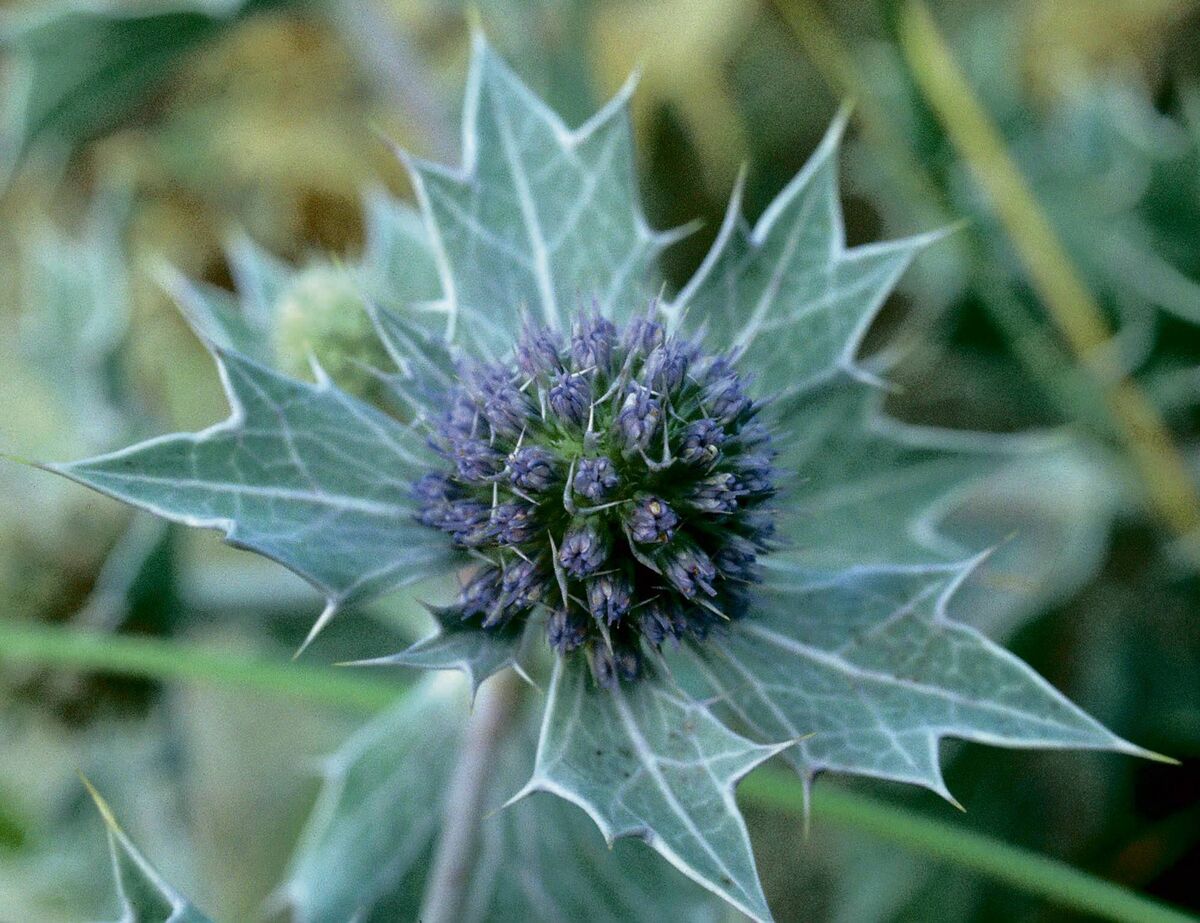
The flowers on eryngium are really quite something, developing as rounded, compact flower heads surrounded by spiny bracts, giving them a thistle-like appearance. Each globular-shaped flower head measures about 1cm-2cm in diameter and is composed of numerous small individual flowers packed tightly together.
It is the colour that really makes eryngium a standout plant. They are the most amazing, metallic, steely blue in colour and each flower head is surrounded by several stiff, spiny bracts that are also bluish-green in colour. These bracts are sharply pointed and add to the overall spiky and thistle-like appearance of the plant.
They are in flower now and have been since mid-summer. The make-up of their flowers allows bees and other pollinators to easily access the nectar and pollen within and as this is a native species, it is also not just serving to help the pollinators but also playing a critical role in local ecology.
Another plant which thrives in poorer quality soils and full sun is lavender, which has been giving its all over the last few months, despite the less than Mediterranean-like weather. Whilst the Eryngium is a herbaceous perennial, dying back each winter and reemerging in the springtime, lavender is a woody, evergreen shrub.
Anyone who has grown it will attest to the fact that if left unchecked, lavender will grow out of hand and quickly develop an unruly, unkempt and leggy appearance. I think it just enjoys our rich soils and climate too much and it nearly outgrows itself.
Once it gets that bedraggled, it is nigh on impossible to bring it back to a well-behaved, bushy specimen. It would be far better to prune it regularly as it grows and to thus stop it from getting into that condition in the first place.
The textbook will tell you to prune lavender after flowering. But let's be honest, there is hardly ever a period when lavender isn’t flowering and so I like to trim it between flowering flushes.
About now, the best of the summer blooms will be fading so I recommend trimming off the dead flower stems and pruning into the bushy stems a few inches.
You can’t but remove some of the stems with flower buds which have yet to open but it’s a sacrifice worth taking. The plant will produce new flowering stems relatively quickly and you will have a nice bushy compact plant in return.
Don’t be in a rush to dispose of the trimmings, for they are, of course, new plants waiting to happen.
These cuttings will root quite quickly, giving you plenty more lavender plants for free and everything that can’t be propagated can still be used for its magical scent inside the home.
Sea holly is native Irish and lavender is not, hailing from warmer areas of Europe and Asia but they like the same conditions and I like to grow them together for they create a really striking colour combination, which when admired on a sunny day allows me to, at least dream, that I am gardening in the sunny climes of Italy or France.
CONNECT WITH US TODAY



Be the first to know the latest news and updates