All you need to know about lithium-ion batteries for lawnmowers

It’s important to know what to expect with well used battery tools and machines. Think of it in terms of fuel for three to five summers. File picture
I was shocked. My 56V Ego battery for my mower was acting up. I have two, and I need two to get around the rugged slice of field acting it out as a casual lawn. The batteries came with the machine (the centre of my life from June to September). I went online to pick up another.
Holy Divine cutting platforms — it was €275-€700, starting with less charge capacity. Tagged on there is the warranty, a mere 12 months. Short warranties are unusual in batteries of any kind, as your supplier has no idea what you’re up to with the battery and a dynamic machine. I’ll admit, I swing between fieldwork and horticulture, and it’s very hard on my battery-powered tools.
All removable, rechargeable batteries for garden machinery and DIY cordless tools belong to a particular “platform”. This is true whether you buy from a top dealer or at Lidl. The charger and battery belong to a designated group, and you can buy more expensive batteries and chargers depending on your needs and your budget.
Platforms are terrific for sharing charging duty with various machines, but batteries gradually degrade and die following a few thousand cycles. Multiply their duty over several machines and the battery life will soon wilt. Depending on your battery usage, and its build quality, you may get several years from a battery, or just a couple of summers. If you buy a lemon, and it's within warranty, it will most likely be replaced with a new battery by the supplier. This doesn’t include backing the car over the mower.
When the battery blinks out its last red warning and you’re out of warranty, you have the choice of going branded or in some cases buying a compatible, generic battery.
Compatible batteries have mixed reviews and often deliver inferior performance. When buying new, there are two things once you know the size, number and branding appropriate to your appliance — the voltage of the battery (V), and its Ah rating or amp-hours. These two things will significantly influence both the price of your battery and the performance of your machines. If you’re struggling with the running time or power of your current batteries, an upgrade may be worth considering.
Voltage is the power delivered to the machine and its muscle, and the higher the number, the greater the power of the machine, whether it is suction, blowing, turning a blade, running a strimmer line — whatever. If you need a lot of torque to cut long grass, a higher voltage rating will be helpful.
A voltage of 60V is equivalent to petrol power, but of course, you have to keep an eye on runtimes and the capacity of the battery (single or double).
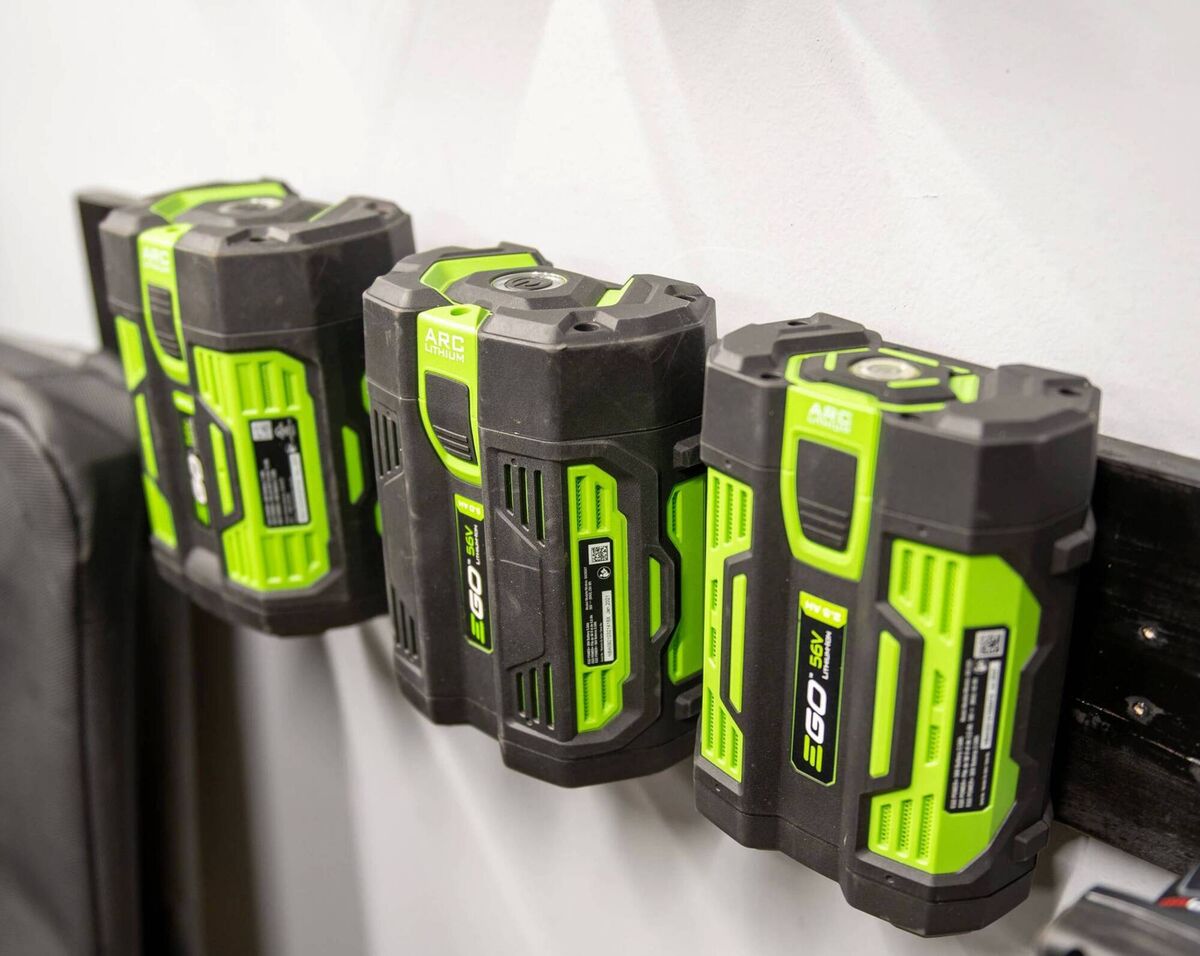
Ah ratings are less well understood, and they are specific to batteries. The Ah is the battery’s capacity, and it determines how long it will hold the charge. This rating can be different in batteries with the same voltage. If you start splicing down the hedges in September with a 24V, 2Ah battery, it will run for approximately half the time of a 24V, 4Ah battery. However, it’s worth keeping in mind that most 4Ah batteries will take twice the time to charge as their 2Ah equivalents. This could prove annoying in a very large garden or small-holding where you only have a Sunday afternoon to get things trimmed and strimmed.
Different tools have different run times, and the Ah rating will influence those times. Using the varieties of the 56V battery I’m shopping for. The Ego 4.0Ah will mow up to 640sqm, line trim up to 110 minutes, hedge trim up to 120 minutes, saw up to 240 cuts or leaf blow up to 160 minutes.
The 5.0Ah battery will mow up to 800sqm, line trim up to 140 minutes, hedge trim up to 150 minutes, saw up to 300 cuts or leaf blow up to 200 minutes. The one I’m replacing will mow up to 1200sqm, line trim up to 210 minutes, hedge trim up to 225 minutes, saw up to 450 cuts or leaf blow up to 300 minutes, but it comes in at a sward-startling €400 (egopowerplus.ie).
Charge and run times vary from machine to machine, and if you use two batteries, you combine their voltage, but the Ah remains the same. 24V 2Ah batteries would deliver 48V of power at 2Ah. If you use a machine that requires 5Ah with a 3Ah battery, it will work, but not for as long.
Most serious gardeners using a battery-powered mower will want two battery sets. That’s either a single as in the Ego mowers, or a double set in the GreenWorx platform of two 24V batteries to power 48V motors. So, if your mower runs with two batteries, for a double set you use and charge simultaneously, you’ll need four fully functioning batteries. As I’ve discovered, it all starts to get very expensive, and one of my smaller strimmer batteries is also on the blink. Hurrah. With this costly cycling of batteries in mind, what can we do to maintain the batteries for our DIY tools and garden power?
Undercharging and overcharging will shorten the life of your batteries. Read the instructions to the letter (find the PDF online if needed). Try to recharge your battery at around 25% of its capacity rather than depleting it completely.
Don’t overheat your batteries. Leave the machine and its battery out of direct sunlight.
Look after your tools. If the machine is struggling or is being misused (for instance, working a mower in very wet grass) this will stress and deplete your batteries. The batteries themselves are not designed to get wet or dirty. Ensure they are stored in clean, dry conditions of no colder than -10C or warmer than 50C.
Only leave batteries on the charger base if it has an idle or maintenance mode. Overcharging batteries even fractionally, will shorten their life. New batteries should be charged the first time according to the manufacturer’s instructions. Storing your batteries for a longer period, remove them from the charger, clean both with a soft, dry cloth.
Modern lithium-ion batteries can be stored charged without damaging them and only discharge around 1%-3% of their charge over the course of a year. Renowned maker Stihl advises: “lLthium-ion battery life is extended if it goes into storage partly charged — that said, it’s worth remembering that cells are negatively impacted in the event of storage with a very low level of charge or if the battery is fully charged. We recommend that you store a lithium-ion battery with two lit LEDs, indicating a charge of 40-60%, to minimise ageing and self-discharge.”
Buy branded batteries intended for your machines and tools rather than compatible products for better longevity.
CONNECT WITH US TODAY



Be the first to know the latest news and updates