Field of dreams: Expect the unexpected at the Naughton family's glorious garden in rural Cork
FROM time to time I experience a garden that makes me stop in my tracks and go: Wow! This is one of those gardens.
I first visited this outdoor room in Donoughmore, Co Cork, about nine years ago when Margaret Naughton and her son Corey wanted some advice on how to turn their green field in the middle of rural Ireland into a garden.
Now in the intervening nine years, this pair have been busy.

What they have created is unexpected. Even as you drive in and park at the front door you are somehow hidden from the wonders within.
Take yourself to the back door as I did and you will be met by a spectacular specimen of Salix Mount Aso with its beautiful furry, red catkins, growing next to the pond and water feature which has matured beautifully in the five or six years since it was created.

It’s probably correct to say that the garden has been created like a series of rooms or different areas and like any good garden, the journey between each is seamless, except obviously the walled garden which is protected by the eight-foot-high wall.
The wall took over six years to build and is not completed yet — though in truth, only a few small stones remain to be fitted.
This garden is part of the family home and as such has evolved with the family.

In 2017 Margaret’s mother passed away and many of the plants that grew in her garden were moved to an area here in Donoughmore which has since become known forever as Nana’s Garden, complete with a beautiful metal arch at its entrance.
A well-positioned rock acts as an interesting focal point within this area and this theme is repeated several times throughout the garden in the most apt of situations you will find similar rocks and stones, none of which happened by accident as Corey and Margaret are quick to let you know.
Another focal point inside the walls, is perfectly situated in the garden to accentuate the formality within.
The garden is a very interesting mix of formality and informality.

Several formal and perfectly symmetrical areas have been created with an urn or similar to draw the eye. Whether it is Margaret or Corey or a combination of both doing the marking out I don’t know, but it is certainly working.
One formal area which is where you enter the garden from the front door is perfectly divided into quadrants with a Liquidambar Worplesdon at the centre of each and surrounded then by Nepeta ‘Six Hills Giant’ and buxus hedges.
The midpoint of this space is waiting for its centrepiece and I can’t wait to see what arrives. This is a garden which has been well thought out, created over time and not finished yet. It is very clearly a garden which is being made and planted by people, a bit like myself, crazy about plants.

Daphne ‘Jacqueline Postill’, Helleborus orientalis, Embothrium coccineum and Tetrapanax papyrifer are not plants that many of us would think of as weeds. But considering that the nearest we can get to a technical definition for a weed is “a plant growing somewhere that we don’t want it”, then these plants have become weeds here, a nice problem to have. They are so happy with their living conditions here that they are spreading and setting seed with gay abandon.
There are several hundred shrubs growing here, countless perennials and at least two hundred trees — and that’s before I even talk about the dahlias which are just about to break ground now for the season ahead.

Margaret describes herself as a dahlia addict and she has over 600 varieties in cultivation, some of which now reside in their own, purpose-built raised beds, built to a sensible height for, as Margaret says: “None of us are getting any younger and I don’t want to strain my back when I’m out gardening.”
Gardening and creating a garden is, for all of us, trial and error and not scared to admit when something isn’t working, Corey hasn’t been slow to take things up and move them when they don’t work where they were
originally planted.

A hedge of Hydrangea ‘Limelight’ which was unceremoniously lifted from its original home to where it now resides, down behind the polytunnel and nursery area where it is now thriving and resplendent during summer, in bloom.
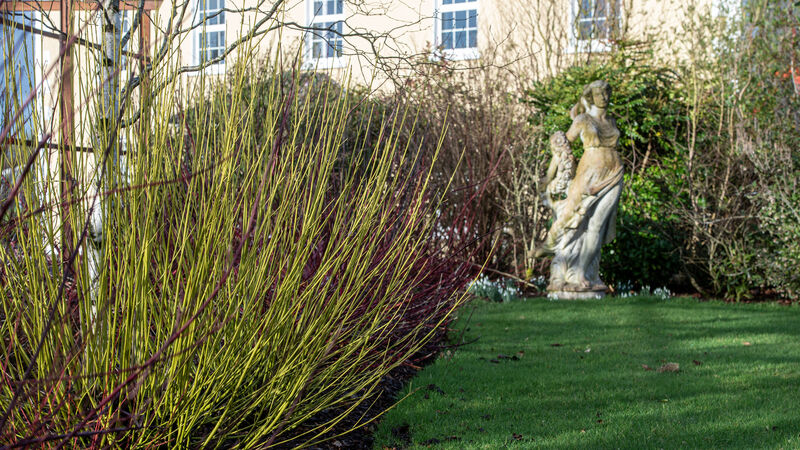
Corey has a grá for dogwoods and there are numerous species of both cornus trees and shrubs, the latter creating a wonderful winter stem effect. As I was walking the garden with them, he was looking, nearly crossly at a clump of, perhaps my favourite variety,
Midwinter Fire.
Cross is the wrong word because I don’t think that would be in his nature, he’s a gardener after all and we tend to be a calm enough bunch, but the clump is certainly vexing him, for they are weaker and smaller than the other varieties growing nearby and I suspect that the next time I visit, they will have found a new home.

He is similarly fond of acers, cannas and willows but his face actually lights up when talking about the purple twisted hazel, Corylus avellana Contorta Purpurea. There are several of them throughout, fantastically dramatic in the winter with their corkscrew stems, soon to be clothed with their purple foliage for the spring and summer.
Margaret also has a passion for eucalyptus and she can be thankful that she gardens in the countryside on a large plot for there is no way she could grow as many in a smaller garden.

Meanwhile, Corey has developed into quite a galanthophile, which is a snowdrop addict. This is one addiction I don’t have. I love the simple common snowdrop and whilst I do admire many of the more unusual varieties, I have never felt driven to collect them, for which I count myself extremely lucky, given the prices that one tiny bulb can command.
You will find interesting specimens here, Juniperus recurva, Heptacodium miconioides, Stachurus praecox, varieties of cornus, up to now, unknown to me, along with both the green and variegated forms of corylopsis.
All this and I haven’t even mentioned the witch hazels, many of which I had the pleasure of admiring in full bloom recently.

I can’t think of anywhere, except the arboretum at Fota where you will see as many of these beautiful hamamelis growing.
I normally advise the planting of the varieties pallida or Arnold Promise as these yellow forms are more showy and visible during the winter months than the interesting red forms such as Diane or Orange Beauty. However, having reacquainted myself here with Jelena I may be for turning and the variety Aphrodite has me positively entranced.
This garden has evolved over the last nine or so years from a greenfield site to a place worth visiting.
Yes, it’s nicely laid out and has many healthy and interesting plants but really what makes it that bit special is the thought, the love and the work that has gone into it.

I know it’s a metaphor that can be overused, but the creation of this garden has been a “journey” for Margaret and Corey — a voyage on which they have learned about planning, design, and plants, their names, where they like to grow, their eventual heights and spreads, how to propagate and everything else that the wonderful world of gardening teaches.
The Naughtons’ garden is private, though they have opened it in the past for important causes such as Marymount Hospice.

Keep an eye out to see if it is open in the future and if you see it advertised, grasp the opportunity to visit with both hands.
CONNECT WITH US TODAY
Be the first to know the latest news and updates