How to rescue your garden after heavy winds and rain
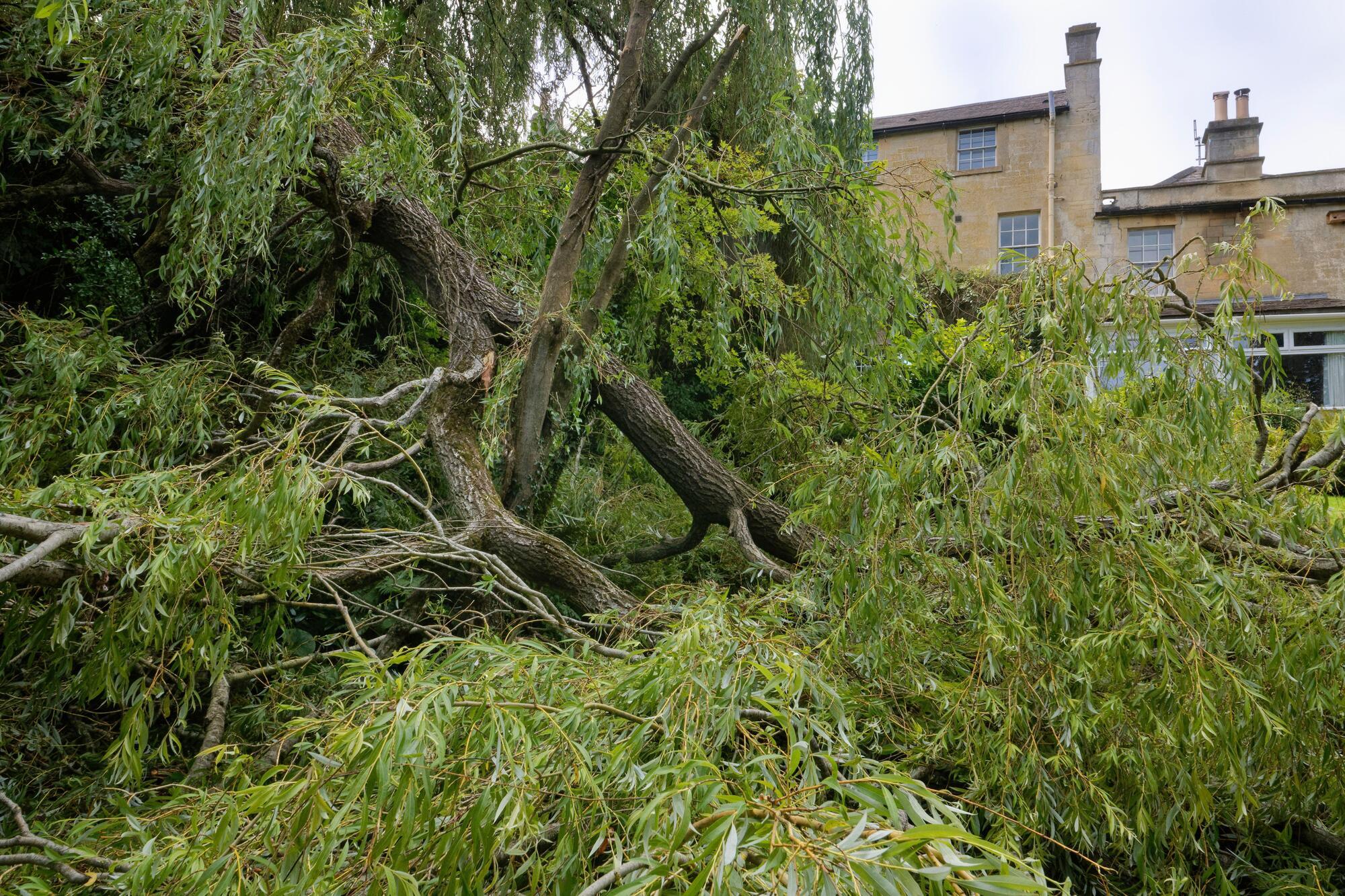
As storm after storm batters Ireland and the UK, householders are doing their best to shore up their properties against further strong winds and rain.
But gardens are vulnerable to the full onslaught of the currently violent weather, and many gardeners will despair at the damage wrought to their precious and normally well-tended green spaces.
However, there are sensible measures you can take to protect and rescue your garden from storm damage, says Guy Barter, chief horticulturalist at the RHS. He advises gardeners to…
“Trees don’t last forever, and there’ll always be the odd tree coming down here and there,” he says. “Sometimes it’s associated with root disease, so it’s worth checking that the roots aren’t rotten and smell of fungus.”
If there is root disease, he advises gardeners to have the stump excavated, pointing out that if it’s a small tree, you can feasibly do it yourself, but he warns against planting another tree in the same spot.
Although wind damage can make plants and trees look terrible, Barter stresses that many trees in particular will regrow.
“Sometimes they just snap off above ground level, but very often they’ll resprout,” he says. “For very big trees you’ll need the help of a tree surgeon, but you can often bring trees back to life. Even if they’re very, very broken indeed they can regrow, so don’t throw in the towel immediately.”
You can’t really tell whether a tree will regrow or not, he explains – although some types are more likely to be resurrected than others.
“Silver birches and other birches aren’t great at regrowing, and others, such as oaks and beech trees, are very good at it, and apple and cherry trees can often recover remarkably well too,” he says. “I think you have to take your courage in both hands and hope for the best.”
Barter suggests looking at the RHS website or a pruning book to see whether a damaged tree is a type that doesn’t respond well to pruning. “If it doesn’t, then it’s probably had it,” he says. “But if it’s a tree that you can prune as much as you like, then it’s fine.
“Some trees can live over a hundred years, and during that time, they’re bound to encounter storms and accidents that destroy boughs, and they can usually recover quite well.”
Barter points out that young plants wave around in the wind, so this is the time of year when you have to adjust tree stakes and ties and perhaps hammer in a few more. “Sometimes trees are pushed over by the wind, and you can just push them back upright, perhaps with the help of a landscaper and a few navvies to get it in position, and hopefully it’ll reroot and carry on,” he says.
He does warn gardeners, however, to check the forecast as there’s no point resurrecting your precious trees if they’re going to get blown down again in a new storm a few days later.
“Things aren’t going to start growing again now until April, so they’re not going to come to any harm,” he points out.
Solid fences are a barrier which can get shaken and brought down in the wind, explains Barter, but if a fence is porous – known as ‘interference fencing’ – the planks don’t quite meet and the gap allows air to filter through.
“A trellis works the same way,” he says. “Although fences have their place, if you live in a windy spot, something that filters it is a lot more satisfactory than something that acts as a barrier.”

In the longer term, Barter says planting deciduous hedges can be particularly useful for storm-ravaged gardens. “If you plant deciduous hedges that lose their leaves in winter, or mixed hedges that contain some deciduous trees, they filter the wind and are a much more effective barrier than solid fences, walls or evergreen hedges,” he explains.
“Happily, plant roots cool in the winter – they’re not going to respire, so they don’t need oxygen,” Barter says. “If you have waterlogging in the summer, trees and shrubs and indeed all plants will die very quickly, but in the winter the lack of oxygen isn’t too harmful, so they’ll usually sit out these wet spells.”
He says the exception to this may be evergreen Mediterranean shrubs such as lavender and rosemary, which can succumb to very wet weather. Barter says if gardeners do lose this type of plant because of the weather, they could either replant with something more resilient, or plant in a raised bed, or plant in a mound to keep the roots out of the water, with just a bit of aerated soil around them.

Barter says lawns are usually fine after heavy rain, but points out: “There may be some bare patches in the spring where the water’s been hanging round, but they can be reseeded, or buy a bit of turf.”
He says it’s important to keep to paths in the winter and not trample turf or any other soil, so if you need to do something in the garden, put planks over the grass to walk on.
“It’s very distressing if you lose a precious tree, but in the great order of things, gardens will go on and there’s no need to get a concrete mixer and concrete it all down – there are lots of things that a wise gardener can do instead.”
CONNECT WITH US TODAY



Be the first to know the latest news and updates