Jennifer Sheahan: How to design bathrooms for small spaces
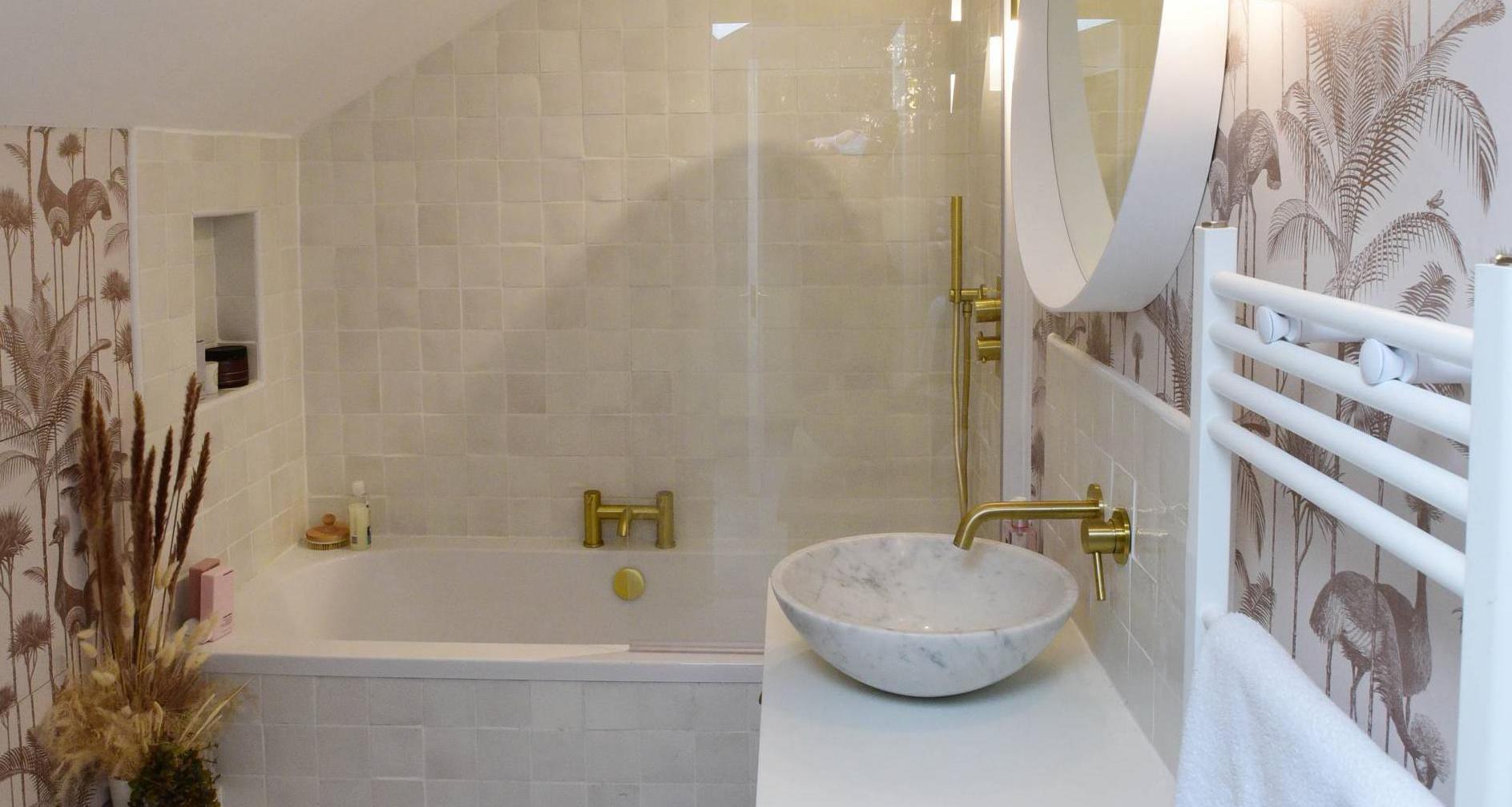
Jennifer Sheahan's upstairs bathroom. Picture: Moya Nolan
I had two big asks for my architect when I first told him my ideas for my newly purchased 42 square metre cottage. The first was that my home must have a bath.
I adore baths — add candles, bubbles, music, wine, and chocolate, and you have an instant luxurious haven for as long as the hot water lasts (do not remind me of the looming energy crisis, please).

The second was that my home must have two bathrooms. I was extending — 42 square meters would eventually become 60 with my new upstairs dormer addition — and I wanted a bathroom for guests. In my mind, I also knew this would increase the resale value of my home if I ever decided to move on, although now that that home has become a beautiful reality there is no chance of me ever leaving it.

Fitting two bathrooms, one to contain a bath, into this tiny cottage took quite a bit of creativity and manoeuvring, but we got it done and I couldn’t be happier. I learned a lot about bathroom design in the process, so settle in — perhaps run a bath while you still can — and let’s go potty.
As with every design, the first step is to list out what it is that you need. Who will be using this bathroom? Will you need to wash children or pets here — if so, will height and access be an issue? What will you need to store here? Will it save your relationships to have two sinks? Does anyone using this space need to sit when showering?
At a minimum, you will likely need a toilet, a sink, somewhere to hang a towel, and perhaps a shower and/or a bath.
You may want daylight — Velux skylights or sun tunnels may be an option if there’s no wall space, or use some good spotlights if no windows are possible.
Perhaps you dream of more, maybe a sauna or a humongous rain shower. Don’t be afraid to add your dream elements — there may be a way to get what you want even if it seems impossible at first.
Once you have decided on your essential (and dream) elements, it’s a good idea to try lots of different layouts to see what fits best. If you’re handy on a computer, you could use design software for this such as Sketchup, or I found PowerPoint a super handy tool.
If you don’t want to mess around with a computer, it’s a great idea to mark out the items on a floor using masking tape, or to cut out their approximate shapes using cardboard or paper and put them in the intended space.

If that space doesn’t exist yet, mark it out on a floor using masking tape somewhere where you do have space. The idea is to be able to move things around so that you can play with lots of different layouts to see which works best for you.
Make sure you have the correct measurements when doing this. It’s much easier to move around some paper and masking tape than it is to replumb a sink. While it’s tempting to squeeze everything in tightly, do make sure that you have enough space between items to move around — around 53cm is recommended.
Most bathrooms are small, and you’ll likely need to make some clever decisions when it comes to maximising your space; for instance, in my downstairs bathroom it took some creativity to make enough space to move around my shower door to get to the toilet.
I finally made it work by only having one shower door along the side — not much water splashes out the front, and the floor tiles have been sealed and very slightly slope to allow any escaping water to drain back into the shower. Curved shower doors are great space savers too, as is creating a wet-room if that is within budget.
Consider item sizes — vanities and sinks are available in a huge range of widths and lengths, so make sure you are clear on what space you have before shopping around.
I did have to make a small compromise with my bathtub and get one that was slightly shorter than average (1700mm). Tubs come in lots of sizes so don’t give up on your dream if you really want one.
Doors are something you may forget, but which can end up taking away a lot of space in your bathroom. If a door is causing serious space issues in your bathroom, consider installing a sliding door.
There are two important decor elements to cover before we get to the fun stuff — lighting and mirrors. Mirrors are easy — go with the biggest one you can possibly fit. Lighting is also straightforward — put wall lights either side of your mirror and a spotlight or two over your shower.
Now for the creative part — I absolutely love to see unique, playful, and dramatic bathrooms; it’s the perfect space to bring your wildest decor dreams to life.

Bathrooms have two unique qualities over other rooms — they’re typically used alone (although no judgement here if you prefer company) and they’re fully enclosed, so you end up with a small immersive space.
In my downstairs loo, I have made full use of this and painted everything in a very strong colour — including the ceiling, skirting, architrave, and the door. I have installed dramatic tiles, and I’ve popped a disco ball in there because who doesn’t like a little mood lifter when they pop in for a pee?!
Don’t be afraid to experiment!

- Got a question for Jennifer Sheahan? Email home@examiner.ie