Jennifer Sheahan: Design solutions for oddly shaped rooms
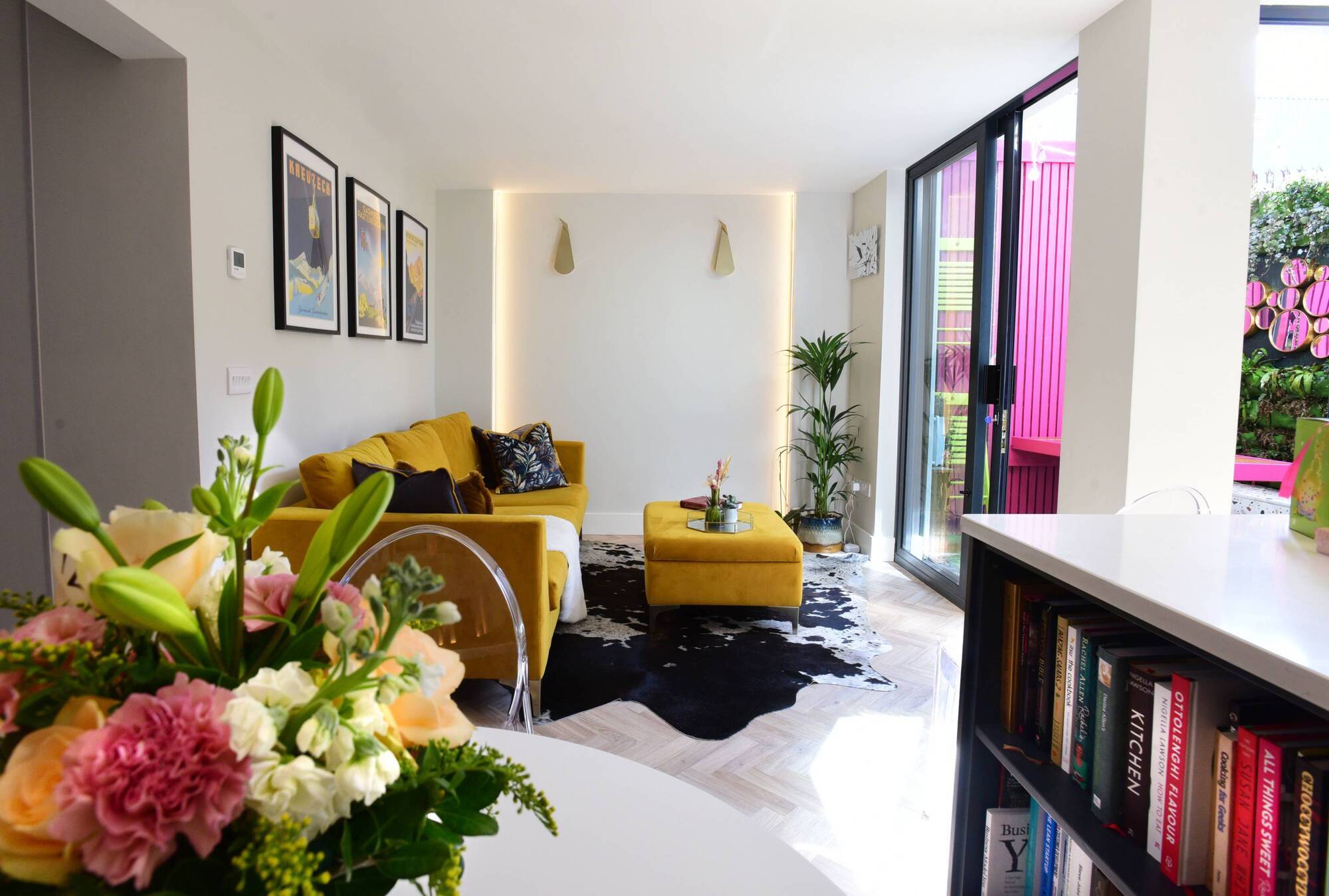
Jennifer Sheahan's living space.
We've all been there — you buy your first castle and you’re super excited to start hanging tapestries and hosting banquets, until you get into a turret and think hmm: how am I going to fit a couch in here?

Alright so maybe we haven’t all been in that exact scenario — and if you have I have little sympathy for your plight but we have found ourselves in oddly shaped rooms wondering how to fit in standard shaped furniture. Sometimes it’s a strange alcove, a curved wall, or an inconvenient beam. Whatever odd shape you’ve ended up in, someone has cleverly designed a solution for it. Here are some of the most interesting:
SLOPING CEILINGS
Many older homes in Ireland have funny extensions or chimneys galore that often create odd sloped ceilings, leaving quirky spaces for you to deal with. I like to lean in to this — consider painting the sloped underside and the back wall a slightly different shade to create a feature, or even add wallpaper for additional impact.

A sloped ceiling can also be super cosy —it’s the perfect spot under which to place a couch or an armchair. Slopes are also an opportunity to create little nooks — you can easily buy different length shelves to fit without having to go custom made, and a simple bench with cushions underneath will turn the space into a cosy reading space — or a desk to create a neat home office space. If your entire ceiling is sloped, adding beams is a great way to turn it into a feature. Faux wooden or painted beams can look very realistic and affordable options are widely available.
NARROW ROOMS
We live differently today and as such some older houses leave us with rooms that are too narrow for the relative luxury of 21st century living. If you’re wondering how best to design your narrow living room or dining room, the first thing to do is to make sure there’s a clear pathway to walk through the room. This may be down the middle or you could pull the furniture out from the walls and create a pathway behind it.
With narrow rooms, it’s best to have the furniture up from the floors — so choose couches or chairs with sleek legs rather than boxy designs that will make the room look cluttered. In any small space it’s a good idea to pull the furniture out from the wall even just an inch — pushing it right up against the wall may feel like the logical choice but it will only make things look squished in.
In a very narrow living room sometimes a couch is just not an option — in this case, a few armchairs with scattered side tables and footstools will be much easier to work with as these items can be more easily placed to fit the room.
Drawing the eye upwards with mirrors, lighting, or artwork is always a good way to create a sense of more space.
Keeping a light, uniform colour scheme for walls, floors, and furniture will help to reduce the compact feeling of narrowness. Finally, consider adding rounded or irregular shaped items such as a curved lamp or a cowskin rug to break up the long lines.
CURVED WALLS
Curved walls are a beautiful design feature — the problem is that our furniture is rarely round. If you shove a regular couch or a bed up against a curved wall, you ruin the aesthetic and leave a weird gap at the back. Curved walls are not uncommon in Ireland, especially in modern apartment buildings, and curved staircases or large bay windows create the same design challenge.
Curves are beautiful, so the first rule here is to highlight it — use it to create a focal point with wallpaper or a different colour. Adding a dining or coffee table is the next logical choice, as they are the one piece of furniture that is round. If the space calls for sitting rather than dining, you can of course blow your life savings on a beautiful custom curved couch.

If that’s out of budget, again consider single armchairs and footstools here for the same level of comfort along with flexibility to position along the curve. A small curved wall can be the perfect spot for a home bar — add custom shelves or attach vertical glass holders to the wall, and add a small drinks trolley or countertop away from the wall. If the curve is in the bedroom, you can again blow your cash on a round bed (and live with the resulting headache of finding round sheets!) or you can simply design a curved headboard to go with your regular shaped bed.
BEAM ME UP
Every house — especially any house built more than 10 years ago — has at least one unwanted beam or load bearing wall jutting into a room. They’re so ubiquitous you may not even notice them anymore — it’s that weird box-shaped thing in the corner of a room that serves no apparent design purpose. Except for keeping the whole house from collapsing, of course.
Most people just paint over them and let them fade into the background, but they can be a nice way to create a focal point.
Supporting wooden beams always look good but you can equally paint it an accent colour or use it to hang quirky knick-knacks.
You can also save space by turning the beam into a lamp — add LED strips along the sides or install wall sconces for dramatic uplighting. If you have a beam in the corner that really bothers you, consider cladding it with mirrored glass. It may sound unusual, but this will transform it from something that takes up space and looks odd to something that actually creates a larger sense of space in your room!
- Got a question for Jennifer Sheahan? Email homeimprovement@examiner.ie
CONNECT WITH US TODAY
Be the first to know the latest news and updates