Islands of Ireland: Donegal's link to Robinson Crusoe and Treasure Island
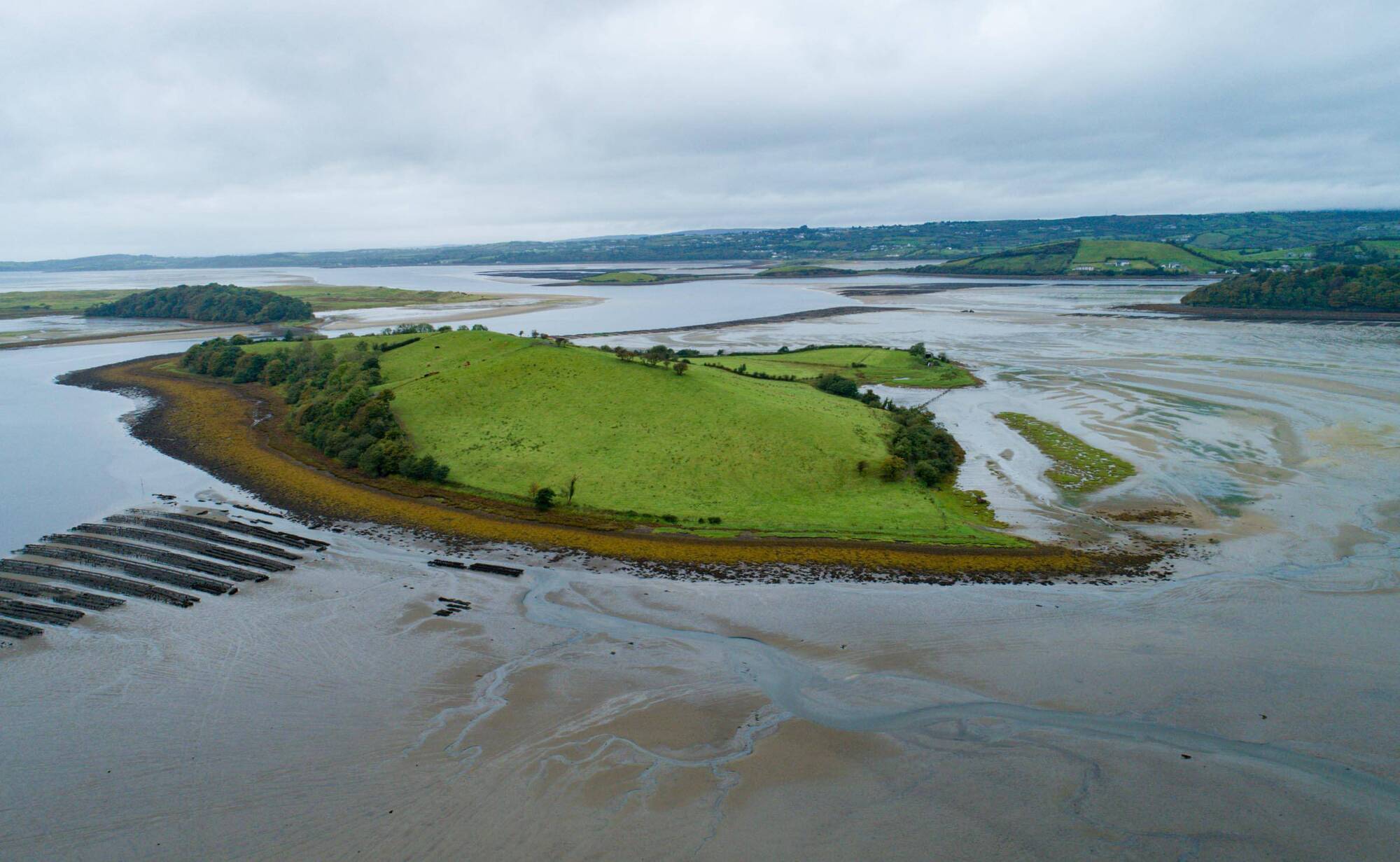
Rooney’s Island, Co Donegal. Picture: Clive Wasson
Of all the castaways in literature, Robinson Crusoe is undoubtedly the most famous. The island in Daniel Defoe’s 18th-century novel was in the south Pacific and this one, which recalled the novelist, is in Co Donegal.
Defoe based his iconic tale on the survival of a Scottish castaway, Alexander Selkirk, who was washed up on the Chilean island of Más a Tierra, which lies on the same latitude as the capital, Santiago. In 1966 this island was renamed Robinson Crusoe Island but the Donegal one had staked its claim first.
This Donegal island is not really Robinson Crusoe’s Island, of course, but the more prosaically titled Rooney’s Island. It lies nestled in the inner reaches of Donegal Bay, not far from Donegal town. Several rivers, including the Eske, empty into Donegal Bay here. The island is a neighbour to several other smaller islands, including Bell’s Isle, Inishnagor, and Inishpat. It is a hilly island under 1km in length and about 300m in breadth, where three 19th century dwellings are evident on the 1837 Ordnance Survey maps. It is surrounded by a vast sea of mud at low tide which attracts a proliferation of waders.

The island was accorded the sobriquet by a Donegal judge in 1907 in the Land Judges Court where tenants and landlords attempted to settle their various claims. A tenant of Rooney’s Island called Hugh White had refused to pay more than £27 for the privilege of cutting seaweed on the island. White had wanted exclusive rights to the seaweed as he feared mainlanders would help themselves to the plant otherwise.
Playing to the gallery, the judge cracked: “But he [White] is the Robinson Crusoe of the island and no one else can get at the island!”
Defending White, his counsel McCloone declared: “It is only an island when the tide is in. It can be approached from the mainland by a dry strand when the tide is out and they can bring over dry carts and cut the seaweed without going over high-water mark.”
White won his case, which highlighted the value of the seaweed as a crop to the local economy and brought into focus the lengths to which poor people would go to defend their claim on it. Survival in many cases depended on being able to harvest it.
Whatever about the tenuous link Rooney’s island had via the judge to Daniel Defoe’s fictional work, it has a better claim to an association with another adventure novel, Robert Louis Stevenson’s Treasure Island. Having escaped imprisonment in Dublin Castle in 1592 the nobleman and leader of the Nine Years War, Red Hugh O’Donnell, reputedly fetched up in this part of Co Donegal while on the run from English soldiers. He was given succour by a shoemaker called Rooney who gave him food, clothes, and shoes.
Red Hugh promised Rooney that, should he return, he would duly reward the shoemaker. Return he did and he granted the cobbler the eponymous Rooney’s Island as well as treasure in the form of a large bag of money. So went the tale.
The Donegal News reported in 1912 that a farmer called Adam McClay came to possess a bag of coins with the impress of English regents Queen Elizabeth, kings Charles the First and James II. The coins varied from the equivalent of a shilling to five shillings in the coin of the time.
As the latter two regents reigned well after the time of Red Hugh O‘Donnell, Rooney couldn’t possibly have had a bag of ‘treasure’ with coins bearing their likenesses. The truth rests outside the conflation of probably several stories, though if it was just Queen Elizabeth then the story gains traction.
The naming of the island after the cobbler has a certain degree of plausibility though.
A 17th-century name for Rooney’s Island was Eniscollman which has had scant references. A more likely explanation for Rooney rather than a person’s name is the suggestion that the derivation comes from the Irish for ‘seals’, ‘ronaigh’ which are in plentiful supply in this part of the bay. And in Irish it is Oileán Uí Ruanaí.
- How to get there: No ferry. Kayak from near Donegal Golf Club.
- Other: Donegal News 22/06/1912


Cancel anytime
CONNECT WITH US TODAY
Be the first to know the latest news and updates