Islands of Ireland: Derrynaflan in a sea of bog
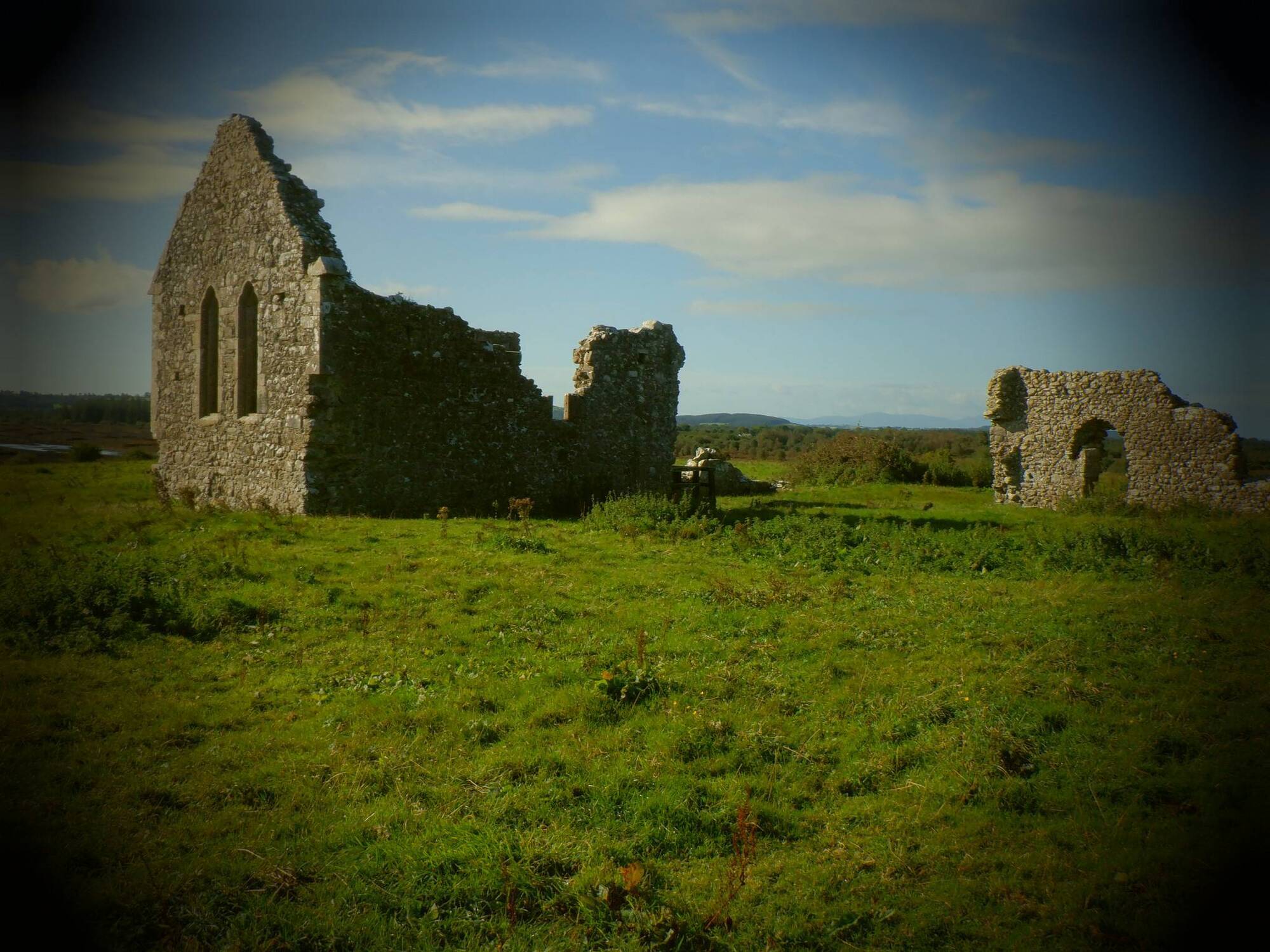
Church on Derrynaflan Island near Horse and Jockey, Co Tipperary. Nearby is the grave of the famous medieval architect the Goban Saor. Picture: Dan MacCarthy
AS you stroll down an avenue of cow parsley, knapweed and yarrow a few kilometres east of Horse and Jockey in Co Tipperary, something lies above the horizon of bog. On the approach down a newly built trackway, a dominant arc rises from the landscape in a place that could have as much significance in the ecclesiastical world as Croagh Patrick. Welcome to Derrynaflan Island.
This island of about 50 acres is a mystical site that has a steady stream of visitors but which has massive potential were it to be fully promoted along the lines of, say, the Rock of Cashel.
All around is the former worked bog, through which two small rivers flow north and south of the island. The prevailing land outside the bog is all high ground and, in the distance, the Knockmealdowns can be seen.
A railway track used to pass through here too, linking Thurles and Clonmel.

As islands go it is pretty unusual in that it is defined by land, rather than by sea or lake, but an island it undoubtedly is. Its geography is characterised by a rock outcrop, smothered in soil, in the centre of a sea: in this case, a sea of bog.
The island has a dual prominence in that it is the location of the discovery of one of our early medieval masterpieces, the Derrynaflan chalice, in 1980. It is also the burial place of the famous architect known as the Gobán Saor.
According to one writer, after St Patrick, Fionn MacCool, Columbcille, and St Bridget, the most popular personage in ancient Irish history was the Gobán Saor.
The architect probably lived in the 7th century, earlier than the time when the round towers, such as at Glendalough, were being built. It is conceivable that at least prototypes of some of the monuments were by his hand. Nevertheless, some historians have ascribed the uniformity of several of these monuments to him.
His name translates as ‘artificer’ or ‘mechanist’, and he built in wood as well as in stone.
So widespread was his fame, that he was reputed to have built many buildings that he could not possibly have done. It recalls the conceit of Italian writer Umberto Eco, who wrote that, if the claim for every relic said to belong to John the Baptist were true, there would be enough bones to supply dozens of the saint.
Gobán Saor was born in Turvy, Co Dublin, and his father, also an architect, was possibly a foreigner and, therefore, taught the young Gobán Saor styles and techniques that were not indigenous. This holds out the tantalising link to the round towers of Ravenna in Italy, and near Asia, which were built around the 8th and 9th centuries.
There are several other standalone islands nearby, including Fox’s Islands.
The spelling of Derrynaflan has been rendered as Doire nav vloum and Deire-na-Bplane, where ‘doire’ refers to oakwood.
It was a common belief that the Gobán Saor did not work on any buildings southwest of Tipperary.
He is also recalled in popular doggerel: “He was the builder of these wondrous Towers/Which tall and straight and exquisitely round/Rise monumental round this isle of ours/Index-like marking spots of holy ground.”
The church on the island dates from the 13th century, with a possible earlier monastic settlement on the same site founded by St Ruadan of Lorrha.
In common with many of our ecclesiastical sites, Derrynaflan was also raided by the Vikings. In the Irish chronicles, there is a reference to the year 861, in which the Danish earls Olaf, Sitric, and Ivar opened the mound of the wife of the Gobán Saor for the “purpose of plunder”.
The Ordnance Survey maps of 1837 record the burial place of the Gobán beside this ruined church. The area has been fenced off and a capstone with a stylised motif of a cat is evident. This is reputed to be the final resting place of the Gobán Saor.
It was said that his repute would last in Ireland “till the end of time”.
How to get there: About 2km east of Horse and Jockey, Co Tipperary.
Other: Irish Round Towers by Hector McDonnell in Ulster Journal of Archaeology, Vol 74; The Island of Lurgoe, The Nationalist July 19, 1950.
CONNECT WITH US TODAY
Be the first to know the latest news and updates