Damien Enright: Lichens can be the flowers of winter
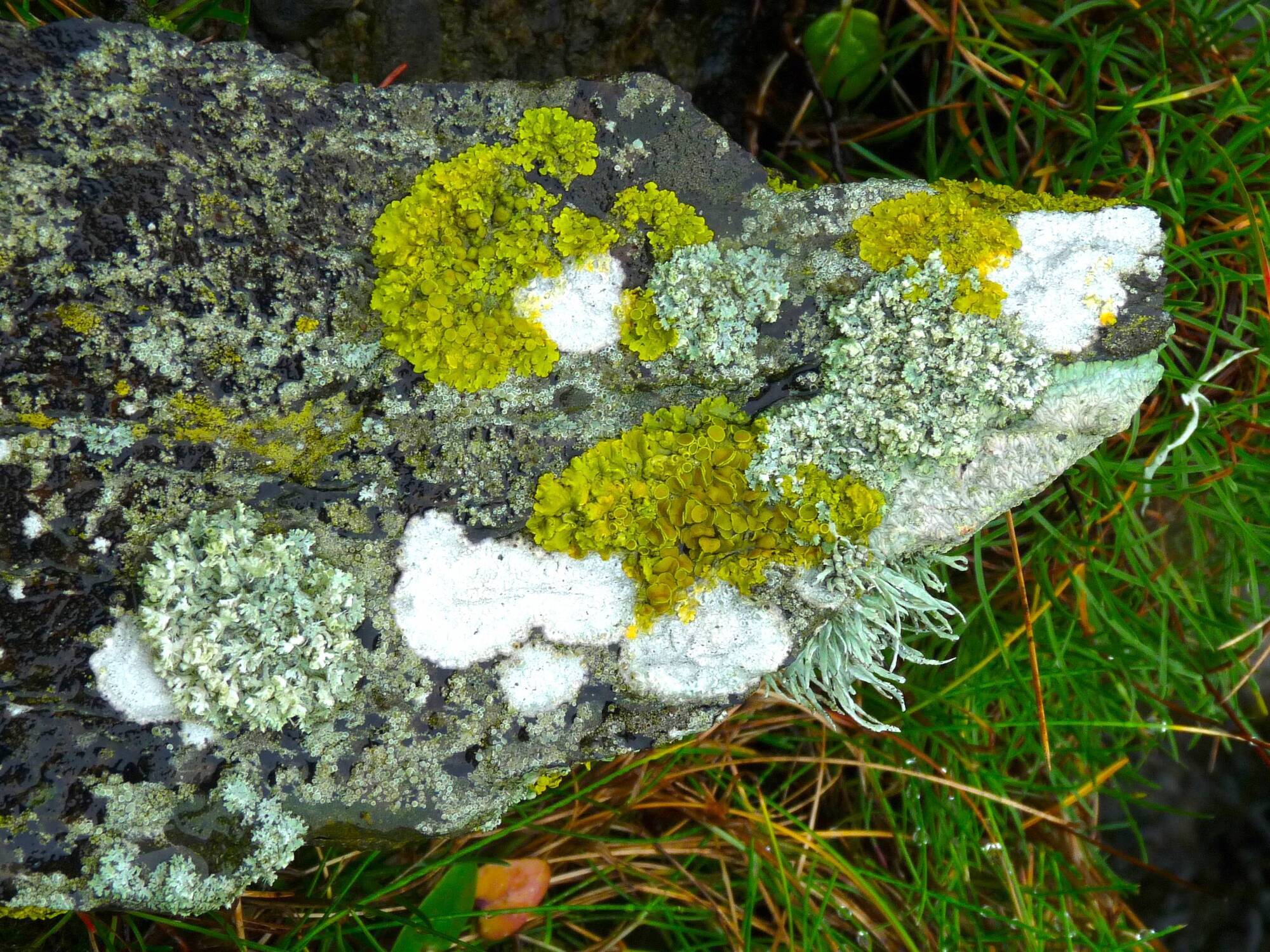
Colour in winter is provided by lichens on stone on a sea shore path lit up by sunlight.
Winter certainly has its rewards if you happen to live near a slob, like I do.
I've used the word 'slob' a dozen times in these columns and never been sued. Today, I looked it up in various dictionaries. In every case, a slob was defined as 'a lazy or slovenly person, often with poor standards of personal hygiene'. I do not live near that kind of slob.
It is also used with the word for an overweight person. This is clearly unfair — 90% of overweight persons are not 'lazy or slovenly', and 'lazy or slovenly' persons are not always overweight.
Only in Ireland, does a slob mean a shallow bay that drains twice a day and reveals acres of mud upon which wading birds of all kinds feed, especially at this time of year. And their presence is what makes walking a slob rewarding.
To the grey canvas of mud, when the tide is low and the sun is shining, the birds add dashes of colour, and occasionally drama.Â
The channels that run through the mud — when the sun is shining — are blue, like the sky, and the mud banks are transformed to shining gold.
All this depends on the sunlight; without it, slobs can be shroud-grey and, in terms of vivacity or drama, dead as door nails.
Patches of egg-yolk yellow grow alongside, or within, blotches of brilliant white, colours so vivid that are, for me, anyway, arresting. I never cease to be surprised at the shapes and colours of lichens on rocks and on trees; they are as vibrant, or more vibrant, than works of art in galleries and raved about by critics of form and colour.
I can't resist photographing them: I could hang a whole gallery with pictures of extraordinary lichens.Â
These images owe nothing to photographic skills, of which I have none; the lichens 'are as they are', as they have been, often for millennia — for they are some of the oldest life forms on our planet — and sunlight and a decent camera lens is all that's needed to capture them as exhibition pieces. They are found almost everywhere, in their thousand shades and textures.
The biology that engenders them, accounts for them and sustains them is encyclopaedic, and I would leave attempts at explanation for another day.Â
Yes, the science is astounding too. But it's their colours, textures, hardiness and presence in almost every environment and climatic zone that intrigues me.
They are wayside art gallery not to be missed.

On another theme, I must refer readers to the purple potatoes now available in certain shops in this potato-paradise of Ireland where, it seems, varieties from almost everywhere will thrive.
The ones we had at dinner last night were purple-black and, indeed, at first reminded us of the crops of Black '47 and the Famine years.
However, they were excellent and healthy to eat, not only the skin, but the flesh, purple-black and waxy like, for example, Charlottes — not floury, like Maris Pipers or Golden Wonders.Â
It was a surprise to see on the bag that they were grown in Timoleague, in west Cork, the village at the head of the slob of which I've been singing the praises.
I sent a picture to my brother in Spain, and we exchanged text messages comparing the Timoleague 'Violetas' — the name by which they're known — with the black potatoes of the Canary Islands, which are definitely black, not dark violet.
This led to our discussing 'papas arrugadas', a small, withered variety of spud, seemingly endemic to the seven islands of the Canaries group.Â
These are small, but not withered when they come out of the ground; they wither when cooked, traditionally, in salt water and left to dry.Â
It seems that, to date, there are 500 varieties of these tubers, first cultivated by Incas in Peru. Inca potatoes had purplish skins and yellow flesh. Potatoes are now, in many climates, the very staff of life — as they were, for centuries, here in Ireland.
It was the colonist, Sir Walter Raleigh, who introduced potatoes here in 1589, on his 40,000 acres near Youghal. Spaniards had brought them to Virginia where he came across them.Â
It was Irish emigrants that first sowed potatoes in North America in 1621, at Derry, in New Hampshire.