The Islands of Ireland: A light touch in Achill Island
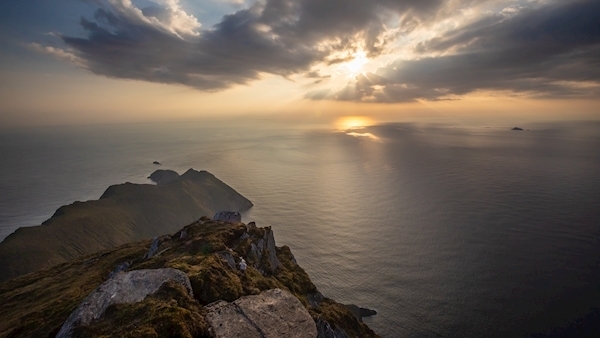
There are many sublime words to capture the nuances of light, and in Achill, Co Mayo, all of them are appropriate depending on the time of day or season.
On a recent visit to a house loaned by a German friend snug in the western village of Dooagh, the light displayed much of its rich vocabulary: Lambent moonlight bathed the mountainside; lustrous starlight flashed in heaven’s vault; light glistened on the sea; light occluded when the brooding clouds rolled in and cut off the vistas; radiant light when the curtain of clouds was drawn back to reveal the dark, inscrutable cliffs; a burnished light of the evening when the white gables of the houses caught the glow of the sinking sun.
The island has a couple of world-famous beaches: Dooagh beach, which can’t seem to make up its mind if it should stay or go (it’s currently gone), and Keem beach, which was ranked third in the world by Condé Nast Traveller.
At 24km east-west and 15km northsouth, Achill is by far our largest island. It was linked by a bridge across the choppy waters of the Achill Sound in 1887 and named after the co-founder of the Land League, Michael Davitt. It was replaced in 1949 and 2008.
And to purists, maybe Achill is not an island as you can drive to it, but it has a separateness and a distinct state of mind.
Most islanders would give only one answer as to whether it is or isn’t an island. Looking south, neighbouring islands dominate the vista when the Menawn Cliffs are discounted, though how could you discard such an astonishing sight: the wedge-shaped Caher Island, the towering Clare Island and captivating Inishturk.
Achill has attracted writers over the years seeking out solace. German novelist Heinrich Boll spent time there in the 50s and 60s; Graham Greene rented a cottage in Dooagh. Irish writers Ernie O’Malley and JM Synge, more closely linked with Inishmeáin, also spent time on Achill.
However, it is painters seeking out the quality of the light who really beat a path to Achill’s door. Co Monaghan man Alexander Williams was one of the first and lived in Achill decades before the much-better known Paul Henry.
Williams’s highly charged paintings are evocative of 19th century Achill life: ‘Toilers of the Sea’; ‘Seaweed Gatherers’; ‘Shark Fishing’. He recorded in his memoirs what Achill meant to him:
The air is perfectly still and a dreamy silence prevails but as I sit sometimes with closed eyes, voices of the children of the village opposite travel over the water. As the afternoon light of copper-coloured sun slants over the bay the hillside glows with a refulgent light.
Other painters to find Achill’s bays, cliffs, mountains, remoteness, irresistible include: Desmond Turner, Henry Healy, John Faulkner, Robert Henri, Louis le Brocquy, and contemporary artists Camille Souter and Padraig McCaul. And naturalists too came including the famous Robert Lloyd Praeger.
On a climb to the almost indescribable fastness of Croaghaun he wrote:
“You can visit Bunnafreeva Lough a place so lonely and sterile and primeval that one might expect to see the piast [péist] or other Irish water-monster rising from the inky depths of the tarn.”
The population of Achill today is around 2,500 and peaked at 5,000 pre-Famine. The deserted village on the flank of Slievemore Mountain is a testament to the ravages wrought by the Famine, a situation brutally exploited by the proselytiser Reverend Edward Nangle who doled out life-saving nourishment in return for religious conversion.
Achill has always been synonymous with shark fishing as exemplified in Williams’s work. The industry employed manyislanders and tales of shark-hunts reached legendary status: 12,000 basking sharks were landed in a 30-year period.
And Achill has a long association with the eagle too with the white-tailed and golden species breeding in the cliffs up to the 19th century. The meaning of ‘Achill’ is unclear. It has also been named as Ecaill, Eccuill, Akill, Akle, and the Aukilles.
Yes, Achill has a history of emigration but also of ingenuity and recent ventures like O’Malley’s Achill Sea Salt and whiskey distiller IrishAmerican provide alternative jobs to the norm.
■ How to get there: Take the N59 north from Westport, Co Mayo
■ Other: Irish Journal, Heinrich Boll, Hugo Hamilton; ‘A Painter on Achill’ G Ledbetter, Irish Arts Review 2002; www.padraigmccaul.com.