Late-night intruder to home was a redshank
I

Late-night intruder to home was a redshank

I awoke in the small hours one morning last week to a fluttering sound; a dark starling-sized bird was flying around the room.

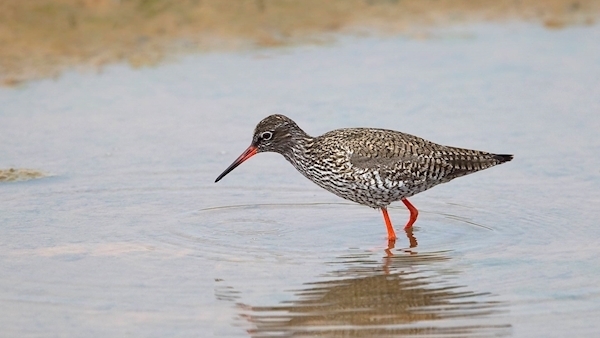
Dazzled by the sudden glare when the light was switched on, it was easy to capture. However, this was no starling; it had long red legs, a lance-shaped bill and a conspicuous white trailing edge to its wings.


Starlings and jackdaws occasionally fall down chimneys but redshanks, creatures of remote wetlands, don’t emulate Santa Claus.

So why was I sitting, still half asleep, at the edge of my bed holding one? Was this a weird Magritte-style dream of bizarre juxtapositions or a symptom of insanity? Should I consult the Golden Pages for help?

Placed in a cotton bird-bag for a few minutes, the intruder calmed down. Most birds are happy in a warm bag, but waders can’t be kept like this for long; they are prone to rheumatism.

When removed, the visitor flapped its wings and waved its legs vigorously. It was clearly fit and well, so I attached a ring to its right leg and released it to the wild.

Wader rings are special, made of extra-hard metal alloys, they can withstand decades of exposure to rough salt-water conditions.

The serial number and the words ‘Inform British Museum London’, inscribed on the band, will still be readable 20 years from now.

‘Ní feidir leis an gobadán an dá trá a fhreastal’; ‘you can’t have your loaf and eat it’, as Brexiteers are finding out.

A gobadán, according to the Nuafoclóir Béarla-Gaeilge, is ‘a long-beaked seashore bird’. Several candidates meet the description but the redshank, one of the sandpipers, is the most conspicuous of them.

At the first sign of danger, this security guard of the wetlands takes wing, with a noisy alarm call, alerting not only its own kind but every other bird as well.

The curlew may have the most musical call and evocative song, but the gobadán’s constant ‘too-lee, too-lee’ is the characteristic sound of Irish estuaries.

It’s surprising so noisy and conspicuous a shorebird, which the French call ‘le chevalier’, is so little known here.

We have a small, slowly declining, redshank breeding population around the lakes and turloughs of the west and callows in the Midlands.

Pairs nest on the ground, one parent generally acting as lookout from a ditch or fence. Each autumn, Icelandic redshanks fly 1,400km across the ocean to join their cousins in Ireland.

Many of the visitors remain here for the winter. Others move on to Britain and mainland Europe. Stragglers even reach Morocco.

About 11,000 are counted annually by BirdWatch Ireland volunteers at our principal wetland sites.

Gobadáns also frequent open coasts, wet marshy puddles and other unlikely places; there are more of them here than just those at the main sites.

I once saw one foraging in drains along the main street of Malahide village following heavy rain.

However, what was this wild creature doing in my bedroom? How did it get in? Was it seized by our six-month-old kitten while foraging for creepy-crawlies on the local green and carried, without injury, through the cat-flap into the house?

That would have been a remarkable feat for so young a cat.

It’s unlikely that we will hear from the bird again. Of the 140,000 rings placed on redshanks’ legs in Britain and Ireland to date, only a thousand have been ‘recovered’.

x

More in this section

Revoiced

Newsletter

Sign up to the best reads of the week from irishexaminer.com selected just for you.

Cookie Policy Privacy Policy Brand Safety FAQ Help Contact Us Terms and Conditions

© Examiner Echo Group Limited