Richard Collins: Wildlife films have a very rich pedigree
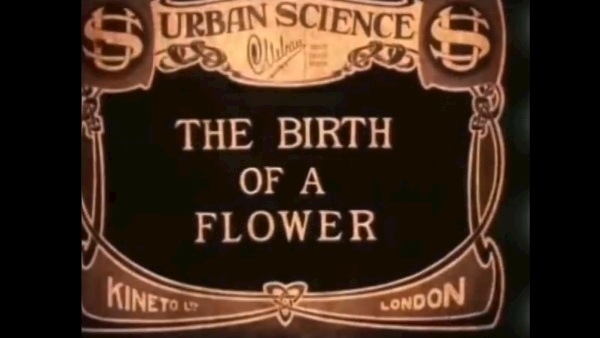
The 1902 film Birth of a Flower showed hyacinths, crocuses and roses opening their petals.
A critic said “this pioneering documentary may be regarded as the highest achievement yet obtained in the combined efforts of science art and enterprise”.
Timelapse photography provided the sequences; such techniques would soon transform our understanding of the natural world. In 1922, Oliver Pike’s The Cuckoo’s Secret solved the mystery of that rogue bird’s breeding behaviour.
The wildlife film has a rich pedigree. Edwin Landseer’s animal paintings captured the 19th century imagination; the Trafalgar Square lions would become his memorial. A century earlier, George Stubbs celebrated the horse. Chardin’s The Ray, drawing on the still-life painting of the Dutch Golden Age, caused a sensation at the Paris Exposition de la Jeunesse in 1728. Irish monks had embellished the pages of The Book of Kells with images of bird and beast, real and imaginary, a millennium previously.
The walls of 300 French and Spanish caves have Stone-age drawings, abstract and figurative. Hand stencils, discovered in Spain’s Maltravieso cave, are the work of Neanderthals. Dated to 64,000 years ago, they were created 20,000 years before our species reached Europe from Africa. Neanderthals were more sophisticated than we thought. The earliest figurative paintings made by our own European ancestors, are around 35,000 years old. However, primordial art isn’t exclusively European.
The oldest rock art at Gabarnmung, in Australia, includes items more than 28,000 years old. A study, published in 2014, showed that the image of a ‘pig-deer’, found on the wall of a Sulawesi cave, was the earliest animal depiction discovered anywhere up to that time but a paper, just published, describes an even more ancient find.
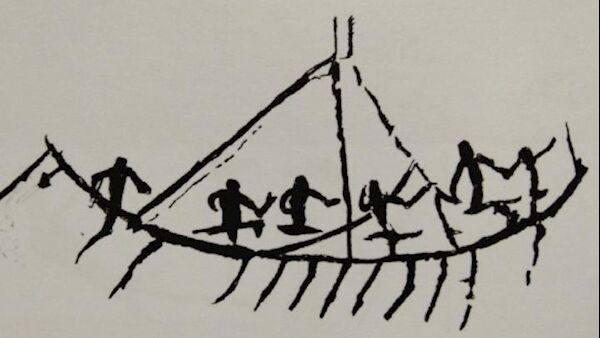
East Kalimantan, a province of the island of Borneo, has remote inaccessible mountains perforated with limestone caves.
Drawings, including many handprint stencils, were discovered on their walls during the 1990s. Archaeologists thought initially that the images were about 10,000 years old. Writing in the science journal Nature,
Australian and Indonesian researchers claim that “cave painting appeared in eastern Borneo between 40,000 and 52,000 years ago, which to our knowledge is currently the oldest date for figurative artwork from anywhere in the world”.
A large red-orange painting, in Lubang Jeriji Saleh cave in East Kalimantan, seems to show three wild cows. Over the millennia, water containing calcium carbonate has leached down through the porous rock, covering the image with a thin deposit. The coating contains traces of uranium. By measuring the radioactivity of shortlived ‘daughter’ isotopes in the deposit, the date at which it was laid down can be determined. The technique is more accurate than carbon-dating.
Samples taken from the surface yielded a minimum age of 40,000 years. Two red-orange hand stencils at the same site turned out to be at least 37,200 years old and a third gave a maximum estimate of 51,800. Other hand stencils in the region have decorative motifs. They date to around 20,000 years ago. A dark-purple depiction of a human figure has a minimum age of 13,600 years.
The sabre-toothed tigers mammoths and giant Irish deer, lovingly depicted in ancient cave art, would soon become extinct. Are the ones featured in today’s wonderful wildlife videos also heading for oblivion?
Plus ça change!
CONNECT WITH US TODAY



Be the first to know the latest news and updates