Nature, red in tooth and claw, as Wolstenholme might say
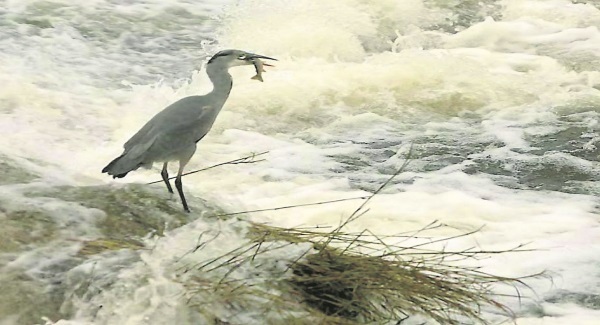
He was a sad sight, the young heron when I took him from the freezer, so much of nature’s energy and artistry evident in the wings, in the strong flight feathers, in the fearsome beak, in the powerful feet, all wasted now, a consummately beautiful and efficient creation flaccid and bedraggled in death.
Obviously, he had been either brave or foolhardy when he made his bid to seize the territory of our resident heron, Ron. The fact that he had been found with his wings folded around him, rather than in disarray, evidenced that he had died on his feet, had died fighting, backed up against the yard wall by the onslaughts of his opponent.
He hadn’t been snatched from the air as he fled, driven off as I’d seen others driven off, even when two
invaders came together, intent on usurping the Lord of the Garden and the Free Lunch-counter, Ron.
His neck was broken and there was blood around his bill, as if stabbed while fencing: here was nature, red
in tooth and claw.
“They’re killing machines,” said Wolstenholme, doyen of local birders.
“Look at the beak, it’s a dagger unsheathed...”
He was right. I’ve seen herons stab sand dabs six inches across in the middle of the back and they instantly cease to move.
He was a young bird, one of this year’s hatchlings, maybe even one of his killer’s sons. He wasn’t starving: The breast was plump, and he was the same size as his father. Wolstenholme opined, without even looking, that he had died in a territorial dispute. This was clear when we examined him.
My neighbours, the Hanlys, who feed Ron while my wife and I are abroad, had sensibly put the body in the freezer for a post-mortem investigation. Maybe when the universities reconvene, a PhD student writing a thesis on herons would like to see him. There is only one record of a grey heron killing a fellow heron (H Z Richner, British Birds, 1985).
Laying the heron to rest, I turn to butterflies and their behaviour this year. Since mid-August we have had a crop of small tortoiseshells as fulsome as the burgeoning blossom on the buddleia, and twice as beautiful.
They carpet the long, fat flower heads, dressing the bush in the colours of a Turkish carpet. They flit and float over it. They are outstandingly the dominant species this year.
I’ve kept count. On August 16, on our white buddleia and the purple buddleia in neighbour Hanly’s garden, I counted 54 small tortoiseshells, two red admirals and a single silver-washed fritillary. It seemed like the foreign pollinators of Irish weed and cultivar crops weren’t coming here this year.
Had climate change or some disaster at home, in North Africa, the Mediterranean coasts and France had stopped them?
Then, on a sunny August 21, among almost uncountable small tortoiseshells, I spotted a painted lady drinking nectar from the tiny white flowerets of the bush, and the number of red admirals had grown.
Also, there was a single peacock, perhaps a harbinger of the panoply of the local and foreign colour and diversity soon to come.
Most pleasing of all was to see so many tortoiseshells. Residents here, they spend the winter semi-comatose behind our household curtains, cupboards and wardrobes. Peacocks, which may be flying until late September, also stay and hibernate.
Red admirals sometimes over-winter.
Friends have suggested that Ireland may now have the best climate in Europe.
Walking in Muckross and Killarney National Park last week, they encountered continental visitors in a ratio of 8:2 Irish walkers.
A dream of the Irish has been to have the means, in retirement, to over-winter in Spain. Now, with the searing temperatures in central Europe, Irish weather has, this summer, became the most desirable in the EU.
Will we have continentals colonising the coasts, as Irish and English have colonised the coasts of Iberia? Will those colonists overcrowd West Cork and Wild Atlantic Ways?
My Kerry-located German mushroom-expert friend last week found ceps galore on the south side of the Caha Mountains, while the north side was cep- and chanterelle-less. Climate change?
My brother in law, grape-grower and consummate winemaker, found an elephant hawk-moth caterpillar as big as his small finger, plump, colourful and sporting a proboscis like a mini elephant’s trunk, in his Montenotte vineyard.
There has been talk of re-establishing wild boar in Ireland. My son in Czech sent me a photo of a pasture excavated by foraging boars.
It’s food for thought for aspirant importers — cause to think twice, in fact. In March 2017 three wild boar spotted in the Sally Gap, Co Wicklow, were reported to Parks and Wildlife service personnel who dispatched them, pronto.