Heron-masters intrigued by blizzard-battling Ron
The ravens have built their nest at their traditional site at Coomalacha, on the Seven Heads in West Cork, as they do every year. I’m glad to hear this, writes
It’s a well-sheltered ledge on the north side of a steep cove the narrow mouth of which faces east, its back turned to the prevailing sou’westerlies. Nevertheless, it must have been as wild as the Gates of Hell during the recent Arctic weather. Smart birds, the pair didn’t attempt to nest until it was all over. They must have felt it coming.
I’ve been watching these birds for 20 years and kept records for 17. During my Raven Watch years, they’ve always built in February, and the chicks have flown by the second week in May. It will be interesting, given the late start, to see when they’ll be fledged and flown this year.
As I write this in La Gomera in the Canaries on April 13, I make a note to go out to the cliffs to see how they’re getting on when I’m at home later this week for St Patrick’s Day. I’d hardly forget anyway. Also, I’ll be at home from the third week of April, so I’ll be able to monitor the fledging and flying of the brood.
The millennium year saw five chicks “glossy feathered” on April 14. In 2001 it was May 2 before the two, only, chicks were fledged, while in 2002 there were “four fully feathered, big as adults” ready to leave on April 24. Last year three were in “full feather” by April 28.
Regarding when they start, I see the nest is usually built and lined in the second week in February, but was already in construction on January 22 in 2005. A typical nesting and rearing cycle was 2013 when the nest was completed by February 21 and on May 5, I noted: “Five ravens all fledged and started flying. Herons standing beside nests.”
The nests the herons were standing beside were, of course, their own, built on the crowns of beech trees 20m-plus tall, again traditional sites, in the local woods.
My wife and I and other local heron-watchers have wondered how the colony will fare this year. All those massive nesting trees were knocked like ninepins by Hurricane Ophelia and Storm Brian, and when I left on February 9 only one nest had been built, with a parent bird daily on sentry duty beside it. How did this bird fare during the deluges, storms and blizzards?
In heavy rains, ravens will sit on their eggs, spreading their big wings like canopies over them; they will sit like this for hours, and overnight; whatever it takes to protect the progeny, whatever is within their power, they will supply. However, in the face of the wrath of the heavens, as experienced by nature and mankind, alike, this springtime how could they survive?
Trees in other places on the southern shore of Courtmacsherry Bay had weathered the storms of October, and our ‘indigenous’ herons, cruelly dispossessed by the heavens, could set up homes elsewhere, although they would not have the luxury of old foundations to build on, and the reassurance of building on nests that had supported full-term hatchings and rearings in years before.
The bay shore around, above, and beyond the village is unusually well forested having been the residence of the Earl of Shannon, descendant of Richard Boyle, the major planter of southwest Cork, who, like other landlords, had grown trees (ironically, the usual verb is ‘planted’) all around his personal domain. “The house of the planter is known by the trees...” as Austin Clarke’s poem puts it.
When I get home, I’ll visit those devastated woods and view that solitary nest high on that lone beech tree even before I go to the cliffs to see the ravens.
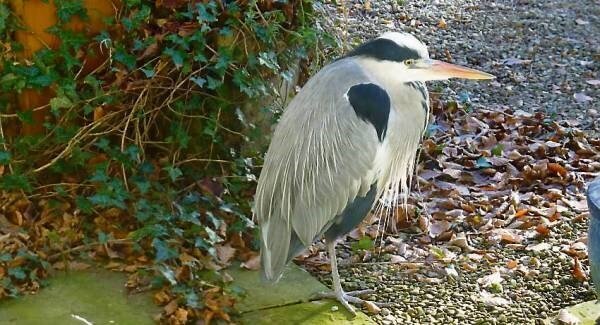
Our neighbours, the Kevin and Beth Hanly, heron-masters (or heron servants) in our absence, report that during the snow, Ron, the heron that, in 2011, we rescued as a scrawny, flightless fledgling wandering lost and threatened on the floor of our local wood and raised ‘hands-off’ to juvenile and airborne status in our garden, didn’t appear for his usual free lunch for three days during the heavy snows.
Only in the mating season does he absent himself for more than a day. Where would he have sheltered? Would he have canoodled up with his this-year’s partner somewhere deep in the snow-free canopy of a sheltering Scots pine? When I arrive home this week, I’ll ask him. He won’t tell me, and we’ll never know how herons ride out blizzards. It’s something I’d really like to know.