Intrepid voles likely came to Ireland via Foynes machinery
I was chuffed (that’s not ‘choughed’, now, and birds are few in this column) to hear the virtues of voles much lauded on the Living the Wildlife RTÉ 1 programme on Tuesday last week, writes
Only a few days before, Paddy Sleeman, a mammal researcher working at UCC, and I had been talking about “the little critters”, as he called them.

The programme, presented by Colin Stafford Johnson, doyen of Irish and worldwide nature photography, followed owl expert John Lusby on his tour of barn owl nest sites, and the nutritional value of voles was credited with helping this increasingly rare species survive.
Voles are one of our more welcome four-legged invaders. Of course, not all the invaders invaded but, rather, were brought here by people who had ‘making a million’ in mind.
Mink, muskrat, and coypu escaped from fur farms set up to make the owners rich, and became a threat to native fauna, riverbanks, domestic animals and so on.
I know Paddy through an old friend, a retired marine zoologist Jeremy Dorman, native to the village I live in, currently suffering in China, so he tells me in letters larded with discontent.
Jeremy has a sense of humour as dry as the Danakil Depression and as bleak.
However, he weathers the slings and arrows he encounters in every part of the world whereto he travels — and they are legion — with a stiff upper lip and forbearance fortified by side-splitting letters home.
More of Jeremy’s letters at another time: this is about Dr Sleeman and voles.
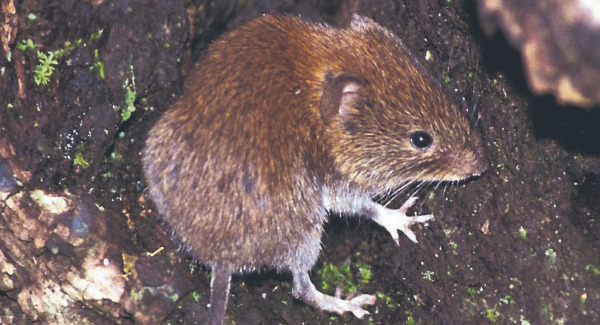
Sitting in front a hearty wood stove in his West Cork cottage, he gave me the inside track on ‘our’ voles, Myodes glareolus or bank voles, normally associated with dense cover but here surviving in the kind of pastoral habitat colonised by field voles in Britain.
I’d thought they arrived in Limerick as shipboard stowaways circa 1964 but Paddy corrects me.
According to my Fauna of Ireland, by Fergus O’Rourke, professor of zoology at UCC, bought when on holiday here in 1971, the bank vole was first discovered on August 20 1964 near Listowel, Co Kerry, by AM Claassens, a Dutchman and a Christian brother.
O’Rourke noted that: “So, far its distribution is limited to a small area in north Kerry/ Limerick region (O’Gorman and Claassens).”
In an aside, Dr Sleeman told me that O’Gorman mischievously accused Claassens of smuggling the vole in from Holland in his pocket.
In fact, his own research infers, that the creatures had probably arrived in Foynes at the Shannon mouth (perhaps on my grandmother’s home farm?) in the early 1920s having hitched a lift on massive earthmoving equipment travelling from Germany to work on the Ardnacrusha Hydroelectric Scheme.
His further investigations would seem to bear this out: The DNA of Irish bank voles matches not that of their UK kindred but of their German relations.
What would have caused the Germans to leave home? Population pressure? Paddy found that there were especially fertile mast years, (years when beech and oak, in particular, produces an abundance of fruit higher than the average) in the 1920s.
The ‘forest’, i.e. bank voles, would then have experienced a series of ‘irruptions’, huge rises in population and, like their northern cousins, the lemmings, have gone wandering.
However, instead of marching to the sea in the desperate need to find new territory, some climbed aboard earthmovers and, along with them, were shipped to Foynes.
There — because the open landscape and changed ecosystem of Ireland was unfamiliar — they likely stayed until, acclimatised over a few decades, they went forth to colonise.
While farmers may have occasionally seen them, or farmer’s cats brought them in, they went unremarked until they were seen, and recognised, by a zoologist in 1964.
Chestnut-brown, with a white undersite, ears barely visible above the fur, and a tail half their length, they are unlike rats or mice, and rarely seen, living, as they do, in the very heart of the hedge, and foraging at night.
This is, of course, the perfect time for owls to prey on them, and they provide a major food source for our seriously endangered barn owls.
Unlike the greater whitetoothed shrew, a recently established and unwelcome alien, they make good and nutritious eating, while owlets, fed by their parents on the shrew, do not thrive.
All in all, Dr Sleeman says they are no harm to the country. He was sorry to find three voles and two wood mice in mouse traps in his cottage; destructive house mice were his target.
In his vole-researching days, he’d have been glad if, instead of hunting them in moonlit hedges on raw nights, the voles had come to him!