How to improve the sense of privacy around your property
“The Constitution does not specifically state a right to privacy, but the courts recognise that the personal rights in the Constitution imply the right to privacy”— www.citizensinformation.ie.
Currently, we hear a lot about privacy on the internet, the danger of live streaming of information and even images through non-password connected devices. However, what about domestic privacy, cutting off pubic intrusion while we are at home?
Beyond the laws surrounding trespass and assault, privacy remains a personal effort to create seclusion.
How can you improve that sense of autonomy and safety behind your own front door and the perimeter of your property?
Fencing and walls
Class 5, Part 1 of Schedule 2 of the Planning and Development Regulations states - “the construction of a wall or fence within or bounding the curtilage of a house is an exempted development, subject to certain limitations, including that such wall or fence does not exceed 2m, or in the case of a wall or fence within or bounding any garden or other space in the front of a house, 1.2m.” (2001).
This is well and good on a flat site, but if your house is set on a rise, a lofty 2m may not be enough to shield you from passing strangers or neighbouring gardens looking up from the bottom of the slope.
Assume nothing — make a request to your planning authority for a Declaration on the matter before going ahead with a Trumpian wall that gives hours of gloom to the neighbours over the months of the year when the sun skips low across the horizon.

Otherwise 1.5m- 2m (maximum) for a back garden fence is generally enough to shield most homeowners’ modesty, unless the neighbours are tricked out with tree-houses and children sailing into the air on a trampoline on the boundary.
A stiff chat will generally resolve these sorts of problems. Trellis panels, in square and diamonds patterns dressed with lofty tiers of perennials plants, shrubs and climbers chosen to move with the seasons can soften and largely kill an unwanted view, where a wall or blind fence is simply not possible or desirable.
Brushwood, willow and other woven roll-out solutions are ideal for chain link fencing if you’re on a budget and need that instant hide.
If you are installing a new sunning balcony upstairs or a raised terrace, save yourself and those around you from embarrassment with opaque or solid enclosures.
Planting
I think we are all clear about the ASBO nuisance of massive, dense Leylandii as a privacy screening. Left unchecked these can reach 18m.
Where these rampant coniferous and fast growing climbing thugs are already present, there are no hard and fast legal requirements for your neighbour to trim or top them, although you can put trespassing branches pruned on your side, back over the fence.
Why plant up clearly unsuitable, high maintenance trees or shrubs that will cause interpersonal chaos in a few short years? The importance of choosing the right species does not stop at size.
Keep another horticultural phrase in mind when planning screening – non-invasive.

Some plants are athletic, enthusiastic propagators and will quickly breach the boundary, and even your neighbour’s paving by roots, rhizomes, branches and seeds.
Bamboo, popular in tight urban surroundings comes in invasive and non-invasive varieties. Deciduous to evergreen, all hedging and trees come with the duty of care. Could you live without the leaf cover over the winter to garner some precious light?
You could try your hand at a casually pleached hedge, with a bare trunk below, but a perfectly clipped wind-break above, great for shielding downstairs front windows.
Hornbeam (Carpinus betulus) is very popular to ‘limb up’ and the less expensive and less committed choice for this technique. Beech (Fagus Sylvatica) is great value (will hold its dead leaves all winter in blazing glory, allowing some dappled light). Plant at 0.5 intervals.
Windows and entryways
I find fumbling for keys, my back to the open roadway, intimidating, and find myself turned sideways, sliding an eye.
A head height panel in Oriental style horizontal timber slats set on a dwarf wall is one firmer structural contemporary solution that can shield and surround you, the door and even a side-gate from view and wind, and will dress up an entryway without a full porch.
Terracing high potted plants, reed matting, or a section of clipped hedge can again act as a thick or open weave partition for a small spend.
Posts supporting trellis or wires can work alone or in league with climbers or even artificial ivy set parallel to the front door (Amazon faux ivy on mesh – €45.99, www.thegardenshop.ie). Consider any loss of light to the front hall when orientating.
We were once a nation of nets, and anyone of middling years with a new glass-box extension in close quarters will have struggled with the big modernist reveal of becoming a floor-to-ceiling spectacle.
With neighbouring upstairs windows floating on high, it’s impossible to block your every move from determined prying eyes without meticulous forward planning in the architecture followed up by effective, defensive horticulture and window treatments.
The demands of heat transference may have been overcome by U-value of unit 0.8 W.m2K or better, but if you are feeling vulnerable there are answers beyond privacy films.
Re-configure the room to place your more public face down-stage, the depth of the house largely swallowing up your movements otherwise.
This might mean using the area for formal dining rather than personal lounging. Install blinds to clip off those top-down, sight-lines while still revealing your garden by night.
Arrange furnishings, leaving an implied corridor of space along the windows and French or sliding doors. Put the back of your sofa to the window, using a low windowsill as a shelf for objects that not only look great in silhouette but run visual interference from outside.
If you build an extension, even one potentially exempt from planning (under 40m at the rear of the house), a window may impinge in a real or imagined way on a neighbour’s existing window of a habitable room.
Objections about privacy and shadowing impacts, before, during and after works are complete, can and do happen.
Consider higher sill levels for example, and communicate what you’re hoping to do, before works starts.
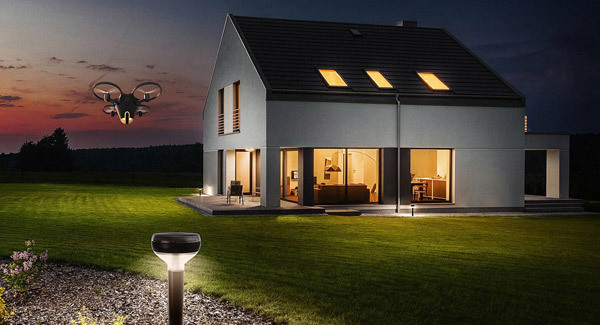
The nuisance of registered drones is increasing, but you don’t have to put up with any eye in the sky near your house.
If you know the owner of the offending object, direct them to the guidelines from the Data Protection Commissioner which are just the same as for CCTV, www.dataprotection.ie
The Aviation Authority of Ireland also has a list of prohibited behaviour including, flying within 30m of any person, vessel or structure not under the control of the person operating the drone, www.iaa.ie
CONNECT WITH US TODAY



Be the first to know the latest news and updates