The fascinating Armoured Ground Crickets are perfect look-alikes for horror-film aliens
The ravens are nesting out on the cliffs at Coomalacha, over a cold, dark sea. Giant swells roll in from the North Atlantic, the swells that, as I write, impede the recovery of the bodies from the rescue helicopter that went down in Blacksod Bay.
The last time we saw the sea was in Namibia, the South Atlantic’s cold Benguela Current battering the Skeleton Coast. Here, at Coomalacha, rain sweeps in curtains over the cliffs where the ravens have built on the same ledge for as long as I’ve been recording them, now 27 years. It’s a passing shower. I shelter behind some furze bushes blossoming in resplendent glory, and the rain quickly lightens. The sea is suddenly blue again, with white surf creeping over the black rock platforms like crinoline.
Like crinoline too, is the blossom on the blackthorn bushes in the hedges, while, in the woods, the carpets of dead leaves are spotted with white wood anemones, open when there’s sun. Elsewhere, dense green bluebell and ramson leaves crowd beneath the big beeches, glittering when a breeze stirs them. Soon, this green will be an unbroken haze of purple and white, and visitors will enchanted by the light in the newly-leaved forest, as atmospheric as a cathedral.
The rain at Coomalacha was gentle. In Namibia, it was vicious. As we drove the long, straight roads, we’d see, in the distance, low, blue-grey clouds rolling towards us, armies advancing in a smoke screen, artillery flashing, electric storms.
When the rain hit us, it was in fusillades smacking into the windscreen like bullets from a Gatling gun, greying out the road that, only seconds before, had been visible to vanishing point but was now invisible, despite the wipers of the big Merc camper batting back and forth as if demented while the whole rig bucked and veered before the wind that drove the clouds that drove the rain.
Once, we saw through the haze, a layby, and bounced and bumped the camper into it. There, in a grey, enclosed world, we ‘sat out’ the rain storm, the hammering so loud that conversation was impossible. Ten minutes later, it stopped abruptly and we stepped out into a fresh, shining world, damp but not muddy, for the thirsty Kalahari seemed to absorb every drop as soon as it fell.
There was no other traffic. In the sunny stillness and the sudden silence, exotic butterflies skimmed and dipped over a single, small rain pool. I wandered about; as I’ve said before, there’s always something to see in the world of nature, quoting ants carrying fodder across a layby in Spain, a snake swallowing a mouse on a layby outside San Francisco, California. Here, I found an even more fascinating sight.
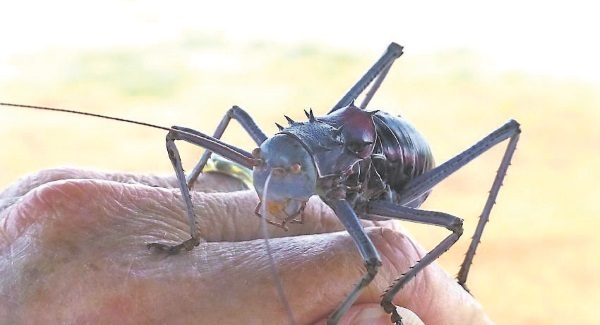
Movements on the rusted fence dividing the layby from the semi-desert might, I thought, be made by a tiny bird, a gorgeous humming bird, perhaps. But, approaching closer, I saw that the creature was neither a humming bird nor “gorgeous”. Instead, it was one of a battalion of unlovely, but singularly fascinating, Armoured Ground Crickets, perfect look-alikes for horror-film aliens.
As long and meaty as my thumb, the ‘architecture’ of their bodies was astounding. Each wore a carapace studded with spikes, like rose-bush thorns. An armoured shield protected the joint connecting the armoured head, with its proportionally massive jaws, long antennae and red, protruding eyes, to the plate armour covering the fat, green, segmented body. As I watched, legions were stripping the desert tamarisk bushes, many already denuded. They strip all vegetation or crops that come before them They will eat almost anything, including fledging birds.
When I pulled one onto my hand, I little realised that its bite could draw blood; that it could, defensively, spit its own ‘blood’, a toxic, green goo from joints in its body; that it could, as an ultimate recourse, regurgitate the contents of its rotund stomach over me (the predator), but quickly lick off any that adhered to itself because its companions would eat it alive upon smelling it. Yes, they eat one another. Marching in search of food when times are hard, (unlike locusts, they are flightless) crickets marching behind will nip off the rear legs of those ahead, which, no longer mobile, provide dinner for their hungry comrades. Disgusting they certainly are by human standards, but for the comrades, and the birds and reptiles that predate on them, nutritious, if not delicious, they must be.
CONNECT WITH US TODAY



Be the first to know the latest news and updates