Vintage View: Classic soap advertisements
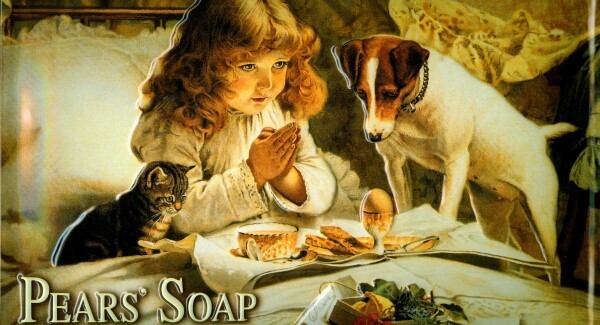
PEARS’ Soap, that softly withering amber nugget was the first branded clear soap in the world, registered in 1789.
With its comforting antiseptic flavouring of herbs (said by sudsy faced followers to recall the scent of warm biscuits, country gardens, warm laundry or that musk on the top of a smooth dog’s head) the dense gem like transparency is achingly familiar.

In the 1980s, we would gloss our teenage eyebrows in place with a lick of Pears. 210 years on the market, the authenticity of real Pears’ Soap is hotly disputed, with Facebook pages bubbling up to decry changes in the ancient formula by its current maker, Hindustan Unilever in India.
Gnarled, rare bars of spicy pre-2009 Pears free of new chemical additions, change hands through Ebay, chat forums and in the classifieds in singles and bales. Seriously.
Andrew Pears (b 1770) grew up on a farm in Cornwall, training as a barber and moving to London at the age of 17.
With family backing he astutely opened a shop on Gerard’s Street in Soho, a fashionable residential area for the fair skinned, wealthy families of the capital.
Barbers in Georgian England attended not only the follicles of their clients — many were respected beauticians and dentists.
Struck by the pock marked, choleric faces of his clients, Pear recognised a gap in the market for a gentle lathering soap for a sensitive complexion.
Soap was already big business with industrial production in places like Marseille in France in play since the 1400s.
Through long experimentation, Pears refined a new, pure glycerine soap (derived from tallow and methylated spirits) combining this sticky base with oils of cedar, thyme, rosemary in an extruded, mellow golden bar which he named for himself.
Pears’ Soap contained none of the irritating acid and alkali of commonplace soap (which in some cases included the wonders of arsenic and even lead for whitening the skin).
The bars were hewn out of a large tablet and shrinking, developed the signature dimple of Pears’ Soap. It came in two sizes, the larger suited to the rigours of the bath at 125g.
Aged for three months, and with a whiff of luxury, Pears’ Soap was an instant hit. Followers loved its hypo-allergenic cosmetic performance and pretty appearance, which gained increased colour and clarity as the marble soft soap was wet and turned in the hands.
When Andrew’s son Francis joined the business, it became A&F Pears. By the 1860s, the company was in 19th century style mass manufacture with Francis and grandson Andrew overseeing the precious batches of soap at a new factory in Isleworth in Hounslow.
A crucial moment in the history of A&F Pears and their soap came in 1865 — Thomas J Barrett (1841-1914) joined A&F Pears as a book-keeper, going on to marry Mary Pears Francis’ daughter.
His inventive, precocious marketing efforts for the soap are disputed as the first works of commercial advertising as we know it today. He deftly exploited the celebration of emerging science, the glowing complexions from the footlights of famous personalities, and the gravitas of respected artworks.
The annual efforts of Barrett’s team, reflected both the sweet sentimentality and sour bigotry of popular pastimes, attitudes and prejudice in Victorian Britain. He pushed the very modern idea that their product, a soap, was more than a soap, it was an established part of a proper lifestyle, a product and daily habit tied to decent, white, Christian life throughout the British Empire.
One of his brilliant branding ideas, was to suggest Pears as part of every civilised persons proper order of the day, ‘Good Morning — Have you used Pears’ Soap?’ posters asked pointedly.
Barrett reached up and down through the cultural spectrum for subjects. Darling high society actress and mistress to Edward VII, Lillie Langtry was pictured with her precious Pears and paid for her endorsement Pound for pound according to her weight, generally £132.
Paintings Thomas Barrett thought suited as illustrations for posters and in-store advertising, were not only just commissioned but hunted out, copyrighted, altered and emblazoned with a Pears’ slogan.
His exploitation of a painting he bought for the company, John Everett Millais darkly intended, ‘Bubbles’ (originally A Child’s World c 1886) is possibly the most famous advertising image of all time.
William Wilbourne James, the curly haired cherub who sat for the painting at the age of five, became a naval commander, a feted statesman and served in both World Wars, but remained known affectionately to friends and military peers until his death in 1973 as Bubbles.
The original Millais painting is still owned by Unilever, the makers of Pears today. Other high points of Pears advertising jimmied from the galleries include Sir Edward Poynter’s beautiful nude, Low Tide, c 1914.
Sadly, Thomas J Barrett included in his annual editions ‘Pears Cyclopaedia’ (c 1897) some horrendously racist content: Pears’ Soap was apparently so effective it could wash a black child white.
African mothers were pictured comically scrubbing their screaming toddlers clean, inspired by a picture of a white mother sanitising her brood back in England.
Harry Furniss, a cartoonist for Punch, born in Wexford in 1845, took a swing at Barrett’s lack of social conscience with a drawing in the magazine where a tramp extols the virtues of Pears’ Soap in a letter to the company — ‘I used your soap two years ago, and have not used any other since!’
It was a jibe at the Lillie Langtry’s mealy mouthed words, but Barrett was so media savvy and insensitive he bought the image from Furniss, and recycled it as advertising.
Furniss was fired from Punch for selling the work to Barrett, but his career was far from washed up. He went on to a brilliant career, making the first animated cartoon for inventor Thomas Edison, inventor of the light bulb.