Vintage view: Sir George Gilbert Scott’s Gothic fantasies
I have kissed many a lamp post, riveted by the ornamental brickwork or Art Nouveau panels clinging to the upper stories of a forgotten Victorian treasure, usually clapped in neon signage in Cork or Dublin.
Mid to late 19th century civic and private buildings rarely get attention from touring gawkers. Over-blown, conspicuous with ornament and pushed aside in favour of the restraint of polite Georgian lines — these busy facades and interiors have long fallen out of fashion — and for most of the 20th century were truly despised in progressive architectural circles.
We’re a little more accepting of Neo-Gothic, however, when it comes to the metaphysical flights of fancy of our churches, but take that onto city streets and the look can be utterly pretentious. It was derided as such.
From 1874-1876, the church of St Nicholas in Hamburg (1846) was the tallest building in the world. Its spire, iced up with ornament and having crept towards 148m in height, proved a perfect marker for vengeful Allied bombing raids, and was heavily damaged in 1943, it was largely demolished in 1951, its stones interred in walls reinforcing the banks of the Elbe.
Lower reaches of the church were preserved as a war memorial, and the crypt repurposed to a cultural meeting space. By one of life’s little ironies, this soaring finger to Heaven, shattered by Operation Gomorrah, was designed by English architect Sir George Gilbert Scott (1811-1878).
Despite the crucial work of Scott and his firm, his 879 high-Victorian designs and restorations are little known outside architectural registers and walking-tour leaflets. As late as 1987, a magnificent classical Italianate vaulted ceiling by Scott was revealed in the British Foreign & Commonwealth Office entombed under polystyrene panels. The building was due for demolition in 1963, and only saved by wails from the Victorian Society recognising the importance of the place
Born in Buckingham in 1811 to a cleric and scholar, the young architect Scott became a follower of national treasure, Augustus Pugin. Starting out co-designing workhouses with WB Moffat, he went on to be involved in the material survival of every great cathedral in England and Wales. His designs were informed by deeply felt principles as a dedicated antiquarian. However, a painful downswing in esteem for his vision marred his lifetime and persisted right into the late 20th century.
A devout Christian Evangelist, Scott attempted to pare back medieval buildings of what he saw as ‘disfiguring’ additions, revealing and retro-fitting to (what he affirmed was), their original correctness and authentic purity. He drew sharp criticism from contemporary design luminaries including the influential voice of William Morris (1834-96) who branded the self-recommending Scott openly as a cultural vandal and ‘happily dead dog’ when he died. It’s interesting, but the same arguments around restoration, renovation and conservation still go on today.
Morris, Philip Webb and his companions in the ‘Anti-Scrape’ movement, saw Scott’s restoration and works in the 14th century Neo-Gothic manner, as flirting with an idealised past rather than embracing the whole architectural history (some of it very old) of an organically evolved British building. Some projects under Scott’s watch certainly suffered from his enthusiastic ‘conservatism’.
Other haters appear goaded in part by Scott’s prolific workload and his sheer success, to take snipes at his ‘incongruous Medievalism’ (James Fergusson 1873, History of the Modern Styles of Architecture). Architects stepped outside the manners of the day to take public stabs at his casual ‘borrowing’ from earlier styles for his monumental works.
Even his biographers and architectural historians had a go. Kenneth Clarke in his landmark book on Gothic Revival (1928) indicated not only that Scott was working for fame and position, but added cruelly, “beyond the Albert Memorial lay the wastelands of Victorian and Builder’s Gothic, where all the sentimental bad taste of a nation converged — the horrors of which only time and war have laid waste.”
Author Gavin Stamp’s beautiful book, Gothic for the Steam Age, published recently by Aurum Press, sets out to redress the balance. After an opening and informative apology to the past, Stamp celebrates Scott’s work for itself, in an eye-watering illustrated biography of greater and lesser-known buildings.
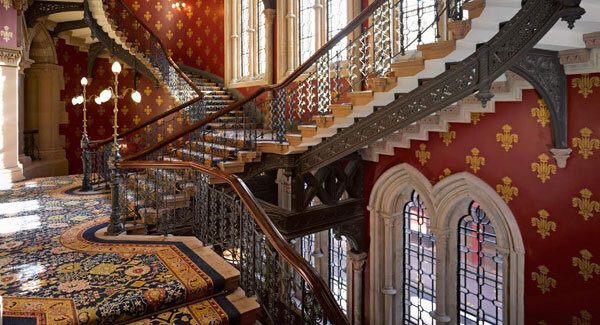
You might not know the man, but having visited London, you have definitely seen his designs in a stroll around the city — The Midland Grand Hotel by St Pancras Station and Hotel (now the Renaissance Hotel), the Foreign & Commonwealth Office (facing St James’s Park), and the Albert Memorial are just three of his castellated, neo-Georgian imaginings.
Scott garnered a knighthood from the grief-stricken Queen Victoria, for his design of the canopied and still magnificently kept Albert Memorial (1862-72) in Kensington Gardens. Meticulously restored in 1998, the pavilion and statue are worth the trip to the park to sense the ardour and reverence of Victoria for her fallen prince, radiating from this ecclesiastically-styled shrine.
The Queen sent a symbolic empty carriage of her own to the funerary procession when her architect was buried in Westminster Abbey in 1878.
Scott’s other treasures includes everything from a prison and bridge to schools, university buildings, private houses, hospitals, and churches.
He was highly interested in fabrics, closely analysing what he found when unpicking ancient churches and he pointed to St Pancras as demonstrating how the new use of cast iron could marry up with Gothic forms.
Gavin Stamp’s book explores in beautifully illustrated detail the writings, recollections, and drawings of the self assured Scott, pointing back to the buildings above all, in luscious photography.
He gives a well deserved, more rounded picture of a driven man, who while not an innovator, or evenas Stamp admits — a man of great invention — was a well grounded, underrated architect, full of energy and enthusiasm.
Like or loathe the results, he (Scott) as Stamp puts it ‘literally created much of the fabric of Victorian
Gothic for the Steam Age by Gavin Stamp is published by Aurum Press, €44.99.