Recognising the real value of good design
Ireland is one of only six countries in Europe that does not have a national design strategy, says Alex Milton, Programme Director of Irish Design 2015 (ID 2015), an initiative launched this year to raise awareness of Irish design at home and abroad and to highlight its value for business and for society in general.
“When you look internationally at places like The Netherlands and Finland, they know that every euro invested gives four back,” he says.
Design clearly means business in his view and thanks to government support for ID2015, it seems officialdom is waking up to its economic benefits and export potential — a situation which has not been truly realised to date.
Córas Tráchtála made a start more than 50 years ago, as the government agency set up to market Irish goods abroad. Taking its lead from Scandinavia — with its cultural and economic emphasis on design — consultants from Finland, Demark and Sweden who were actively involved in design practice and education in their own countries, were invited to Ireland to help develop a craft and design sector.
Together they compiled what came to be known as the ‘Scandinavian Report’, from which one of the key recommendations was the establishment of Kilkenny Design Workshops in 1965 and the recruitment of designers from across Europe who would guide Irish craft workers in silver and metalwork, textile weaving, textile printing, ceramics and woodwork.
But in subsequent decades, design never reached industry status, often perceived as a niche activity where a few have done well — but with most working for a single wage in isolated rural workshops.
It’s an image that’s been hanging slowly in recent years and which will speed up on the back of a busy programme of national and international events and initiatives which have formed the backbone of ID2015.
So far, it has had significantly more impetus than efforts in the 1960s, helped by the backing of 16 government departments and agencies and some commercial sponsors, and the fact that some of our designer-makers have already been noticed internationally.
One only has to visit an international exhibition to see the amount of interest Irish design attracts, with 1.5m people having seen the work of over 140 designer/ makers in the shows rolled out so far this year.
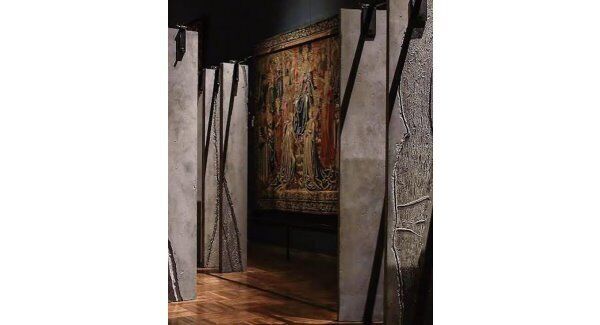
Of this, 250,000 visited the Ogham Stone installation at London’s V&A; the Design Hub at Dublin Castle has attracted 125,000 to date, with shows at locations including Chicago, Eindhoven, Paris, Hong Kong/Shenzhen and at home, making up the numbers.
But this hasn’t allowed Alex to rest on his laurels:
“We’ve been set some serious metrics by government which included 200 business start-ups,” he says. “We’re now up to 300 and €10m in sales globally.”
Yet his concern that Irish business has not grasped the importance of design is palpable, and he speaks as someone who understands the need for quality design from a business and academic perspective, having trained as a car designer before running his own design consultancy and then moving into academia.
It was during his professorship at the Irish College of Art & Design that he was lured away in June of last year as a secondee to ID2015, and there’s no sign of him returning to his old job on December 31. It seems the programme is set to continue with showcases at international exhibitions and developing design for business, education and outreach.
“These are the three fundamentals on which ID2015 has been built,” he says. “It was a sleeping giant and I saw an opportunity in getting involved.”
So far the initiative has delivered over 6,000 training sessions for small to medium-sized enterprises which now understand design, Alex says, adding that he sees the real challenge for Ireland in it’s lack of visual education.
“It’s not taught at primary or secondary level, and at third level, it’s only taught in the ghettos of design college. If you do an MBA in Harvard, Yale or Stanford, you’ll do modules in design.”
But with so many countries already having a design strategy and just the initial research started for one of our own, how do we compete against international stalwarts like the Scandinavians and Dutch and even the eastern Europeans? These countries who are serious enough about design to support the education of students for the same length of time it takes to get a medical degree here.
“Designers in Ireland understand the analogue as well as the contemporary,” Alex explains. “There an appreciation of what came before, tied in with contemporary training to make us operate more efficiently.”
Design education programmes are now being piloted in 20 secondary schools, but there have also been fun events to engage children and families in Hidden Heroes: The Genius in Everyday Things which took place in Dublin Castle in collaboration with the Vitra Design Museum, showing over 30 everyday objects from a tea bag to a zipper, all based on a simple but ingenious ideas that have remained much the same for decades.
It was an engaging show where even the most design-challenged of us could pause, identify with and consider, where the notion of design became real.
CONNECT WITH US TODAY



Be the first to know the latest news and updates