Latin proves its worth
Plants people work in Latin and some of us even think in Latin. Who said we weren’t an exciting bunch? The reason for using this ancient language is manifold. It is descriptive with many species names describing characteristics of the plants of that species such as ‘coccinea’. Several Genera have a species ‘coccinea’, for example Schizostylus coccinea.
The word translates as scarlet and indeed Schizostylus coccinea is the plant known to many as the scarlet red flowering Kaffir Lily. Similarly japonica, this is a name given to species referring to the fact that the species is native to Japan.
This is all great if you are interested but on a much more practical level Latin is used because it is international. An Ilex aquifolium is the same in Cork as it is in Britain or China or New Zealand. Common names can vary from parish to parish with many plants having dozens of different common names. For example, Pulmonaria which is referred to as lungwort, soldiers and sailors and Ladys milk drops amongst other names.
Common names will very often tell you what the plant may look like such as the poached egg plant Limnanthes douglasii which has blooms which look like, you guessed it, poached or fried eggs. Two such common names which I think can be disconcerting are the Christmas Rose, Helleborus niger, and the Lenten Rose, Helleborus orientalis, because niger doesn’t always flower at Christmas, sometimes not opening its simple white flowers ‘til the spring is well aired and orientalis often opening before the end of December.
See now why common names can be confusing? However do not under any circumstances let this possible misnomer stop you from growing any of the beautiful Hellebores.
Helleborus niger produces white flowers on low stems with quite stiff nearly waxy leaves. However, for me it was with the orientalis varieties that my love affair with this genus began and continues.
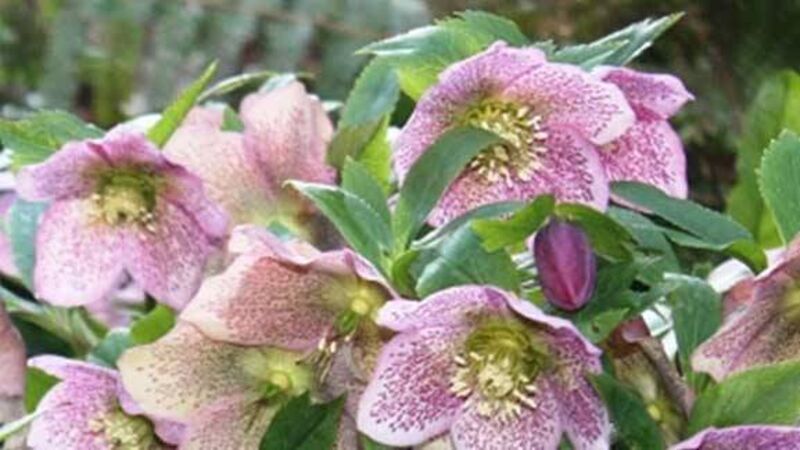
Flowers are produced from white through pink to the deepest purple nearly black and everything and I mean everything in between. Every different shade of pink that can you can imagine is represented in some Hellebore somewhere. Pink mixed with white, pink speckles, white speckles, bicolours, you get the idea. These flowers are often obscured by the dense covering of leaves above. I recommend you remove these leaves during December or early January. This will allow the flowers to be seen and grab the limelight as they should but also nearly all Hellebores will suffer to some degree from the fungal infection Hellebore Leaf Spot.
This fungal infection, Microsphaeropsis hellebori is unsightly and will weaken the plant in the long term and there are fungicides available to treat it but I find the best treatment of all to be cultural control. In other words remove all infected leaves.
It is so nice to see flowers at this time of the year and attention should be paid as to where to situate these beauties. You are unlikely to get value from them if you plant them down the far recesses of the garden where you only venture during the balmy sunny summer days we are so used to after last year.
No, place them somewhere that you will see them during their season. Someplace where their dainty nodding faces can lift your spirits even on the bleakest of wet, dreary January days. They do like semi-shade and good amounts of leaf mould and humus. If, like me, you have a fascination with black flowers and you try and source the darkest of the Hellebores then pay attention to where you plant this one. It can be easily lost in darkness of our winter weather so I suggest underplanting with something nice and bright, maybe some snowdrops or the dwarf Daffodil February Gold. H. orientalis flowers are nearly always facing down, nodding on top of their stems and so you will nearly always be looking down at them.
For this reason let me suggest planting in a tall pot or raised bed where you could ideally be looking at them at nearly eye level because the intricate beauty of these flowers is in their little faces.
Call them Hellebore, Helleborus, Lenten Rose, Christmas Rose, make up a new name, call them whatever you want but make sure you treat your garden properly and plant at least one to enjoy the mini works of art.
If you haven’t got around to it yet then don’t delay in mulching your beds and borders now with good organic matter. Farmyard manure provided it is well rotted (ideally two-three years old) is ideal. It will improve the humus content of the soil, the soil structure and texture, it will also help prevent frost and snow damaging roots and protect against loss of water from evaporation during the summer. But also because of the high nutrient levels it will provide good fertiliser for your plants. Homemade compost, Celtic Gold which contains the probiotic wormcasts, and mushroom compost will all benefit. Just be careful as mushroom compost will have quite a high pH and, therefore, is not suitable for use around acid loving plants such as Camellias, Azaleas, Pieris.
CONNECT WITH US TODAY



Be the first to know the latest news and updates