Vintage View: Tales of woe
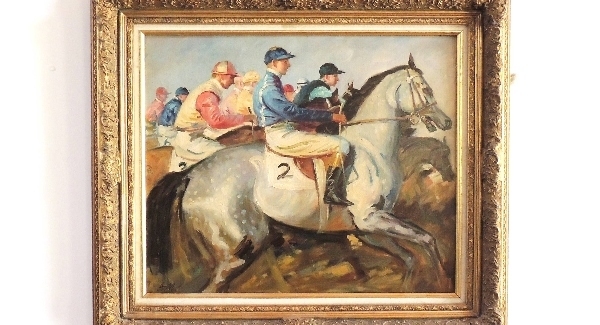
This picture was a heavily-interpreted racing scene called ‘At the Start’, sketched roughly in oils and unfinished (or so my senses lubricated with greed told me). It nestled in a heavily carved frame, which appeared as potentially interesting as its contents. The artistry was accomplished and cobwebs laced the crusty corners of the faded gilded frame. My brain was just about boiling in my head from two Lucozades over lunch, and I became dangerously over-excited.
Instead of asking a porter to bring the painting down for examination, I bounced around amongst the tables and chairs making the odd cunning circuit of the room to cover my interest. The legend in the catalogue read blankly: ‘Painting of Horses. 20th Century’. Right there was all anyone with any experience needed to know. There was no indication of any provenance or age, whatsoever and the auctioneer wasn’t putting his reputation on the line.
Sadly, it was too late for the greenhorn. I had already seen two initials at the bottom left hand corner of the work — large, scratched with what must have been a bread knife, and oddly crude enough to see from leagues below — AM. I took those two letters and galloped off down the track. I, amateur antique buyer, Kya deLongchamps, had discovered an important version of the famed 20th century British artist Sir Alfred James Munnings (1878-1959). ‘At the Start’, was probably a working sketch.
Well, of course, I bid on it. All that saved me was the wit or pity of every dealer in the room which let me have it for €300. Never mind the Caravaggio found at a Dublin presbytery, I was certain of instant stardom and what would I buy with the proceeds of the dedicated sale at Christies in London?
I writhed in lip-licking anticipation as the staff heaved my prize off the wall. My, my, it was in great condition. It came closer and was hefted into my keeping with total lack of interest by the weary porter.
Well, phew — the painting itself was indeed a painting I surmised smartly — in fact, you could still smell the paint. Curious. Crikey, I thought, my nose running over the halting knife plunges mucking up the exciting jostle of young thoroughbreds and jockeys. Munnings (RA) must have had one too many G&Ts up in the studio that day. The proportions of the horses, something for which he was famed, was a little off. These horses, mincing around on their cannon bones and swollen joints would never run.
Turning my purchase around to examine the back, the truth hit me in a financially agonising moment. I dragged it to a quiet corner to sulkily confirm my worst fears. The back was finished in a wash of thin, brown paint, the canvas held in with tacks from a nail-gun. I had bought an Eastern European reproduction of an Alfred Munnings painting. It was an honest reproduction, not a fake, the sort of thing that’s bought to cover walls in hotels and corporate buildings. I still have the picture. It’s a wonderful wall filler — colourful and pleasing. Unwitting friends who couldn’t tell a horse from a Ford Cortina, still eyeball it with interest. The crisp resin frame is highly convincing.
If I had paused to consider the likelihood of a masterwork appearing unrecognised by a reputable, old antique firm one Sunday afternoon in Cork, if I had asked the always present, available and friendly auctioneer or his staff for more information —if I had taken the trouble to get the painting taken off the wall — I could have learned my lesson without spending any money bar the €2 entry fee. That painting stays on the wall to remind me; if it looks like a duck, if it sounds like a duck, it’s a duck — not a racehorse.