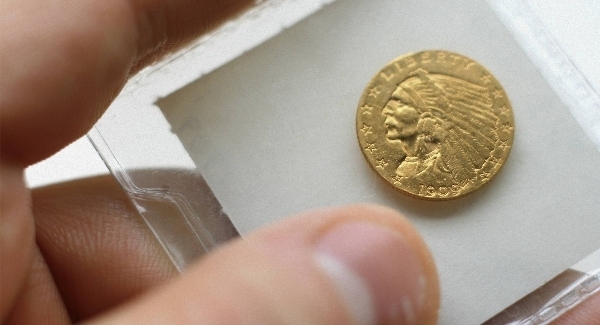
Vintage view: Gold coin
Provenance can be important for the unique, off-standard thing and for pieces with a connection to a famous person or event. Say for example a rifle came up for sale, said to have been the weapon used by a Republican supporter to assassinate Michael Collins at Béal na Bláth on Aug 22, 1922.
In one scenario, it’s in an auction catalogue and the auction house presents it has having provenance. In our other fictional sale, it’s a classified ad with a vivid description of the weapon’s history.
Provenance: Imagine the weapon had been found, barrel hot in the gorse, the shooter arrested, and his rifle seized by say, Lt Smith — the motorcyclist with Collins’s convoy and recorded as being the rifle fired at Collins.
Say this rifle went on to be kept in the private possession of some or other army official who made a full written record on Aug 23, 1922, with a number on the lock plate and even a photograph of the piece.
Let’s suppose then that our rifle eventually was released to sale decades later with a letter from the owner saying it was the weapon taken from a locked military archive, together with the original paperwork, a full visual description, lock plate number, and best of all, a photograph of the piece at the time of the ambush in Lt Smith’s hands.
In this case, it could be said to have strong provenance. There’s a paper trail in records both printed and photographic taking it right back to the scene and adding considerable weight to the belief that it was most likely the gun that killed Collins. Its presence at Béal na Bláth on Aug 22, 1922, would certainly be beyond dispute, making it a highly valuable piece.
No provenance: Now for arguments sake, imagine a similar rifle, right for the period, appearing on DoneDeal, claiming to be the assassin’s weapon. The story given with it here is that a mysterious Republican sharp shooter on the run in late Aug 1922 had pressed it into the quivering hands of his Aunty May one night near Skibbereen, and it had then come down through the family to the seller.
They were sure beyond a shadow of a doubt it was the gun that killed the Big Fella, and others who knew the circumstances of the ambush including the use of dum-dum ammunition had confirmed this one night in a secret Republican meeting in Sept 1922 around May’s kitchen table. Even if the story is true, without any further supporting evidence this is not provenance, it is hearsay, traditional, sheer legend.
If someone was selling a John Lennon sketch from Jan 1961 scrawled on a concert programme for The Beatles, it would be more likely to be accepted as having provenance if they could prove they were at the concert with a ticket-stub or were photographed with the star.
Provenance for something unusual and desirable could be as simple as a receipt of sale, but for high-end items with a unique human history, establishing provenance can make something valuable — priceless, even.
* A list of owners, preferably back to the creation of a piece and even recording its commissioning.
* For an ancient artefact, a detailed record of its finding and a list of owners from then to the present day.
* Detailed photographs (even something present in a painting) placing the piece at a time or in the possession of a known owner.
* Verbal evidence may be acceptable in some exceptional cases.
* Undisputed identifying marks, for example serial numbers stamped into metalwork, or a signature accepted as genuine by an acknowledged expert.
* Certification by an acknowledged expert in the field, for example assigning a painting to a particular artist.
* Scientific tests, for example, dendro-chronology to date timber.
CONNECT WITH US TODAY



Be the first to know the latest news and updates