State supports are increasingly vital for new home buyers
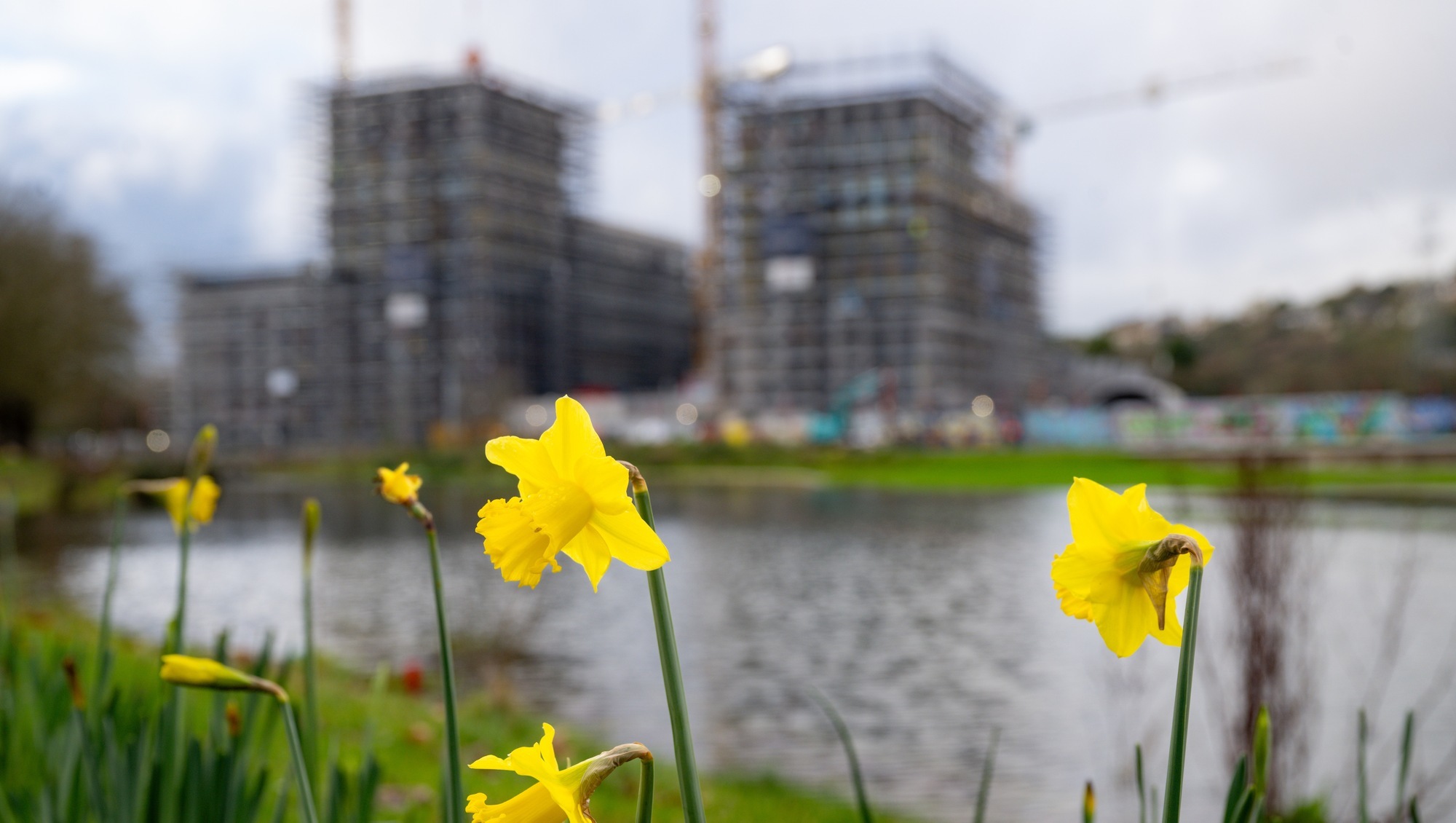
Spring greenery and daffodils in Marina Park in the foreground, with construction cranes and a major residential development rising in the background. The scene highlights the balance between expanding urban housing and the preservation of accessible public green space. Photo: Chani Anderson
Government supports for first-time buyers, and other purchasers of new homes, continue to take on increasing importance, as house price continue their upward trajectory, as the once-traditional, ‘starter’ staple, the three-bed semi-d, heads to and past the €500,000 mark – that’s half a million euros to you and me – in many cases.
Against that upward movement, economists and critics of the State’s financial supports who argue that they help underpin high prices and drive them further, might argue that increasing the support thresholds (as they did last July in the First Home Scheme) is the chasing equivalent of catching a falling knife … prices will go only one way.
And, that’s upwards.
Government support schemes such as the First Home Scheme (shared equity) and Help to Buy (get a smidgin of your tax back, worth €30,000) continue to play a significant role in making a new home purchase possible, especially for first-time buyers, says estate agent Adrianna Hegarty, based in East Cork and where major growth areas in heer orbit now include Midelton, Carrigtwohill and Glounthaune.
“The Help to Buy scheme and the First Home Scheme are commonly used together; it is now the exception rather than the rule that a buyer of a new home is not relying on one or both of these supports,” says Ms Hegarty, adding “the ceiling limits attached to these schemes are increasingly relevant in Cork.”
Those thresholds (upped in 16 local authority areas in 2025, typically by €25,000) now stand at €450,000 in Cork County, and at €475,000 in the city for houses and at €500,000 for increasingly-common apartments.
“Where a development sits comfortably within those price thresholds there is usually strong competition for the houses,” says auctioneer Suzanne Tyrrell of Cohalan Downing of her city-based firm, stating “once prices begin to move above the €500,000 mark, the buyer pool becomes smaller. That’s not because there is no demand, but because many purchasers can no longer rely on those supports and must rely solely on mortgage capacity.
“We are seeing a clear distinction in the market between developments priced within the support thresholds and those that sit outside them,” Ms Tyrrell outlines, adding “where developments sit within the Government support price thresholds we are still seeing extremely strong demand, often within days of launch.”
As ever, location also remains a key factor in Cork, with apartments in the main now coming on stream in the more city central areas, while houses continue to hold sway further afield.
“Developments in established commuter towns around Cork city such as Midleton, Carrigtwohill, Ballincollig and parts of Douglas continue to perform very well where good transport links, schools and amenities are already in place. Buyers are increasingly looking at the broader lifestyle a location offers, rather than simply the house itself,” notes Ms Tyrrell.
Out to the east, “while the First Home Scheme itself is working, and we are seeing increasing uptake after some initial hesitation when it launched, that cap does limit accessibility to certain house types in areas such as Carrigtwohill and Midleton,” according to Midleton-based Adrianna Hegarty.
“Interestingly, we are also seeing some trader-down buyers entering new home schemes, particularly in developments such as Water Rock. Many are opting for two- and three-bedroom homes, seeking modern, energy-efficient, and manageable options that offer flexibility as they travel more or simplify their lifestyles.
“In many new developments locally, the cap would typically cover two-bed homes and some three-beds, but it can exclude most four-bedroom houses and even some larger three-bed family homes. It’s something purchasers regularly raise with us. That said, the First Home Scheme combined with Help to Buy is definitely supporting first-time buyers, particularly in larger schemes where there is a mix of house types.”

New homes specialist with Savills Elizabeth Hegarty chimes with these observations, across a wider geographical area, east to the city, west of the city at places like booming Ballincollig, and in the expanded city boundary too.
“Now more than ever, affordability and the need for Government incentives is evident and directly impacts sales velocities,” the Savills seller continues, saying the increase caps/thresholds in the First Home Scheme (outlined above) are both welcome and necessary.
“This has helped offer the opportunity for purchasers to use this scheme on more house type options. Unfortunately, the Help to Buy scheme remains unchanged, since its initial introduction in 2017,” Savills’s Ms Hegarty states. (Funded to the tune of €740m, the First Home Scheme is subject to twice-yearly reviews.)

Further recent tweaks to the First Home Scheme in January “are an assistance to aspirant buyers and aids viability,” says Paul Hannon, director and head of Sherry FitzGerald New Homes Munster.
On the back of a 50% uplift in new homes sales in January/February 2026 over the same two-month period in 2025, Sherry FitzGerald’s Mr Hannon adds that new tenures – such as cost rental – “are maturing and we will see more Local Authority and LDA supported affordable homes coming to market over the next few months. Now, there are many different pathways to home ownership and we regular host information webinars with experts to assist aspirant buyers on their journeys.”
CONNECT WITH US TODAY



Be the first to know the latest news and updates