New Homes: Your guide to buying your first home
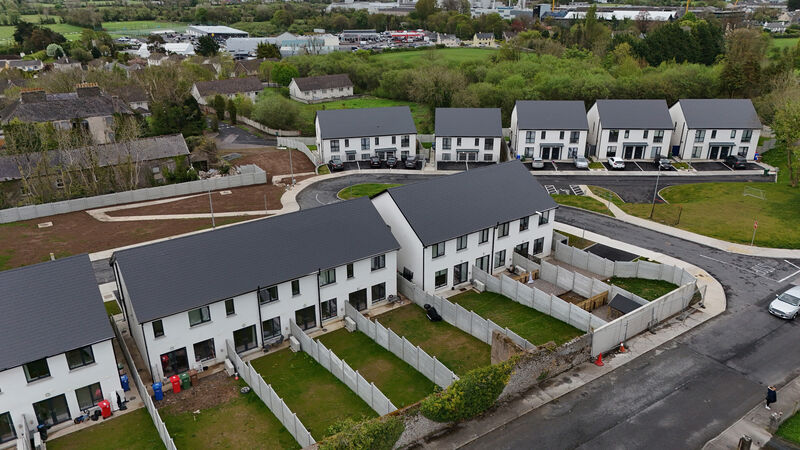
Dream of owning your own place? State schemes are helping people buy a home. Photo shows new housing at Cedar Court, Rathgoggin, Charleville, Co Cork. Picture: Dan Linehan
Buying your first home is a privilege in these times.
Back at the time when my father was buying a house in the 1950s, one steady wage coming into the household was enough to afford the cost of a starter home. This meant that most people who were lucky enough to be in a job (unemployment was high) could afford to buy a house on one household wage.
By the time my turn came around in the late 1990s, house prices were rising fast in line with a burgeoning economy. At a national average of around €89,000, they were already about twice as expensive as the average home had been a decade earlier.
When the Celtic Tiger economy really took off, house prices soared along with it. By the next decade, house prices had trebled. Between 1991 and 2022, house prices increased by 466%, while at the same time, real wages had increased by only 56%, according to the Housing Ireland Conference in 2026.
In 1991, the house ownership rate in Ireland was at 79.3%, while now it’s around 66%. We used to be a country with one of the highest ownership rates in Europe. Now we’re in a much lower category, with the former Eastern Bloc countries being amongst the highest.
Measuring the affordability of homes is a science that is often difficult to measure accurately. The income data, for example, has to be at an aggregate national level, with much of the scientifically reliable data confined to the industrial sector. With a wide variety of earnings spread across the economy, the use of a national average doesn’t capture the full range of affordability.
But you don’t need a statistician to tell you that the dream of owning your own is becoming increasingly unaffordable for people in Ireland.
The good news is that this ship is slowly turning back into the right direction. All the recent administrations have continued to make a priority of increasing the supply of houses to the market with a variety of initiatives and schemes that add to the housing stock or help to bridge the gap between affordability and income.
It is also true to say that, once someone is in a position to purchase their first home in Ireland at the moment, they’ll find a number of supports in place to help them achieve their dream.
Buying a home is, for the majority of people, the biggest purchase they’ll make in their lives.
Such a purchase can be daunting. Buying a home is a long-term commitment and typical mortgage terms these days are around 30 years.
In this feature, we guide the first-time buyer through the entire process, from assistance available through Government schemes to avoiding some of the potential pitfalls along the way.
Generally speaking, the process of buying a home is a legal one that goes through a succession of logical steps that are handled and overseen mostly by your solicitor; it has been done multiple times before in a well-rehearsed and time-honoured manner.
In the current market, you have to be fully informed and fully armed. Let us say, for example, that you’ve found the home you want and your bid is being considered by the owners. In many cases nowadays, there will be stiff competition from other people bidding on the same property.
If you don’t have mortgage approval in place in principle (making a bid ‘subject to finance’) and the people you’re bidding against do, then you’re putting yourself at a distinct disadvantage. So, instruct your solicitor, have your funds in place and a clear budget for all those additional costs that will soon be coming your way and you’ll give yourself the best chance possible to make the dream of owning your own home come true.
This is the single most important purchase you’re going to make in your lifetime, so the location you choose needs close examination. Does it have schools, shops, sports facilities and other amenities?
And what about the future? If you have a young family, what about their future needs? Is there a good bus service for when they go to college?
When my wife and I were looking for our first home, we persuaded ourselves on a number of occasions that we had found ‘the one’ for us, only to sit down and realise that there was something that wouldn’t work.
In one case, it was the simple fact that the fantastic fixer-upper we’d seen was just too far out in the sticks. It was the right price, the right size with room for expansion and it had a wonderful setting, but living there would have meant having to drive the children to school every day, posing logistical challenges and adding to diesel costs.
Then, when they got older and would be looking for lifts into town for various sport and social activities, it would get increasingly difficult.
It was strange when the realisation hit us, because we never had any notion of buying in that area in any case. But it was a lesson in how easily you can get led astray by yourself in the hunt for a property.
The reason you can lead yourself down so many blind alleyways in a such an important situation is that looking for a home is a highly emotional exercise. We all have a vision of our ideal home in our minds and we’re looking for that place that will just speak to us when we find it; a house that we will fall in love with.
And while there’s nothing wrong with that, the decision on where you buy is also a pragmatic one – one that requires you to think clearly about what your needs are and to prioritise the essential and the important things to you.
Begin with making a list of all the things you require. Write them all down freely as a wish list. Then break down the list into sub-sections and scrutinise each item on the wish list under the headings of essential, important and ideal.
It’s an exercise that requires time and consideration. Pin it up somewhere on a large sheet of paper on a notice board or somewhere with easy access and add and subtract over some time, discuss the different merits of your requirements and what they mean to you until you’ve narrowed down the list of things that are essential for you.
That’s a good place to start and once you’ve agreed on this list, then you have a basis for making a good decision that you won’t regret. Here are a few guidelines to help:
Reading through data and staring at images only tells you so much. If you’re considering a particular location, you need to get a real feel of what it would be like to live there.
Talk to others who live there to get their view. Drive around the place and ask yourself questions about the proximity to services and public transport. If you’re seriously considering living in a particular area, it might even be worth renting there for a while to really see how it feels.
Whether you’re living alone, as a couple or with children, you want a place where you’ll feel safe. Does the area have a reputation for trouble or anti-social activity? If so, is the reputation well-earned or is it based on the past and other people’s prejudices?
Check with the local authority to get an idea of what’s planned for the area. Maybe it’s going to be one of the hottest spots in the county within the next decade because of future developments nearby or a new access road.
Finally, if you do just fall in love with a place, that might not be the irrational as it first appears, because if you fall in love with it, the chances are that any future buyers will too.
Do you need to hire someone to go house-hunting on your behalf?
It’s a legitimate question and for some people to get a buyer’s agent to do the looking and negotiating for them makes perfect sense. It all depends on your circumstances, of course. Life can be incredibly busy and the hours required to put into the process of house-hunting/buying are many.
The other advantage using the services of such an agent is that they will know the business inside out. They will be fully aware of the entire process and of all the potential mistakes and pitfalls one can make, making them a helping hand in many ways.
It’s an additional cost in the whole process, of course. Normally, the fee for taking on the buyer’s agent is paid up front at the start of the process.
For most people, the approach is normally to approach a local estate agent/ auctioneer in the area you’re looking, call in and make their acquaintance and spend an afternoon or two checking out a few properties. Once a good rapport is established with a local estate agent, they’ll see that you’re serious and after that it’s a case of keeping in touch with them and scouring theirs and everyone else’s website to see what’s coming up. There are, of course, the aggregator websites with multiple listings, such as myhome.ie.
You’ll be able to do most of your monitoring by watching those websites. Even so, it’s worth checking individual agents’ websites and checking in with the agents themselves too. No matter what business you’re in and despite all the shiny electronic advances that bring elements of the real world to our computer/smartphone screens, there is nothing to compare with the human touch. Talking to people in person and on the phone will give you far more information every time.
All estate agents and auctioneers have to be licenced in Ireland and there is a public national register that you can consult on the website of the Property Services Regulatory Authority (PSRA) on psr.ie.
Another very useful website to consult that will give you a very clear idea of what the property market is doing is that of the Residential Property Price Register (propertypriceregister.ie). Here, you’ll find information on properties sold since the January 1st, 2010, and it’s a very sobering experience to see just what various properties sold for; as opposed to looking at asking prices alone, which don’t tell the full story.
The vast majority of homes have a Building Energy Rating (BER) score to tell you how energy-efficient they are and that’s an important element in helping to choose your home.
The majority of home sales are by private treaty. This essentially means that it’s not by public auction. Public auctions are normally more common with land sales and it’s usually only a very rare home that will be put up for public auction.
If you’re interested in a property, it’s important to talk to the estate agent about the status of the price guide and the expectations in terms of its final value. Traditionally, a price is advertised, with the vendors hoping to get as close to that price as possible. In recent years, the strength of demand has been such that bidding from various interested parties has regularly resulted in the price advertised being exceeded.
For many estate agents, this has resulted in a more widespread adaptation of properties being advertised at a lower price, with the expectation that that price will be exceeded. It’s important, therefore, that you find out from the estate agent what the expected price will be; whether the property is advertising at €300,000 and hoping to sell for about €290,000, for example, or whether the home is advertising at €300,000 but with the expectation that it will reach €320,000.
If you have sound legal counsel and go through the process methodically, there is less chance of pitfalls catching you out or scuppering your plans. One of the most common recurring mistakes that people make when buying a home is that they don’t listen to the advice of the experts involved.
The home-buying process is a technical procedure that will, all going well, result in a dream coming true for you and it’s an area that the various professionals involved know inside out. They’re all getting decent fees out of their involvement in it too, so it’s generally a good policy to follow their advice.
But there are still things that you should be street-smart about when buying a home, the better-informed one is, the less likely there are to be unpleasant surprises on the road to dream-home-bliss.
Just as with the radon risk, the Government also has a useful map of the country showing you where there are areas that area prone to regular inundation. The OPW’s database of flood maps is available at floodinfo.ie and it can quickly put to bed any concerns about potential flooding in the property you’re looking at.
When it comes to new builds, they have their own particular set of potential problems that require a certain amount of management and a snag list. It’s an area where a snag list specialist can be of benefit.
There are a few main areas to be actively inquisitive about before committing in the first place. These include reviewing the floor plans and enquiring about the size of the development, as well as the estimated timeline for completion. As mentioned above, you should also check to see if any management fees or similar charges to be considered for any common areas. The property might also be registered with a structural defect scheme and if so, you should check the conditions of the policy.
With new builds, it’s often the case that both contracts are signed at an early point, before the property is complete. It’s important to regularly monitor the situation as it progresses. If there are any delays, for example, there is the possibility that your loan offer goes out of date before you can complete. This is where it’s vital to keep the lines of communication with your lender open to avoid any unforeseen problems that delays in these circumstances can bring.
Once the home is complete, it must undergo a Building Control Amendment Regulation (BCAR) Certification. This is to ensure that it is habitable. It must also secure a Building Energy Rating (BER) Certificate to ensure its energy efficiency. Both of these are organised and paid for by your builder.
In avoiding pitfalls, an increasingly popular move by home buyers is to hire a snag-list expert. For many, it might be one consultant too many in the whole business, but there are also plenty of people who are happy to pay and extra amount to someone who will micro-manage another aspect of it when so much else is going on.


CONNECT WITH US TODAY



Be the first to know the latest news and updates