'We saw the first signs of disposable fashion': Family reflects as historic Cork pawnshop goes up for sale

Former Cork pawnbroker shop hits market for €595,000, offering rich history and redevelopment potential near UCC
'We saw the first signs of disposable fashion': Family reflects as historic Cork pawnshop goes up for sale

Redemption at hand? Nos 58/59 Gillabbey Street are near St Fin barre's Cathedral Cork. Agent Hugh McPhillips guides at €595,000

REMINDERS of past times come with the sale of Cork City’s 58/59 Gillabbey St, a former pawnbroker’s shop near St Fin Barre’s Cathedral and University College Cork (UCC) likely to find new uses more in tune with more affluent times.

The property was one of five William Jones Ltd pawnbrokers shops owned in Cork by the Jones family, who had started their business in 1902 — eventually operating two shops top and tailing Shandon St, on North Main St, on Sullivans Quay, and at Gilabbey St by the Church of Ireland Bishop’s Palace and St Fin Barre’s Cathedral.


William Joyce Ltd on Sullivans Quay, now leased  to the Quay Coop for the past 40 years

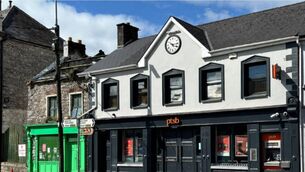
The Sullivans Quay shop has been leased to the Quay Coop for the past 40 years; the one at the bottom of Shandon St was acquired by an expanding O’Connors’ Funeral Home; the one at the top of Shandon St by the North Cathedral later became a credit union branch; the North Main St one stood where the Gate Cinema now is; while Gilabbey St later found mixed uses as a bookmakers — Tommy Ryan’s — and a motor-related business Tynans’, repairing radiators and making car registration plates.

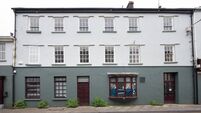
Gillabbey Street's nos 58 and 59

The upper floor of one section had been rented as a private residence to a tenant there for over 40 years, it’s understood, and the total property spans almost 6,000sq ft to include two houses/shop, large rear stone shed with lofted attic, and courtyard.

Carrigbarre behind Gillabbey Street. File pic: Denis Scannell

Nos 58/59 are now, finally, for sale and repurposing, guided at €595,000 by estate agent Hugh McPhillips of Marshs auctioneers — who says it’s likely to be redeveloped, with interest currently shown by small builders and developers.

The conjoined buildings (BER-exempted) originally bounded the acres of grounds and gardens of the 1780s C of I Bishop’s Palace and the 1740s Carrigbarre House facing St Fin Barre’s, now redeveloped sympathetically for student accommodation with a mews scheme in Carrigbarre’s courtyard garden.

Future uses could include residential, student accommodation, or educational, suggest Mr McPhillips, given proximity to UCC and the Crawford College of Art.

Nos 58/59 left use as a pawnbrokers in the 1960s, said a family member now selling and who also explained how their businesswound down from the 1960s and 1970s, after a very long tradition, as mainstream banking and credit unions became more democratic.

Pawnbroking has a legacy going back centuries to the Medici family in Italy and the traditional sign, three balls hanging up outside shops came from the Medici family’s coat of arms, noted the vendor of Gillabbey St: he added that pawn shop numbers in the 1880s, up to the mid 1900s were in the hundreds, with only four now licensed in the country. Charles Haughey updated old Victorian practices with a 1964 act which gave additional consumer protections.

The third generation Jones family member who‘d worked in the business in Cork said: “It wasn’t just the ‘poor man’s bank’ as it was sometimes called, it was vital for thousand of families who had no other recourse at all to credit.

“In the 1940s, ‘50s, and ‘60s, people might have had some property, but they had no money. Pawnbroking was the purest form of obtaining credit, as you had to have property, unlike borrowing from a bank, on a promise.”

Typically in the trade, items were pawned on a Monday and redeemed on Saturdays, or over longer times, and if not redeemed with six months could be sold by auction.

“We saw a lot of silver and gold, you’d have to get special secure storage for it,” recalled No 58/59’s vendor.

“We were nearly the first to see ‘disposable fashion,’ with clothes not made to last; electronic goods rapidly changing, and becoming obsolete, and cheap gold jewellery coming in from holidays in Spain.”

DETAILS: Marshs: 021-4270347

x

More in this section

Revoiced

Newsletter

Sign up to the best reads of the week from irishexaminer.com selected just for you.

Cookie Policy Privacy Policy Brand Safety FAQ Help Contact Us Terms and Conditions

© Examiner Echo Group Limited