Water Wells: Facts and Fissures
THE imminent arrival of domestic water charges, the Government has long declared that those with a private water supply are exempt.
This pardon was not a given, and we can thank the bureaucrats in Brussels for firmly clarifying this point to our leadership as late as 2012.
Few without private water on tap have any understanding of how a modern well operates. There is bound to be some curiosity surrounding the potential to bore our way out of the charges attached to a property relying on local authority water.
Frank Seery of Seery Water Services has drilled hundreds of commercial and domestic wells throughout the South East from his company’s base in Waterford.
“Anyone can potentially have a well put on their property,” he says, “and homeowners with an authority supply can and do install a private well. There’s a few reasons. They can obviously reduce their water charges if they are metered. It can improve their water pressure if they are situated at the end of the mains, and of course the taste of the water is often much better as well water has no added chemicals.”
A modern well is a highly engineered sealed structure, linking an aquifer (in simple terms an underground lake) to a water supply. Aquifers, both in shallow and deep gravel, and what are termed bedrock-aquifers, are easily found. Having bored through bedrock (the noisiest thing you’re ever likely to hear outside of the housing of a jet engine), the driller installs a system that includes a steel and PVC lining to protect pipes carrying the supply up from a submerged pump through rock and clay. The water is drawn up to a modest vacuum pressure tank so as to be on tap when needed, rather than kicking on the pump every time the tap is turned.
Going underground and bringing a viable flow of drinkable water to a house is a highly skilled area. According to the Institute of Geologists of Ireland (IGI), drilling is not sufficiently regulated despite legislation to protect groundwater from pollution in 2010.
The IGI has a guide to the drilling of wells on its website (igi.ie), and it’s a good place to start if you’re thinking of going for your own supply and don’t know your facts from your fissures. There’s even a groundwater mapping section for determined hydro-geeks.
Geological findings aside, old fashioned diviners and dousers are still respected as a means of determining where to bore a well, but I have to say my well man found water exactly where he expected using his local geophysical smarts and hands-on experience.
Well drilling does not require planning permission. Most domestic wells operate at a depth above 90m and must be carefully sited and deep enough to avoid down gradient pollution from any domestic waste water system or surface run-off from, say, a neighbouring farmyard or fields where slurry is spread.
In 2004 the EPA reported that 25% of domestic wells were contaminated by sewage because of insufficient ‘setback’ (the distance between hazards and the well). The IGI argues that proper siting, installation, and sealing of a well lessens the need for “end of pipe” solutions such as filtering and purifying.
You’ll be told by any wag that 10m is sufficient between a well and a septic tank, but there are many variables.
If you don’t have the proper advice in siting, drilling, and sealing your well, your supply may be compromised. Take specialist advice from a reputable driller. Frank recommends getting the well drilled before the building starts on a new site. Not only is water then available during construction, but any problems with the supply can be sorted out early.
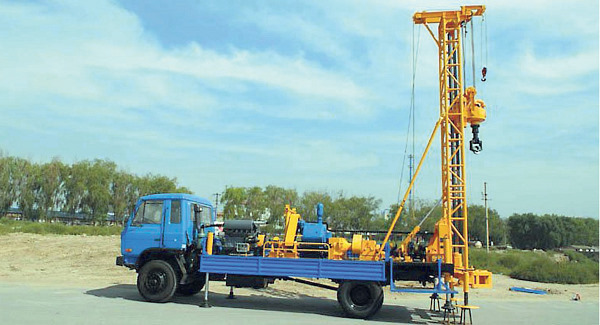
Access for drilling is generally not a problem, as an air rotary drilling rig is a gargantuan but nimble piece of equipment that folds up and out.
“If an oil truck can get in, we can get in,” says Frank, adding “a free site survey and a discussion of any access challenges are offered by reputable well drilling firms”.
Can my well dry out?
Water held in the aquifer may fluctuate during the course of the year, but generally they quietly recharge from the rainwater falling on the earth and percolating down. Your driller can offer solutions if a supply dwindles, including lowering the pump into the aquifer, altering the pumping rate or deepen the well, but most new wells will be designed with an eye to expected fluctuations
The cost of a well, presuming it’s above 90m and there are no weird and wonderful underground adventures is €2,500-€3,000 inc VAT. This covers the boring the depth of the well by the metre.
and includes the steel liner. It does not include the erection of a pump house to shelter your pressure tank if you don’t have a suitable building on site, and the point where the pipes leave the ground (the head) should also be set under even a small protective structure easily accessed by the maintenance crew through a manhole.
Request a written quotation after a site survey by your potential supplier. Running your well pump demands a negligible amount of electrical power, but it does need a sheltered place to plug in. As well as an annual maintenance check, it’s important to know what’s normal for your well and to note any changes in the behaviour of the supply.
If your home is over seven years old, if you have no local authority supply, and the house is your main residence, there is grant aid to improve your well. The maximum amount is €2,000. If you are buying a house with a well, ask to have the supply chemically and microbiologically tested. Note not only where the well is in relation to the septic system of the house (is it close or downhill of the waste water), but also in relation to any neighbour’s tank or hazards.
Frank says: “Ensure any company you use is reputable, insured while on site and offers a back-up service. I’ve experienced cases of persons just drilling, taking monies and walking away. If problems do occur this can become very messy.”
The Environmental Protection Agency (EPA) claims up to two-thirds of private water sources may be infected with cryptosporidium, E.coli, and other bacteria, and the potential health threat does not stop there.
One litre of domestic wastewater contains about 1m E.coli bacteria. It takes just a few organisms of one type of E.coli (VTEC) to cause severe human illness. In rare cases VTEC infection can be fatal. You may not get sick for years from drinking contaminated water, but a baby or visitor without a strong enough immune system may be struck down. The drinking water standard for E.coli must be zero.
It’s vital your wellhead is properly sealed and guarded against surface run-off. Potential contaminants include slurry, septic tanks, chemical storage, fuel tanks, animals grazing near the bore-head, and old bore-heads.
The EPA has made a Protect Your Well app available to help you to assess your water supply. Your local environmental health officer can also give you advice on testing, treatment and grants to ensure your well water is safe to drink.
See epa.ie