Letters to the Editor: Lucky to survive near miss at BreastCheck
Of all breast cancers, invasive lobular breast cancer is the hardest to find. Picture: Larry Cummins
I am a member of Lobular Ireland and would like to tell you briefly my story and my very near miss with BreastCheck in 2023/2024.
I was recalled after my first mammogram at 51 for calcifications that were biopsied and found to be benign.
The diagnostic mammogram done at recall noted a lesion adjacent to the calcifications.
This was biopsied and diagnosed as invasive lobular breast cancer (ILC).
I was recommended for an MRI and told this was a catch all.
No one ever mentioned breast density — and I had never heard of it. The MRI showed one tumour. I was relieved.
The tumour was large so I asked for a mastectomy. They said it could be done as a lumpectomy and I wasn’t given a choice, nor was a mastectomy ever discussed. I had the lumpectomy with clear nodes and margins.
So I was being discharged for radiation with a yearly screening mammogram as the only follow up.
This didn’t sit well with me as a screening mammogram did not see the tumour.
I asked for better follow-up, they said no, so I asked for a mastectomy, which they gave me — my right breast was half the size of the left.
I had the mastectomy and two extra ILC tumours were found by pathology.
One was small but one was large at 2cm. So I actually had three tumours, not one.
I got all my notes and did a lot of reading. My MRI did say I had heterozygously dense breasts. I wondered why, with this knowledge and an ILC diagnosis, an ultrasound was not performed?
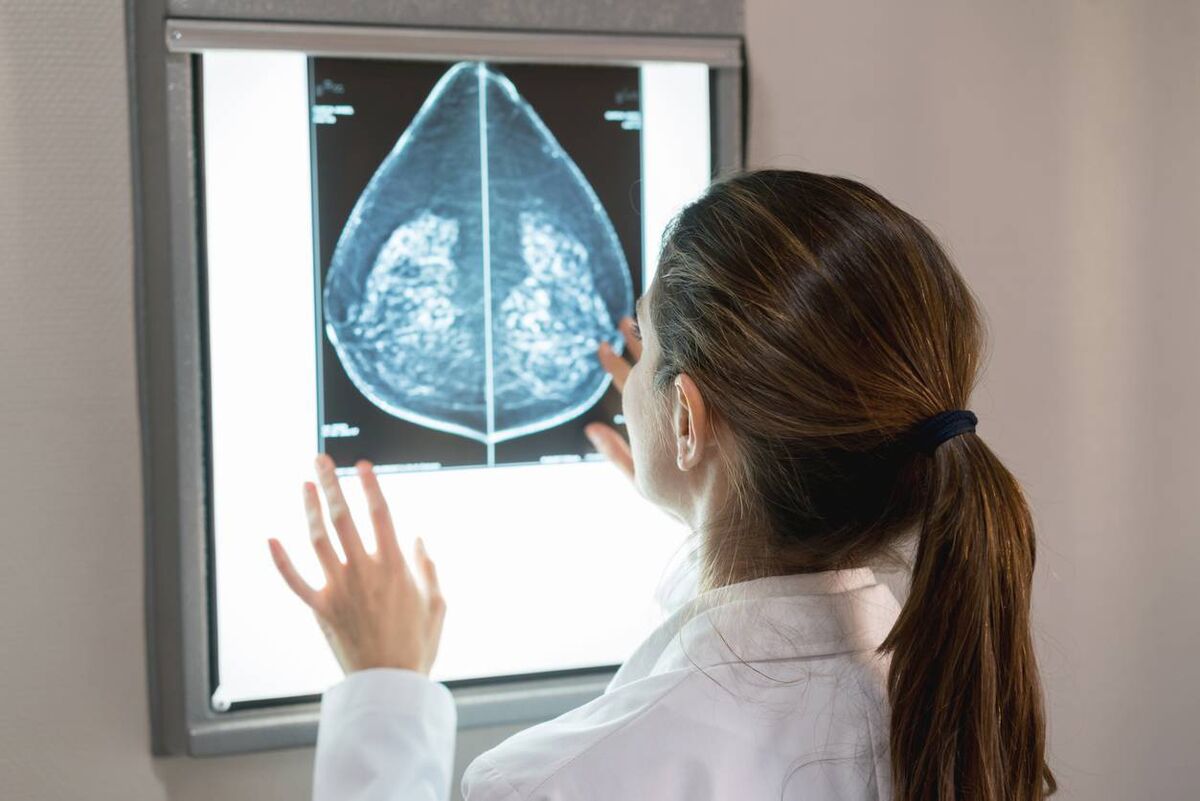
Of all breast cancers, ILC is the hardest to find.
BreastCheck has three imaging types.
All three need to be properly used to find ILC.
If they cannot provide this the patient should be told.
I actually had private health insurance — had I used that I would have gotten a full 40-minute MRI and ultrasound.
BreastCheck never gave me an ultrasound and the MRI was a “fast” 10-minute one that takes bigger slices.
Later, I learned of research which states fast MRIs are not recommended for ILC because they often miss them due to growth patterns.
I had a meeting with BreastCheck and asked about my near miss.
They said it wasn’t a near miss because the extra two tumours would never have caused a problem as I had been put on anti hormone therapy and scheduled for radiotherapy after the lumpectomy.
However, neither would have been effective at eliminating a 2cm invasive tumour. Otherwise, surgery for such tumours would be unnecessary.
My case is not recorded as a near miss anywhere as I suggested. They say they record interval cancers, but they are very, very specific in how these are recorded.
In short, my screening mammogram did not see three ILC tumours due to breast density. Thankfully I had calcifications that led to my recall and treatment. Breast density was never mentioned, but I did find this information on my MRI report. They never gave written mammogram findings.
It is extremely unlikely my surveillance imaging would have found this, at least until it became very large or I became symptomatic, possibly even stage four. I would never know or be told I had dense breasts.
My mastectomy request was not because I thought there was more cancer — I believed them when I was told the MRI would catch absolutely everything.
It was because I feared that more would grow undetected.
I had read up on how difficult ILC was to see on mammograms, down to 11% detection rate when combined with dense breasts.
I should have been listened to initially when I asked for a mastectomy.
Admittedly I didn’t push the matter as I didn’t realise I had a choice — the choice of surgery was never discussed; I was railroaded into a lumpectomy I never wanted.
However, I do feel extremely lucky that I am on hormone therapy and now cancer-free.
Had I not educated and advocated for myself I would be returning to BreastCheck in years to come with a recurrence, only to be told I was one of the unlucky ones.
I’m sorry if this may seem so long-winded.
Your journalists may be in a better position to get more up-to-date statistics to compare our breast cancer survival with our peers.
My reason for publishing this letter anonymously is because some friends and family are unaware of my diagnosis.
I wasn’t surprised to read that Cork Chamber’s Cork Airport Survey 2026 found a direct air link to New York is the “top among business travellers in the region”.
One of the essential steps to making this happen is to lengthen the runway at Cork Airport, so larger aircraft can take off fully laden.
The airport will never reach its potential with a runway that is too short to accommodate the aircraft needed for long distance travel to be financially viable.
I urge our political leaders to make this an issue for the development of Cork as a true alternative to Dublin for investment.
The deadline for public submissions for the Dog Breeding Establishments (DBE) Amendments Bill is September 8.
Submissions can influence the nature and course of an industry producing an estimated 70,000 puppies annually, with a substantial proportion destined for export.
Large commercial breeding facilities inevitably create pressure to prioritise volume over hygiene, genetic screening, and maternal care.
Research from the Royal Kennel Club found that almost one in three puppies sourced from low-scrutiny commercial environments becomes seriously ill or dies before its first birthday.
Claims of exceptionally high mortality in intensive puppy production should therefore be treated as a warning that welfare standards require much greater scrutiny.
Since the Dog Breeding Establishments Act 2010, there has been a striking failure of enforcement.
Licensed establishments have never faced criminal consequences.
The legislation’s principal mechanism is the improvement notice: failure to comply does not itself constitute a criminal offence.
Instead, the process can lead to an application to remove an establishment from the register. This created a significant enforcement gap.
Meanwhile, prosecutions of unregistered backyard operators or individuals committing serious cruelty under the Animal Health and Welfare Act 2013 have sometimes succeeded, often following work by charities such as the ISPCA and DSPCA.
This has created the misleading impression that the underlying problem — industrial overbreeding — was actually being addressed.
The unintended consequence has seen charities and taxpayers providing a costly clean-up service for irresponsible breeders and owners.
Compulsory microchipping has made dogs considerably more traceable, but enforcement is undermined when ownership details are not updated.
Mandatory DNA testing and certification of a litter’s coefficient of inbreeding (COI) would give veterinary authorities clear oversight of compliance with basic standards.
Compulsory DNA and COI certification would be legislatively cost neutral but is not yet mentioned in the proposed bill.
Consequently, such accreditation would guarantee meaningful consumers protection.
At present, a heartbroken purchaser is left with little more than inadequate refund-or-replacement remedies.
Emotional damage to children is unmeasurable.
Such unacceptable risks being dumped on consumers is not just unethical, it questions whether consumer protection regulation has been asleep at the wheel.
For over 20 years online advertising has become the industry’s principal marketplace.
Yet despite the 2024 Digital Services Act transparency requirements, none of the Irish platforms publish DBE or registered-seller business name and address details nor private seller non-trader declarations.
Not a single Irish puppy digital advert has complied with EU law since 2024.
Additionally, the four authorised microchip databases — Irish Kennel Club, Fido.ie, Microdog.ie, and Animark.ie — also need to consider their position in sharing data via an application programming interface with any non-compliant advertisers and platforms.
In terms of costs/benefit analysis, the DBEs and puppy mill trade has been, and continues to be, an unmitigated disaster for the Irish economy.
State support, charitable donations and veterinary bills borne by new owners conservatively amount to more than €20m annually.
That is more than another €336,051 bicycle shed every week.
Puppies and dogs ultimately pay the highest price of stolen lives and unrelenting cruelty, but are taxpayers really expected to provide endless bailouts for an industry whose worst operators repeatedly externalise the cost of their business?
Please make a submission before September 8. This legislation must solve the problem — not legalise it.