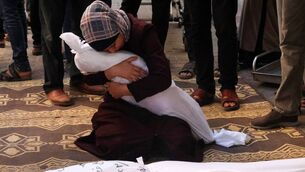
Letters to the Editor: Stunningly disordered Israeli regime
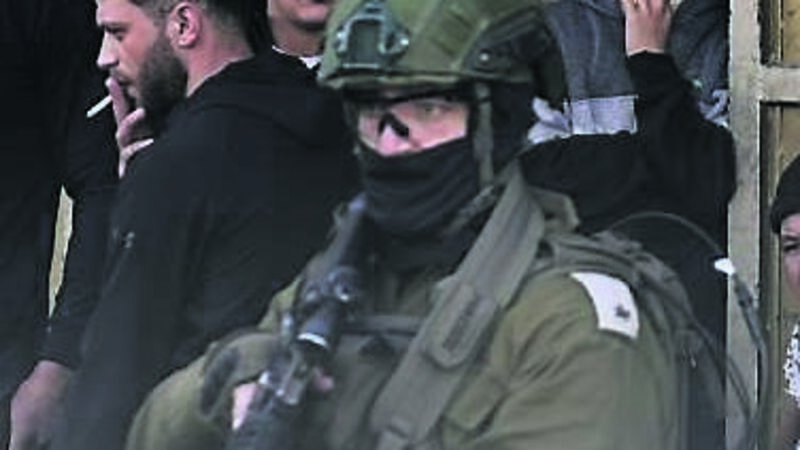
An Israeli soldiers aims a weapon during a military operation at a market in the Balata refugee camp in the West Bank, as Palestinians stand nearby. Picture: Majdi Muhammad
The passing of a law by the Israeli parliament introducing the death penalty for Palestinians only, who are guilty of crimes involving fatalities, is a further descent into the moral morass of Israel’s current government.
What about the deaths of Palestinians caused by the settlers in the West Bank appropriating Palestinian lands, without any justice exercised against the perpetrators, and committed with the strong collusion of the Israeli police force?
How many more egregious actions does the Netanyahu administration have to commit before the international community takes assertive action to not only express absolute disapproval but also to attempt, by strong sanctions and the withdrawal of military assistance, to curb a regime that appears hell-bent on completely destroying the international reputation of Israel for many decades to come.
The appointment of Itamar Ben-Gvir, an extreme and hardline fundamentalist as national security minister in 2022, was symptomatic of a stunningly disordered regime, and he subsequently went on to oversee a prison system (of a type) that, given the dire treatment of Palestinian prisoners and the breaking of international law, is more usually found in authoritarian regimes or in undeveloped war-torn countries.
He is now in celebratory mode at the success of his extreme right party, Otzma Yehudit, in proposing this barbaric legislation which, given his record so far, will be administered with roughshod standards and an absence of proper legal process.
Is it now to be expected that the international community as usual, and shamefully, does next to nothing in the face of such behaviour by a nation that aspires to be the only Western-style democracy of the Middle East?
Sadly, the answer is probably yes.
As the son of Sean O’Callaghan, I read with interest Mick Clifford’s review of JP O’Sullivan’s book — “Book raises questions on IRA informer’s death and subsequent garda investigation” ( , March 28).
While the review raises legitimate questions about the garda investigation into the murder of John Corcoran, it devotes considerable space to denigrating my father, describing him as a “fantasist”.
It is worth noting that exactly the same word and phrasing was used by Gerry Adams’s counsel, Edward Craven KC, during the recent civil trial in the Royal Courts of Justice in London (John Clark and others v Gerry Adams).
The identical language also featured in the cross-examination of Shane Paul O’Doherty in the same proceedings.
In the same breath, Clifford describes O’Callaghan as both a fantasist and “an intelligent man and, by the mid-1980s, one of the gardaí’s best informers in the southern jurisdiction”.
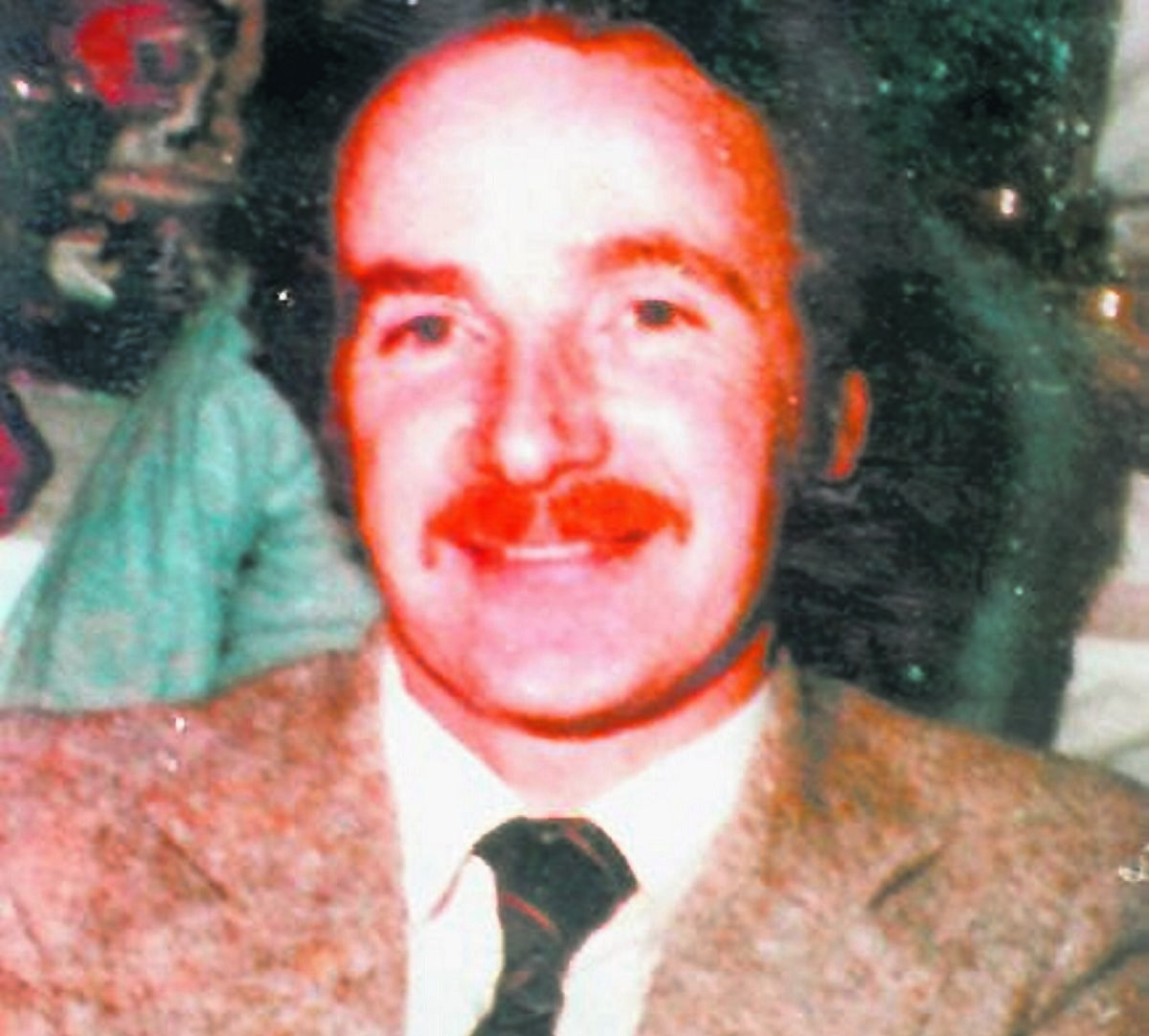
The simplest explanation for this apparent contradiction was given many years ago by the former taoiseach Garret FitzGerald.
Having had access to my father’s intelligence reports as taoiseach, FitzGerald publicly described him as “one of the Irish government’s most important spies operating within the Provisional IRA”.
Sean O’Callaghan chose to be an unpaid informer, and his information had thwarted an IRA plot to assassinate Britain’s Prince Charles (now King Charles III) and Princess Diana, saving the life of the future king.
FitzGerald explicitly rejected attempts to dismiss O’Callaghan as unreliable.
He attested my father’s intelligence had been of genuine operational value to the Irish government, and he had acted with courage in extremely dangerous circumstances.
Nobody disputes that gardaí and others have serious questions to answer about the handling of the Corcoran case.
The paramount fact, however, remains that the men who ordered and carried out the murder of John Corcoran were senior members of the Provisional IRA. It was they, not the State, who abducted, interrogated, and executed him.
Regurgitating language and smears that were comprehensively disproved decades ago does little to advance substantive journalism on this difficult subject.
In response to Christopher Nial’s opinion piece — “Free GP care for all could turn out to be a poisoned chalice” ( , March 9), I agree GP services should be unhurried, preventive, relationship-based, and available to everyone.
That is precisely why the Social Democrats put forward a 20-point plan to address the crisis facing general practice.
Our plan does not provide for overnight free GP visits, as the writer suggests.
Instead, our plan calls for the expansion of free GP care to under-12s in 2026, followed by the entire population by 2030.
This is hardly a shock overnight universalisation warned against in Mr Nial’s piece.
I firmly believe GP care should be free. That might sound radical, but it shouldn’t. It’s the European norm.
In Mr Nial’s piece, he uses the NHS as an argument against our plan.
In my view, that is a red herring.
The problem with the NHS is not that it is free, it is that it was starved of funding by the Conservatives for over a decade.
In Ireland, there is political consensus on the need to remove cost barriers — all that’s been missing is a government willing to follow through.
The 2016 programme for government committed to extending free GP care to under-18s.
However, we’ve had three governments since then and we’re still waiting.
All that’s been delivered is an extra two years — expanding free GP care from under-sixes in 2015 and to under-eights in 2023.
And, while welcome, it took eight years to achieve this minimal progress.
In his book, , former taoiseach Leo Varadkar laments the failure to expand free GP care to all children.
He is right to say services for children should not be means tested — although it’s a pity he didn’t come to that realisation while he was in power.
In terms of capacity, there is no doubt we need more GPs.

There is also no doubt demand will increase if access to GPs is free.
But that should not be seen as a bad thing.
Too many people are avoiding seeing their GP due to cost.
That is why our 20-point plan includes a range of measures to increase capacity.
Simply put, we need far more GPs and GP nurses.
The core GP contract is five decades old. It’s a relic of the past.
We need a contract that facilitates new ways of working, provides for work-life balance, and meets the evolving career expectations of younger GPs and trainees. We also need a national strategy to attract, support, and retain future GPs.
Many GPs, particularly those working alone, report not being able to take annual leave, cutting maternity leave short, or having to work extended hours because of a lack of cover.
This isn’t acceptable. There should be a national programme of locum cover across the State to ease the pressure.
There are also physical capacity constraints. We don’t ask teachers to build their own classrooms, so why do we still expect GPs to build their own surgeries?
The HSE must accelerate the roll-out of primary care centres to provide the physical space for new GPs to set up.
In remote and rural areas, where the existing GP model is becoming increasingly unviable, the HSE should directly hire GPs. As the saying goes: No doctor, no village.
For deprived communities, which are some of the most underserved, we are proposing a Deis for GPs scheme to provide additional supports to practitioners.
Ultimately, GP services need more than a quick fix — they need fundamental reform.
That is just what the Social Democrats are proposing.
In previous major conflicts/wars, we could always rely on the internationally agreed UN to loudly try and spell out hope for peace and solutions.
The recently created board of peace is disappointedly weak on reasonable peace proposals that can be trusted.