Letters to the Editor: Israel  responds with two fingers to the ICJ
Letters to the Editor: Israel  responds with two fingers to the ICJ

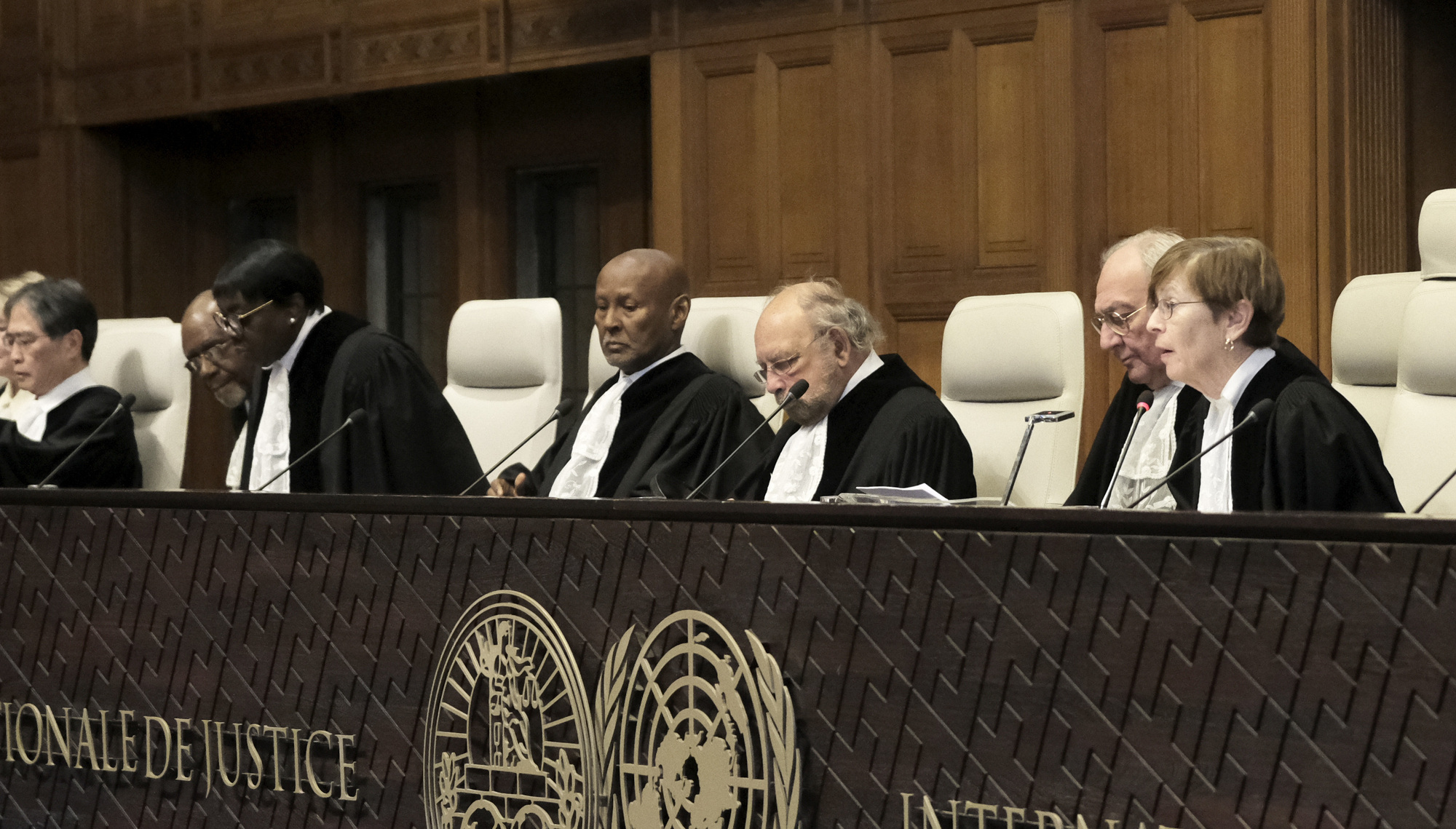
Judges preside over the opening of the hearings at the International Court of Justice in The Hague, Netherlands, this week. Picture: Patrick Post/AP

Much of the commentary on the historic International Court of Justice (ICJ) Ruling last Friday has underplayed some key factors, namely:

None of the Israeli legal team’s arguments, including its lengthy right to self-defence in occupied territories, were accepted by the court. The ruling was a clear 6-0 win to South Africa.

All aspects of the ruling received a huge majority vote of either 16-1 or 15-2 in favour.

Even the Israeli judge voted for the rulings that called on Israel “to prevent and punish incitement to commit genocide against Palestinians” and “to ensure the provision of urgent services and humanitarian aid to Gaza”; the former being accepted by the court as not just plausible allegations by South Africa, but facts that have already occurred.

Such a damning indictment of any country by the highest court in the world is unprecedented.

Israel has responded with two fingers to the ICJ and the world showing its disdain for international law by killing more than 373 Palestinians and injuring 643 within 48 hours since the court’s ruling, while also ramping up efforts to starve and displace Gazans, according to the Swiss-based Euro-Med Human Rights Monitor, all of which is in clear breach of the temporary and immediate steps stipulated in the ICJ ruling.

Other countries’ governments, including that of Ireland, must now get off the fence and support South Africa’s case lest they are content to be legally and morally complicit in what is plausibly, if not undoubtedly, an ongoing genocide.


Jim Roche, PRO, Irish Anti-War Movement Steering Committee, PO Box 9260, Dublin 1

Brigid’s cross is sun symbol of pre-Christian era

It is interesting to see the revitalisation of Brigid. As with many of our saints, Brigid was originally a goddess. She is associated with fire. Her cross is a sun symbol and, like the triskele, should be moved to show the movement of the sun. She represents the return of spring and the return of life. She also has associations with England and Switzerland.

The eve of Brigid’s day is known as Imbolc, or “sheep’s milk”. Pre-Christianity gives Christianity a basis for preserving the myths and historical times of this remarkable woman.

Daragh Smyth, Clonakilty, Cork

Water wildlife has plenty of places to move

Irish Examiner journalist Sean O’Riordan reported on January 8 that council engineers had intimated that Inland Fisheries had made it known that removing debris deposits, especially silt from the rivers running through Midleton, is “so sensitive” to wildlife that the local authority will have to get permission for such works from the Department of the Environment, a requisite that could take two years.

Prioritising the habitats of fish and wildlife that live in waters locally over that of a multitude of people who reside on the banks of the Owenacurra and Roxborough rivers represents an extremely worrying scenario for the people of Midleton, which ought not to be condoned.

Where sensitivities and sensibilities are concerned, Irish Fisheries and the Department of the Environment also have a duty to ensure that the rivers in question do not become suffocated, not just by debris but by wildlife habitats as well, simply because of the catastrophic consequences this negligence would have upon the inhabitants of Midleton and its environs.

Any arrangement authorising supremacy of wildlife over that of people’s survival and the protection of their property represents utter folly in my view, especially given that 74% of the earth’s surface is comprised of water, affording wildlife plenty of room and alternative places in which to reside.

Pat Daly, Midleton, Cork

RTÉ payments threaten future of public services

It seems reasonable to expect that the chief financial officer of a national, public broadcaster would fully understand the rules and entitlements around redundancy payments.

In that context, does the suggestion that RTÉ rather than the individuals
involved in the latest unveiling from the broadcaster, might resolve any tax issues not exacerbate this latest shabby drama from Montrose?

What authority does the organisation have to spend scarce public resources to paper over what seems at best an abuse of position and opportunity? It is more than sad to watch RTÉ implode in this way, a denouement that reflects the early stages of the collapse, for very similar reasons, of Britain’s postal services.

Even so, I wish my former employers were moved to grant me an unjustified redundancy and pay the ensuing tax liabilities. They, correctly, did not consider that possibility.

RTÉ should not pay any tax bills in this situation as that would endorse the kind of behaviour that threatens the very future of our public services, and not just broadcasting.

Jack Power, Inniscarra, Cork

Content creation sorely lacking in broadcaster

I am just a lowly viewer and audience member, but I am only too aware of the need for public service broadcasting. I am also aware, as are so many, that RTÉ is not necessary for that function, as it has been unable to function.

There is a reason that Irish viewers are so enthralled with pay TV and pay content services from abroad.

Ireland has been severely let down by its national broadcasters over the years. Ireland has had one of the biggest take-ups of cable and pay TV services since the 1970s — and that’s not to mention spillover signals from the 1950s
before we even had a national TV broadcaster, with many tuning to BBC Radio and Radio Luxembourg since the 1920s.

I am sure many readers in Munster will remember the calls for more access to British TV services in the 1970s, resulting in the opening of RTÉ 2 in 1978, a channel now devoid of Irish content outside of sport.

Others in Donegal will remember election candidates running on a TV deflector ticket.

Only TG4 can stand tall, but it has the issue of the language barrier.

Those in the media may wish to stop using Moya Doherty’s “existential
crisis” cliche, there was no “existential crisis” under Dee Forbes’ tenure as director general (or under any of their predecessors). It was largely an internal crisis that no one in RTÉ or the media wish to admit to.

Instead they want us to believe that if RTÉ had received an extra €50m, their executive board would not have taken their car allowances and that RTÉ would be a strong national public service broadcaster.

If the Government is willing to increase funding to RTÉ, Kevin Bakhurst and his leadership team better get ready to spend it on content, not fast cars.

Éamonn Geoghegan, Athlone, Co Westmeath

Stormont’s role is a democratic facade

The decision of the DUP to return to Stormont has been greeted as a victory for democracy by the Irish and British governments, as well as the main political parties within the six counties. Sinn Féin’s Michelle O’Neill will become First Minister, the first non-unionist to head a devolved administration since Britain partitioned Ireland over 100 years ago. This will be hailed as proof that the six-county statelet is now a stable democracy, its politicians having matured under the benign influence of the British government which acts as an honest broker to curb the mutual animosity of the two hostile tribes.

The reality, of course, is much different. Stormont’s role is to provide a democratic facade to the continued denial of democracy in Ireland. It is an
institutionalism of sectarianism, where nationalist is pitted against unionist in a futile pursuit of gaining dominance over each other within a set of institutions designed and incorporated to deny any control of their respective lives. Stormont’s function is to disguise the reality of where political power lies. The British ruling class maintains executive power. The returned executive will continue with the same policies as before, i.e. overseeing the implementation of British government cuts.

The election of the first non-unionist First Minister, one who describes herself as an Irish Republican, reflects the changing political realities of the relationship between British imperialism and Ireland, North and South. O’Neill’s election reflects how Sinn Féin has become a co-administrator, along with unionism, of British rule within the six counties. This has led to a crisis of identity within unionism as the protectors of Britain’s interests in Ireland. However, Britain’s position has not been weakened, it now has republicanism, in the form of Sinn Féin, vying with unionism for the role of chief administrator of London’s rule in the six counties, while working class communities compete on an increasingly sectarian basis for their share of the crumbs.

Paul Doran, Dublin 22

x

More in this section

Revoiced

Newsletter

Sign up to the best reads of the week from irishexaminer.com selected just for you.

Cookie Policy Privacy Policy Brand Safety FAQ Help Contact Us Terms and Conditions

© Examiner Echo Group Limited