Letters to the Editor: We must end the carnage on our roads
Letters to the Editor: We must end the carnage on our roads

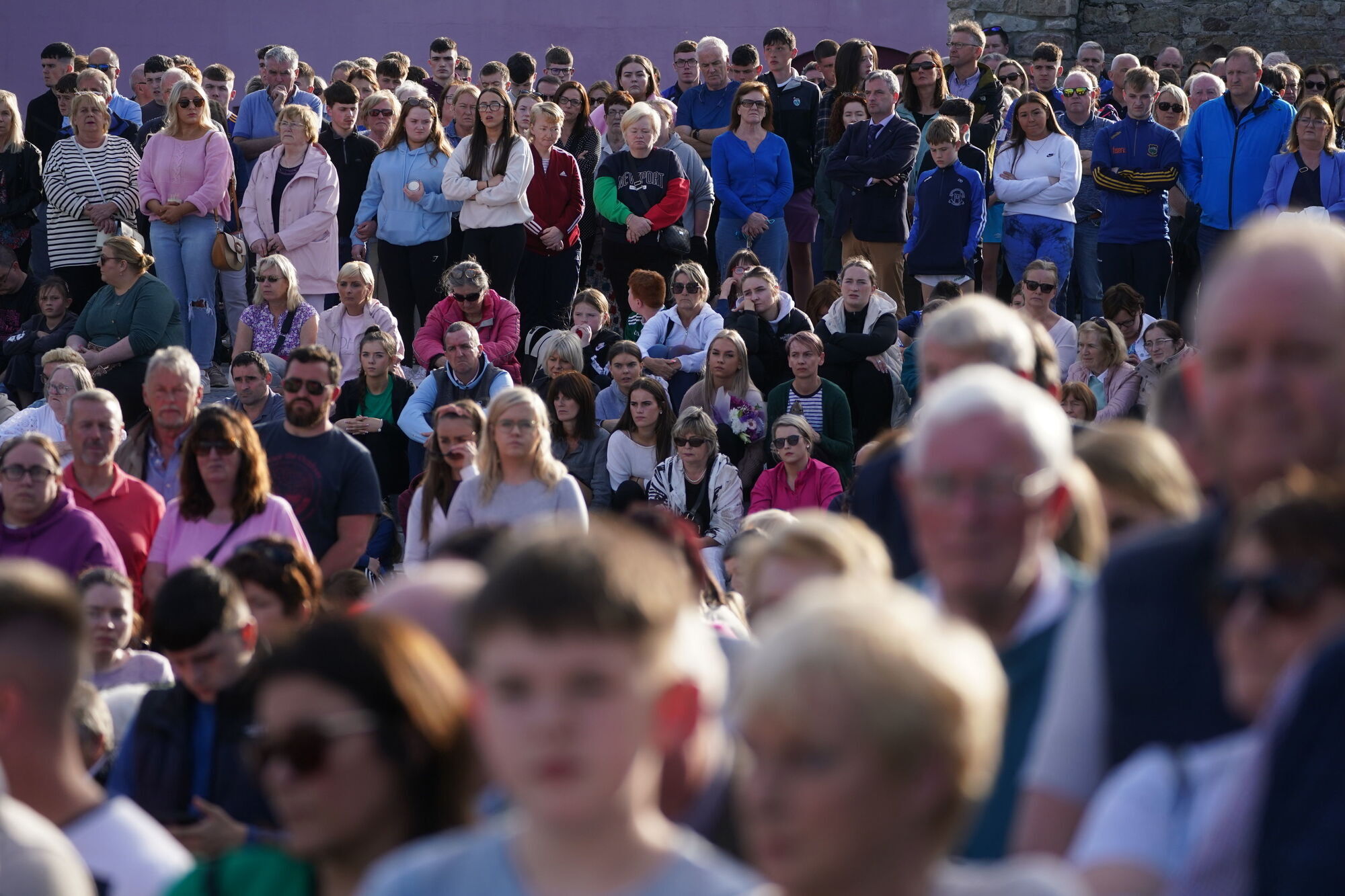
An entire community came together to share their grief and offer their support for the bereaved families during the vigil in Kickham Plaza, Clonmel, Co Tipperary, on Sunday evening. Picture: Brian Lawless/PA

The recent carnage on our roads with the untimely deaths of four teenagers in Clonmel is becoming an all too common occurrence. There is a pattern emerging of teenagers going to various events in cars which can result in fatalities. We need to find out why these things occur. There is a conspiracy of silence around fatal accidents in this country, as the funerals go on and on without anyone asking why? We can’t fix it until we know what is broken and prevent these things from ever happening or negate the possibility of them doing so.


Maurice Fitzgerald, Shanbally, Co Cork

Tipping point

When the price of a pint tipped over the €4 mark some 10 years ago, I considered giving it up altogether. Never one for making quick decisions, I have, at time of writing, the matter still under consideration.

Tom Gilsenan, Dublin 9

Enjoy Spain, but skip the bullfight

Whatever about climate change and forest fires, many Irish people look forward each year to a holiday in the sun, and Spain is at the top of their list of options.

Understandably, because it’s a beautiful country with stunning beaches, hotels, and scenery, and you’ll meet wonderful people there.

But not everything about it is wonderful. The bullfighting season is in full swing and continues until mid-October. The traditional image of the bullfight is of a brave man, the matador, nimbly dodging a charging bovine, swishing his cape, and putting his life on the line to entertain.

Unfortunately, the truth is very different. Before it enters the ring the bull has Vaseline rubbed into its eyes to impair its vision and is beaten over the kidneys to weaken it further. And the contest is not just between a bull and a daintily-dressed swashbuckling fellow who wouldn’t look out of place in a comic opera.

The bull is stabbed repeatedly by horsemen with razor sharp lances, inflicting unbearable pain on an animal already weakened from extreme disorientation resulting from its earlier “softening up” treatment.

The matador can afford to take some risks, faced as he is by an animal that is already close to collapse. Then, when he has extracted sufficient entertainment value from his prancing around the ring, taunting the bull and eliciting cheers from the baying fans, this “brave” man pushes sword down between the shoulder blades of the pain-racked bull.

The mighty creature, snatched from a field in the countryside for this spectacle, is brought low, with nobody there to ease his plight 
 just a cheering, blood-lusting crowd.

If you opt to enjoy a holiday in Spain this year, please don’t attend a bullfight. There are enough tourists attending bullfights just once in their lives to keep the vile practice alive. Significantly, a majority of Spaniards now want bullfighting banned, but it thrives on “curiosity tourism” fostered by the notion that one simply must see this great “tradition”. Well, there’s nothing to see but the agonising death of a bull.

Please don’t become part of that audience. If you do, you might as well assist the Matador to stab that tortured animal in the back. So, enjoy the sun, but skip the cruelty.

John Fitzgerald, Callan, Co Kilkenny

Cawley’s criticism 

The leader page in the Irish Examiner runs to a fairly standard format, with editorial comment, journalistic articles, and letters. 

However, a letter by Mr Ray Cawley — ‘In defence of new RTÉ boss Kevin Bakhurst’ (Irish Examiner, August 25) drew my attention. He castigated hotelier Mr John Brennan for daring to have an opinion on the recent RTÉ saga. Mr Brennan, in an even-handed and temperate open letter questioned whether the axing of Tubridy by the RTÉ director general (DG) was humiliating to Tubridy, and on the face of it, and without knowing the details of the discussions taking place, it very much looked humiliating. Mr Cawley deemed the letter a ‘nasty attack’ on the DG.

However, a week or so previously one of the nastiest, personal and vitriolic letters I ever read was from the same Mr Cawley — ‘Lack of response from Martin’ (Irish Examiner, August 15) — in which he attacked the Tánaiste and Minister for Defence Micheál Martin in a particularly despicable manner, for the crime of failing to live up to Mr Cawley’s high standards.

On another note and referring to the same page on the same date, the column by Jennifer Horgan — ‘Hotels stock free shampoo and sewing kits, why not sanitary pads?’ — was about tampons and who should pay for them.

I am puzzled as to what audience this was targeted at. However, I am saddened that journalistic standards have gone so low.

Joe Kennelly, Inniscarra, Co Cork

Stocking sanitary products in hotels

I would like to support Jennifer Horgan idea of having sanitary products in hotels.

She highlighted a situation most women have been in at some stage of their lives and I really identified with it (although I have never appeared on live TV).

Hopefully the Irish Hotels Federation will take this idea on board, it would be a great help to the women/girls of Ireland (and elsewhere).

Emily Finn, Swords, Co Dublin

Conflict in care

While I agree with everything Dr Colm Henry says in the article — ‘Ageing population means elderly are now “purpose” of health system’ (Irish Examiner, online, August 22) — I fail to understand the statement of Health Minister Stephen Donnelly last week in which he says patients over the age of 70 will not have to wait no longer than 24 hours on a trolley to get a hospital bed.

Dr Henry points out that this is frankly unacceptable yet Mr Donnelly is quite happy to be OK with this. Why the conflict minister? Why not allow those with the medical expertise decide.

James Farnan, Hillview, Co Waterford

Encouraging ‘prosumerism’

Luckily, there is a solution to the planning permission hell described in the article ‘Council refuses planning for Midleton solar farm to ‘preserve character’ of green belt’, a problem which sadly faces so many new solar developments.

The solution is putting panels on roofs, and not on precious land. An example of how well this can work can be found in the Netherlands.

On a good day in that country, solar panels easily generate some 14 Gigawatts of electric power, which is more than three times the typical demand of the Irish grid. They have accomplished this in a country less than half the size of Ireland.

This is possible because in the Netherlands solar energy is primarily produced on the roofs of households and businesses: 80% of solar was placed on roofs in 2021. Only a minority of solar energy is generated in commercial large-scale installations on fields.

This impressive feat was made possible by allowing consumers to cross off excess electricity generation from their remaining power usage, thus giving households rewarding and predictable savings.

The State should, as much as possible, encourage consumers to place solar panels on their roofs; not only because this spares scenic agricultural land, but also because it has the additional benefit of taking initiative out of the hands of the industry, putting it into the hands of consumers instead.

Consumers thereby become electricity-conscious ‘prosumers’, who profit from their contribution to the energy transition, instead of it just being a sunk cost.

Ethan van Woerkom, Ballyheigue, Co Kerry

More in this section

Revoiced

Newsletter

Sign up to the best reads of the week from irishexaminer.com selected just for you.

Cookie Policy Privacy Policy Brand Safety FAQ Help Contact Us Terms and Conditions

© Examiner Echo Group Limited