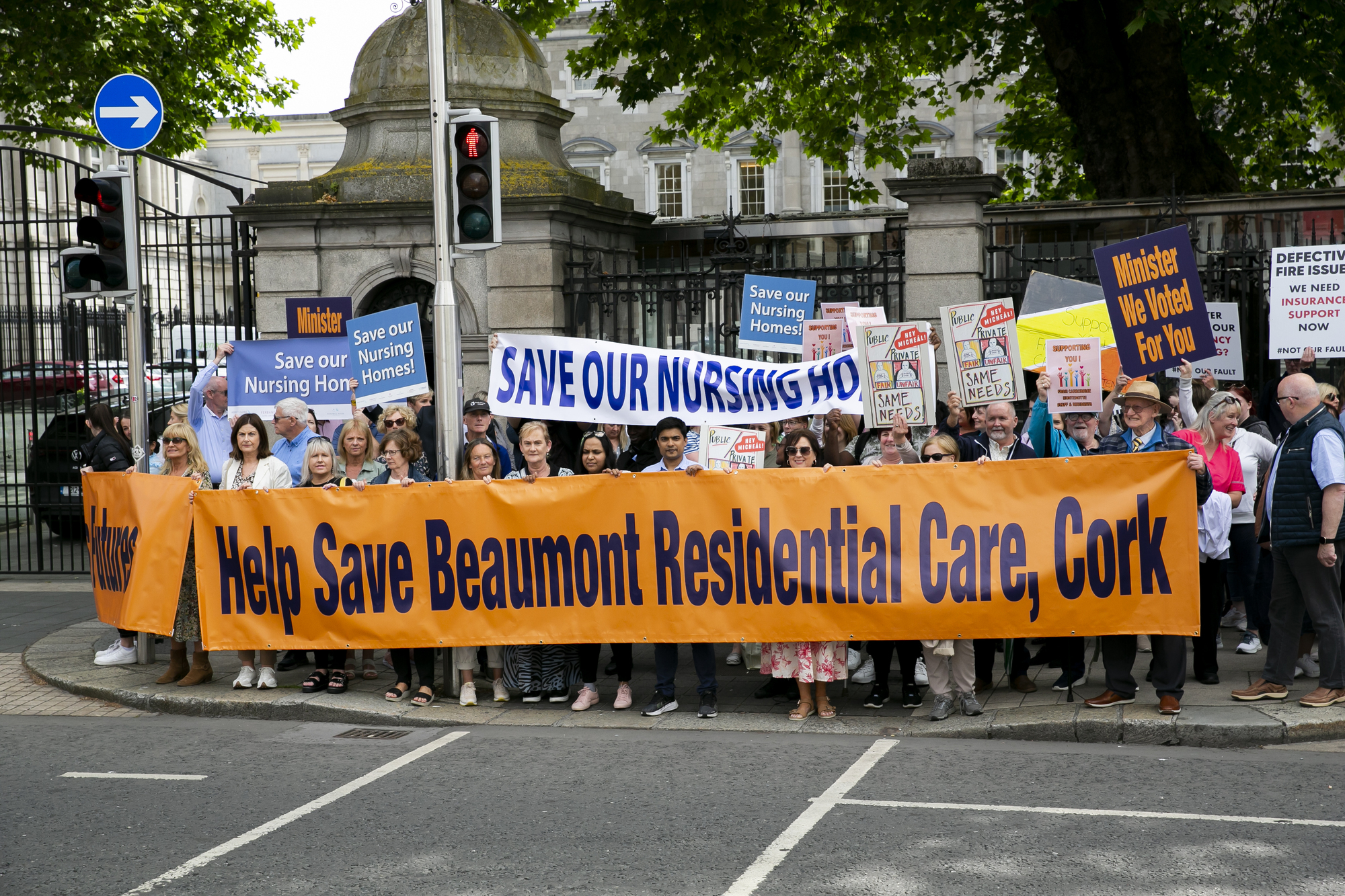
Regarding Stephen Donnelly’s comments in relation to Beaumont nursing home — ‘ Donnelly accuses nursing home firm of cynical tactics over Fair Deal’ (Irish Examiner, June 19), CareChoice is not the issue here Minister Donnelly, Fair Deal inequality is.
Blaming CareChoice for this crisis is disingenuous to say the least and very upsetting and disrespectful to the 56 families of the residents in Beaumont Residential Care (BRC) affected by this Fair Deal funding crisis.
We, the families of the 56 Fair Deal residents reject Mr Donnelly’s remarks in on Monday’s Irish Examiner regarding “cynical tactics” used by CareChoice.
We are acutely aware of the inequality surrounding the Fair Deal underfunding when compared to HSE-run homes. CareChoice ceo Stuart Murphy has had many meetings with us and has outlined the background and lead-up to exiting the Fair Deal scheme.
This action was only taken as a last resort following the continual failure of the National Treatment Purchase Fund (NTPF) to engage with CareChoice to negotiate extra funding.
CareChoice made a loss of €6m last year.
CareChoice has spent more than eight months trying to get the NTPF to properly engage and there is currently no meaningful engagement.
We reject Mr Donnelly’s claim that CareChoice’s action was unnecessary. It should never have had to come to affecting the lives of 56 innocent and frail residents of Beaumont.
Mr Donnelly has been a party to the closure of 25 private homes during the last 20 months due to the decision of the department which he leads to chronically underfund the NTPF.
We do not believe the minister has ever visited a nursing home which was closing or spoken to a director of nursing of a closing home and consequently Mr Donnelly has limited knowledge of the impact of a closure on a home or its residents or families.
The blatant inequality in the allocation of Fair Deal funding to private nursing homes when compared to HSE-run homes is at the core of this funding crisis.
This difference is €730 per resident per week in favour of HSE-run care homes.
The anxiety this is causing residents and families is enormous.
We will not give up this fight until we get a ‘fair deal’ for our loved ones in Beaumont Residential Care, and for all future residents of private care homes affected by this chronic underfunding of the Fair Deal Scheme.
Families of “Save Beaumont Residential Care — Fair Deal campaign”
Leaving Cert like a double marathon
I sat my Leaving Certificate (LC) in 1981. I recall (I still can remember parts of it) that the weather was also very sunny (at least for the first few exams).
My daughter sat her exam this year. In many respects, not much has changed with the usual exam pressures, last minute studying, hoping one’s predictions appear on the papers, all in all, an endurance test as it was in 1981. But the current LC is much more than an endurance test, it is more like running a double marathon.
What follows are general and specific observations with a plea for change:
This year’s LC students did not sit a Junior Certificate (neither will those sitting next year’s LC). Sitting the LC mocks is not like the real thing (my younger daughter sat the mocks and real Junior Cert in 2022 and can now vouch that both experiences are vastly different).
Many students and teachers were out sick with covid over the past two years during this Leaving Cert cycle — and with other seasonal illnesses which returned with a bang once the wearing of masks was dispensed with. I think the State Examinations Commission (SEC) has shown a total lack of empathy with our students and a total lack of understanding of their mental health — a real disconnect.
Yes, some allowances were made but very little indeed if you place them alongside the difficulties the students and teachers faced since their own Junior Cert year. It would seem that the SEC believes that because much of the world has returned to some kind of normality post covid (which is still here), so must the LC. This is somewhat removed from reality.
I am assuming that one of the aims of the LC is to allow students to show off what they have learnt over the LC cycle. The LC papers should afford them space to do this. And, yes, papers will have to be set to enable those correcting them to differentiate grades. But from what I have seen in 2023, the tendency now is to cram as much into the papers to ensure that students have no time to draw a breath. Now it’s a race against the clock. I accept that timings are part of the learning process and I faced this in 1981 but it has now gone too far. There is too much emphasis on getting the timing right.
For instance, in Paper 2 Irish, students were given two Léamthuisicint (Comprehensions) to read with six questions (five containing three sub-questions and one, with two sub-questions) so 17 per Comprehension giving a grand total of 34 questions, My daughter advised me that she had roughly three minutes to answer most of them. So, why have two Léamhthuiscint? Why not just one? Would students not be better served in having that bit more time to answer less questions in a more complete manner? My own daughter is good at Irish, and was fine with it, but all in a rush.
Much has been said and written about Math’s Paper 1. We all accept that the questions in the maths papers are staggered so as to try and separate the H1s from the H2s and so on. As with all papers, it should give students an opportunity to share the knowledge learned over two years. However the aim of this year’s Math’s Paper 1 seems to have been to catch students out right from the start. And maybe to discourage those students who study honours maths solely to secure those 25 extra points? The SEC needs a dose of realism.
Back in the old days in 1981, there were no aurals; although I did have an oral in Irish. Naturally, the aurals extend an exam’s duration. Depending on subject choices, some students would have sat Irish Paper 2 on Tuesday, June 13 (9.30am to 12.35pm), Biology on the same day, (2pm to 5pm); French on Wednesday, June 14 (9.30am to 12.50pm), History also on June 14 (2pm to 4.50pm), and Business on Thursday, June 15 (9.30am to 12pm(O)/12.30pm(H)). Any reasonable person would see that this is a truly exhausting and grueling schedule. To only allow just over an hour (in reality, it will be less than an hour) between French and history is ludicrous and shows a total lack of consideration for our students. This places those students in a less advantageous position to those who do not have this schedule.
I note, historically, the core subjects are sat early and have been bunched together. The current scheduling is stacked in favour of science/business subjects. It discriminates against other subjects. I think it is now time to review this and look at mixing it up a bit to reduce the clustering of the core subjects.
I would ask the SEC (and the department) to make, what are essentially, minor changes to the exam to make it a truer reflection of our students’ work and to remove the unnecessary stress and obstacles thereby reducing it from a double marathon to at least just one.
Feargal Ó Dúlaing
Ennis
Co Clare
Opt for ordinary maths for easier life
Without a doubt, students who pass higher level maths should be awarded additional points. These points reflect the extra time spent studying this difficult subject, the money spent on grinds, the promotion of STEM, and the dedication of the student. Maths is difficult, and opting to take it at a higher level should be noticed and rewarded. However there are plenty of students who are capable of higher level maths but opt for ordinary level for an easier life.
Jessica Davis
Louth
Bonus points for choices in college
I have been a secondary school teacher for 42 years. In that time I have taught four subjects to Leaving Certificate higher level: accounting, economics, business and mathematics. In my experience, the degree of difficulty and amount of time required to score highly in maths far exceeds what is needed in the other subjects. If there were no bonus points to reward the extra work, I would be advising students to think seriously before investing the time.
I have always felt that there should be some form of bonus point system based on the choice of course in college. Extra points for your English result if you choose to study English, language results in the LC would gain bonus points for language courses ... bonus points in mathematics would then just be awarded for mathematical-based courses such as engineering.
Sheila Heneghan
Lismore
Co Waterford
A history lesson for Fianna Fáil?
Nary a week goes by without either Micheál Martin or Leo Varadkar insulting and crudely attacking one of the smallest parties in the Dáil, People Before Profit. They have a very thin skin, and quick temper, when it comes to being questioned by PBP. This time, Micheál got his back up when PBP asked why only one anti-war speaker was invited to the government’s four day conference on neutrality. Mr Martin reacted by saying if PBP were in power, they would “have the jackboot on the people”. Really? This from the leader of one of the dominant parties for eight decades, persecuting 50,000 pregnant women, criminalised people for loving each other, and engaged in widespread corruption. Instead of lashing out with unfounded hateful insults, Mr Martin should open a history book, and get his head out of his own jackboot.
Patrick Connolly
Western Road
Clonmel
Co Tipperary