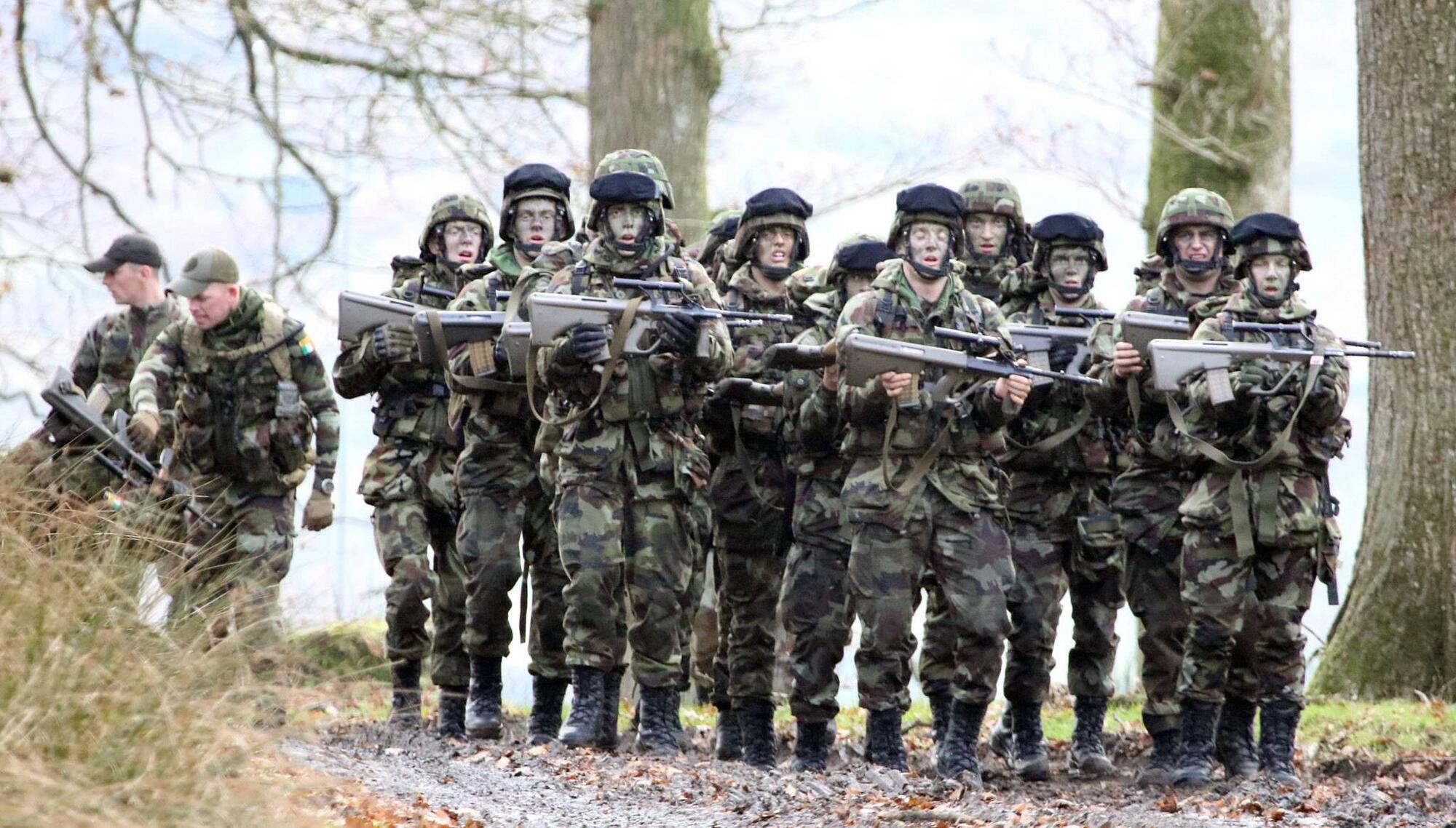
I had the privilege of being born in a military hospital, in the 1930s, at the Curragh Camp. My father served and I followed suit for about 32 years up to 1992.
If we want to be a neutral country, then we must study the consequences and obligations to support neutrality and the levels of deterrence required.
Neutrality must not be an attitude to a few countries, or a preventative against possible occupation or reducing the possibility of significant military strikes on our infrastructure.
The current European war waged by Russia shows that boundaries will not stop an aggressor intent on expansion of influence. The only response for a neutral country is to defend its territory and seas with modern capable forces and sufficient supports to sustain an army in the field or those at sea and in the sky.
We are presently in a much weakened state having lost historic capability, including medical support structures and nursing.
The backbone of a modern island defence is absent and needs to be fortified at an ALL arms level, in land, sea, and air services. We might then consider it is safe to be neutral.
John JordanCloyneCo Cork
Boost the economy with marine activity
Ronan Smyth reports that Michael McGrath is taking steps to address the risks associated with corporate tax windfalls — ‘McGrath: Action needed on corporate tax risk’ ( Irish Examiner, April 27). ISME has called for an agency similar to the IDA to help small enterprises instead of large multinationals (not a bad idea, considering SMEs employ a huge percentage of the workforce).
Another good idea would be to stop giving away the massive resources of the sea which surrounds us; a properly developed maritime industry would employ thousands and contribute billions to the domestic economy.
I cycle along Kennedy Quay on the way home from work and saw three German and one Dutch trawler tied up there last week.
Once I saw a Dutch-registered trawler unloading onto a Dutch-registered articulated truck. What did the domestic economy gain from that? The truck and trawler probably filled up their huge tanks with diesel in Holland. Maybe the lorry driver bought a coffee and a sandwich somewhere on the way to Rosslare to help out the economy here.
Michael O’FlynnFriars WalkCork
Ball-throwing has no place in hurling
The ball-throwing which is making a mockery of hurling has just got to be stopped. I'm so fed up with it, that I find watching hurling games now more like a chore than anything else.
I am wondering when Croke Park will tell referees to properly police this massive problem, or have they decided that there are only a few cribbers out there, and if they ignore them the problem will disappear. That will not happen.
The answer to the problem is to introduce a new rule whereby if a player receives a handpass, he cannot give one at that time.
This new rule would have a few advantages:
1) The number of handpasses would be reduced so referees could police the problem much easier;
2) Ball passing with the hurley would become far more developed, and so become a very impressive and often used skill;
3) Hurling would become far more interesting from the spectators' point of view.
This rule could be introduced immediately, just like the changes that were made to the 20m free-taking a few years ago, which has worked well.
Liam BurkeDunmoreCo Kilkenny
It’s a cruel, cruel, and violent world
For a long time we have constructed a myth that respect, harmony, and fairness is the norm and violence is the exception, while the reality is the opposite — violence is the norm and respect and fairness the exception.
This is a difficult fact for most of us to live with or face up to.
The list is long. It’s something like this: Hierarchy, patriarchy, dominance, and poverty; sexism, racism, classism, homophobia, and poverty; war, torture, genocide, ecocide, ignorance, and poverty; child cruelty, animal cruelty, hare coursing, assumed privilege, discrimination, and poverty.
These are just a few of the violences we live with and perpetuate. We are a species with the gift of consciousness and most of the time we go sleepwalking through life. Who or what will change this violence?
Mary ShanahanTraleeKerry
Rate of abortion must be reduced
In 2018, many voters were persuaded to repeal the Eighth Amendment on the grounds that the eventual abortion law would be modelled on the draft legislation proposed by the Government before the referendum.
Now, less than five years later, we are facing calls to change this legislation, removing some of the most basic safeguards which were part of the Yes campaign’s promises.
This is a truly heartwrenching place to be in as a country. A renewed examination of Ireland’s abortion policy may well be needed, but the proposals on the table for “sweeping changes” such as removing the three-day waiting period for reflection, attacking a doctor’s freedom of conscience, and increasing abortion gestational limits are deeply alarming.
Women who face unplanned pregnancies should be given options to continue with their pregnancy — including information on supports and adoption services.
In the current system, abortion is being promoted as a first ‘solution’ to unplanned pregnancy. This needs to change and the Government must seriously begin to offer meaningful supports for these women.
If a renewed abortion debate is on the cards, let us firstly focus on the need to reduce the abortion rate.
Siobhan Nic CathailRáth Ara ContaeRos Comáin
Windy weather is part of our folklore
The Scairibhín (pronounced 'the Scaraveen') is an old Irish weather phenomenon, which apparently unknown to most of us, explains the cold, windy weather we have been experiencing for the last few weeks. It is a more commonly used term in rural, rather than urban areas, possibly because of its effect on livestock, crops, etc.
It translates directly to “garbh shion na gcuach” — the rough month of the cuckoo. As described by a weather expert on a local radio station recently: “The Scaraveen is the time between April 15 to May 15, each year in Ireland, when weather patterns on the west coast of Ireland become unpredictable and severe at times.”
It is said that the old people were afraid of this tumultuous period, as it was believed to bring a lot of illness with it.
It’s interesting to know that this severe weather period can, in fact, be traditional. It is even recorded in Irish folklore.
We can’t blame climate change for everything.
Eileen LuceyCrookstownCo Cork
Political system paralysis up North
I am a great believer in the saying “if you want to understand anything, start from the beginning”.
So, where did the rule that if any one party in Northern Ireland — be it the DUP, Sinn Féin, or the Alliance Party — declares it will not attend the Assembly then the Assembly cannot meet? This, in effect, gives any party the power to paralyse the political system.
Is there such a rule in mainland UK? Would such an idea be tolerated in Westminster?
Do you know of any democracy on Earth where this applies?
Surely what the northern secretary should do is get rid of it.
Brendan CasserlyBishopstownCork City
New interpretation of border control
Unfortunately Northern Ireland differs from the rest of the United Kingdom in that it shares a land border with another country — the Republic of Ireland.
As goods can slip easily over this 310-mile border, it’s logical that goods coming from the UK mainland should be checked before entering as they could easily end up in the Republic.
Goods travelling the other way from NI to Great Britain can’t readily pass over into France and other foreign countries. Goods leaving mainland UK either by ship or plane destined for foreign countries are checked, monitored, and observed.
Therefore, if NI is treated differently from the rest of the UK in regards the importation of goods, it shouldn’t weaken NI’s integration with the rest of the UK; and a softening resolve on the part of the British government towards NI’s position within the UK shouldn’t be inferred from the situation.
Also the situation shouldn’t be used to delay the functioning of the NI Assembly, as is presently happening.
Louis ShawcrossHillsborughCo Down