Letters to the Editor: Defence Forces battling to retain staff because of poor prospects
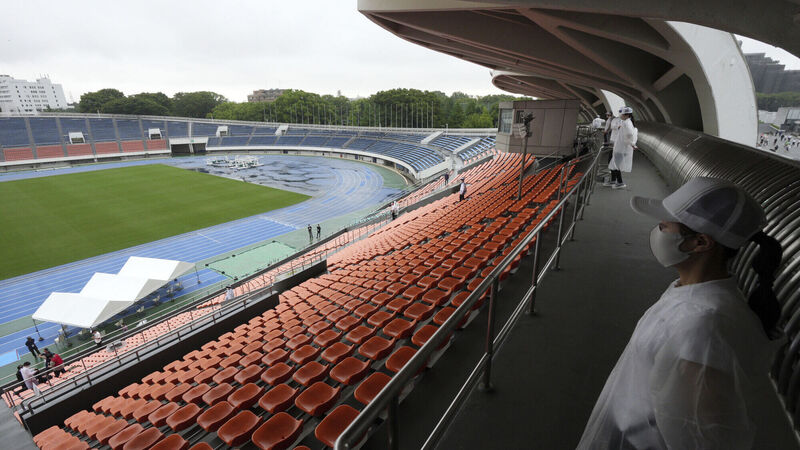
Empty seats in the grandstand during the flame unveiling ceremony of the Tokyo Olympics at Komazawa Olympic Park. Picture: AP Photo/Eugene Hoshiko
Re your article , July 9 ('No let-up in Defence Forces exodus, as 236 quit in five months'), I served in the Defence Forces from 1985 to 2017 (32 years).
In 1994, the first of the new so-called contract soldiers were enlisted. Their terms of engagement gave these personnel poorer service entitlements than those of us on previous contracts.
As the terms of engagement have worsened for new recruits, it is little surprise that these people will no longer tolerate a career with so few long-term guarantees.
Other ranks personnel got the right to representation (PDForra) in 1990 and the 'contract soldier' was announced by 1994. I believe this was a response to soldiers gaining rights. The chickens are now coming home to roost.
The undermining of the service contracts in 1994 is to blame.
The homeless centres close at 9am and reopen at 9pm, which leaves the patrons roaming the streets in all weather, getting into their bunks in wet clothes. No wonder there are so many suicides in Ireland.
Landlords and agencies use the term 'we are going to upgrade your room or apartment', but with no guarantee the tenant will ever get back in when the upgrades are complete.
It's just not good to treat people like cattle, moving them from one place to another while renovations are taking place, then increasing the rent and leaving tenants wondering where they will go next.
People within the system deserve so much better. All they want is a safe place for themselves and their families and it's high time we got a housing system that works for all the citizens of this country and for our government to declare a national housing crisis.
We have no idea what effect the lack of housing in Ireland is having on an entire generation of children.
I am totally disheartened by what I think is discrimination.
As far as I can figure out, if you're not vaccinated, then you won’t be served at a restaurant or a pub, which I think is an injustice, just because some people don't want to be vaccinated.
Everyone should be treated with the same dignity and respect and not be ridiculed because of their beliefs.
And, as Jesus said when they were about to stone Mary Magdalene, let he who is without sin cast the first stone. Who gives anyone the right to judge?
There is a philosophical question: 'If a tree falls in a forest and no one is around to hear it, does it make a sound?' This could be extended to, 'If no one goes to the Olympics, did they happen?'
The Japanese government has finally decided that there will be no crowds at the 2021 Olympics, which seems a wise and expected decision.
What will really be different? The athletes will still compete, unless there are positive cases of Covid-19, when events will stop and maybe the competition will be cancelled. There will still be winners and some records will probably be broken, but at what risk to the athletes' and officials' health?
Perhaps it would be better to put a line through 2021 and come back in 2024, for the safety of everyone, although given how a number of countries are handling the Covid-19 virus, that might be 2028 or 2032.
The world has bigger problems than who will win the 100m race and the Usain Bolt record isn't likely to be beaten for a long time.
Sit at home, watch the Olympics in safety, and cheer through your masks.
It is encouraging to learn that Dublin Corporation is about to introduce a four-day week. It indicates that some public servants are smart enough to appreciate how greatly technological advances have changed the economic and employment environments. It is unfortunate that there isn't similar smartness in the Dáil, however.
Denizens of Leinster House, currently squatting somewhere along the quays, show little understanding of how greatly technology has transformed economic activity and the enormous impact that robotics and automation have on employment.
Otherwise, they would not be so determined to restore a 'growth' ideology that is entirely inadequate to manage technological economics and which is crumbling all over the world. 'Growth' economics are coming to an end, to be replaced by abundant sufficiency. The last thing that the greatest ever economic success needs is an outdated ideology that cannot recognise, cope with, or manage the implications of unprecedented life enhancement, enormous abundance, and increasing leisure.
The Covid-19 scare has diverted attention from the greatest challenge to ever confront human beings: The world must decide whether to embrace technology and devise an economic strategy capable of reaping the best from invention and innovation, or, by persisting with outdated and inoperable 'growth' and employment policies — kept on life support by ever-increasing 'debt' stimulus — endanger the greatest success ever achieved.
It is doubly important for Ireland to get economic policy right on this occasion, as the dominance of multinationals draws to a close and as reliance on our own intelligence and efforts becomes paramount in determining our future prosperity; or otherwise.
Even if gambling isn't regulated, grown men should be able to regulate themselves. Our soft society allows some to spend their lives behaving like children!
We can all succumb to seductive promises, but common sense must always prevail, particularly when others depend on us.
As usual, men's problems become those of women.
There has been huge wind-farm development in Connemara. This provides a very considerable input of green energy to the grid. However, there has been a cost. Many have seen their areas transformed. Flicker and noise continue to impinge on the daily life of those unlucky people who live nearby. The skyline of much of Connemara is dominated by these huge, steel structures. Beautiful, unspoilt areas have been changed, probably for ever.
Yet Connemara remains a beautiful and special place. The destruction of landscapes has been limited. Its wildness and beauty still attract thousands every year, from Ireland and abroad.
Currently, developers are seeking permission to construct a giant turbine in An Cnoc, in Indreabhán. This structure, higher than the Spire in Dublin, would loom over the many houses nearby. It would dominate the skyline for miles around. Furthermore, it has now been revealed that Galway County Council is seeking to zone many new areas in Indreabhán as 'suitable for wind-farm development'.
The logical conclusion is that within a few years, another large area of Connemara will be covered with wind turbines. It is outrageous that these projects are being pushed through during Covid-19, when communities cannot organise meetings to protect their areas.
Planners and politicians are under huge pressure to fulfil Ireland's need to replace energy produced by fossil fuels. However, it cannot be at the expense of the Irish landscape, which is such an important feature of our country, our culture, and identity. As our appreciation of the countryside increases, so does its destruction, under concrete and steel.
Connemara has enough wind turbines. It is contributing more than its share. No further planning permission or zoning for wind farms should be granted. Let this beautiful, iconic Irish landscape be preserved for the millions who love it and for future generations to come.