Irish Examiner view: Trump causes a stir with Irish unity comments
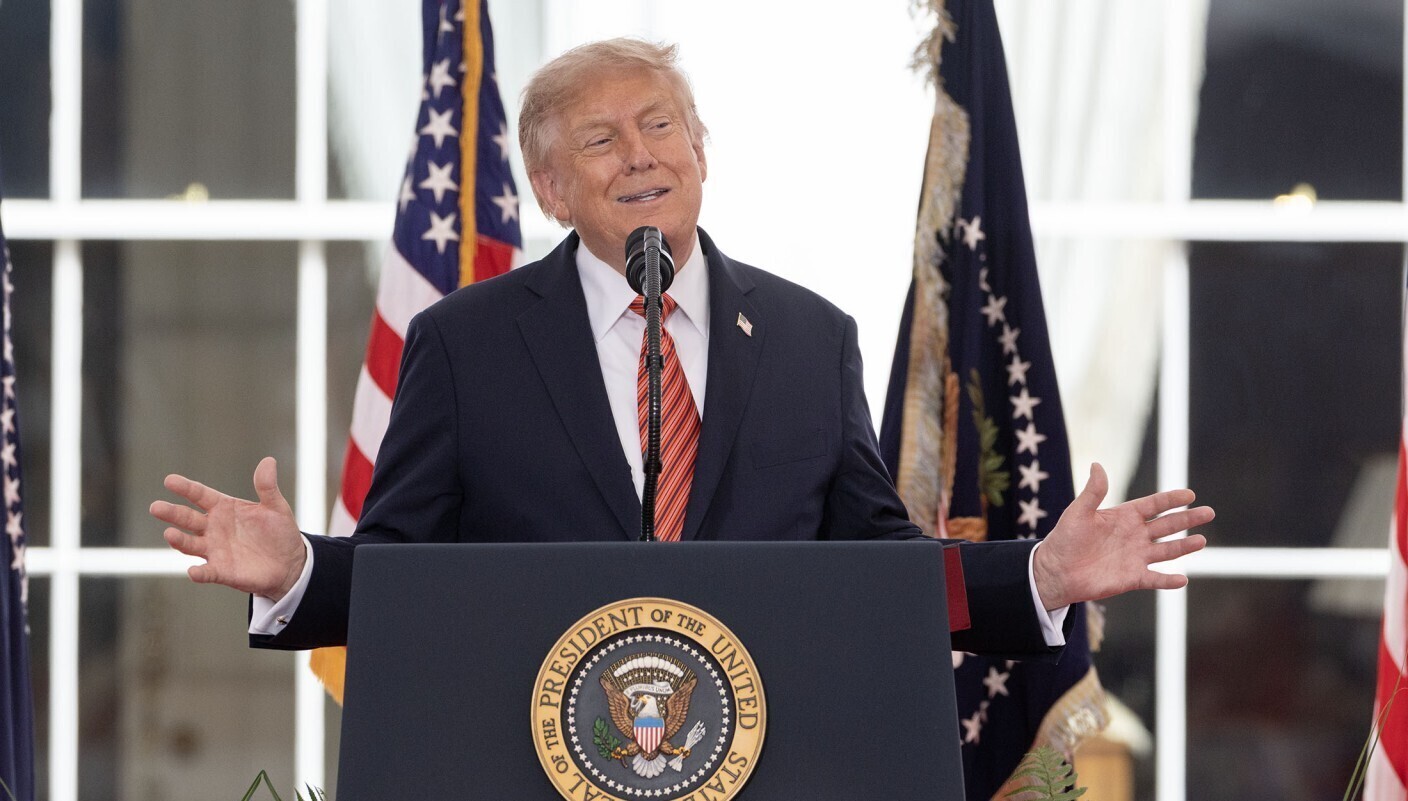
US president Donald Trump speaking in the US ambassador's residence in Dublin on Saturday. During a press conference Mr Trump said Irish unity was 'going to happen eventually, it may as well happen now'. Picture: Naoise Culhane/PA
The American sociologist, Robert K Merton, popularised the concept of the law of the unintended consequence, whereby certain outcomes are unanticipated, sometimes beneficial, but often harmful or contrary to the original intent.
It is not difficult to think of US president Donald Trump’s “united Ireland” comments on Saturday in this context, particularly given his colourful history of goofs, slip-ups, and regular descent into the political version of verbal diarrhoea at stage-managed rallies where the faithful rarely pay much attention to what he’s actually saying.
It is different in this part of the world, where politicians’ words are parsed and considered carefully, and also dissected by the media.
British prime minister Andy Burnham’s recent assertion that a vote on testing the waters about Irish unity was “off the table” caused heightened commentary on this island.
So too Trump’s assertion on Saturday that he “would love to see” Irish reunification.
Not only was this a massive break with traditional US policy on the matter, shattering Washington’s long-standing neutral position on Irish unity and the sensitivity of both British and Irish governments to such talk, but it almost seemed off the cuff and unprompted.
Read More
That is unlikely, given the president’s penchant for being a provocateur on almost every divisive issue he has faced. He likes being a contrarian and feels that is part of his raison d’etre.
His unprovoked opinion certainly caused ripples in Dublin and London. In the North, however, the main unionist reaction was humorous rather than vitriolic. One unionist wag was unusually phlegmatic: “Perhaps he’s not as orange as we thought he was.”
Having prefaced his remarks by saying “I don’t want to cause any trouble, but…” Trump then went on to stir up a hornets’ nest.
That retaining the North as a part of the UK remains an electric issue for the London government is something that did not appear to bother him. However, this is a matter for the people of Ireland to decide upon. In time, we may well do so, but it is certainly not a matter for the US president to discuss so blithely.
Trump frequently challenges the sovereignty and territorial integrity of other countries — often some of America’s biggest allies — but it is nevertheless accepted that he only does so in the full knowledge that such actions remove focus from issues he’d rather not talk about.
As he flew back to the US yesterday after what was effectively a hugely expensive (for Ireland) vanity visit to one of his golf properties, he once again left a furore in his wake.
There may have been huge relief in Dublin that this was the only controversy he caused.
As a supersized El Niño gathers in the Pacific Ocean, setting the world on a meteorologically uncertain near future, Ireland must prepare for what is expected to be an unusually mild and wet winter season.
The World Meteorological Organization has described this as an “exceptional event” and there is consensus among national meteorological agencies about its strength and impact.
It is expected that temperatures will be above normal across all land masses with variations from slight to severe depending on the region, while rainfall forecasts are much more varied, veering from drought in some places to significantly wetter weather and flooding in others.
The net effect is that Met Éireann is saying that it does not have the same certainty this year and into next year as it normally would, with such unpredictable weather patterns.
It is understandable that people living in Midleton and other flood-prone areas are increasingly anxious about what is ahead. A protest is planned in the East Cork town in the coming weeks about delays in the rollout of flood defences in the wake of Storm Babet three years ago.
Some 600 homes and 300 businesses were damaged during that event and the damage caused is estimated to be between €180m and €200m. The people of Enniscorthy in Co Wexford are similarly concerned after they were inundated by flooding last winter.
We know the effects of El Niño are coming, but are we prepared for it? It would seem not.
The student accommodation crisis across Irish university cities and towns is a hugely pressing issue and especially so at this time of the year when so many students are starting out in college or returning after their summer break.
We know we have a significant shortfall in purpose-built student accommodation, and the cost of renting houses, apartments or even traditional “digs” in other peoples’ homes has become prohibitively expensive for many.
Official figures show that, as of the end of 2025, cities such as Dublin, Cork, Galway, and Limerick face a combined
deficit of 38,900 bed spaces. Property shortages as well as high costs, added to ever-increasing student numbers, are part of the problem.
An Oireachtas committee was told last week that a lack of accommodation is the single biggest barrier to students accessing and completing higher education.
It also heard that the cost of what accommodation there is, has become unsustainable and is forcing students into insecure living arrangements such as couch surfing with friends or staying in hostels for weeks on end. For others, long commutes are the only option.
The Department of Higher Education said last week that its long-delayed student accommodation strategy has been deferred again and will not now be published until later this year.
Given that this is a matter of considerable urgency, that is simply not good enough.

CONNECT WITH US TODAY



Be the first to know the latest news and updates