Irish Examiner view: Ceuta crisis is part of the legacy of colonialism
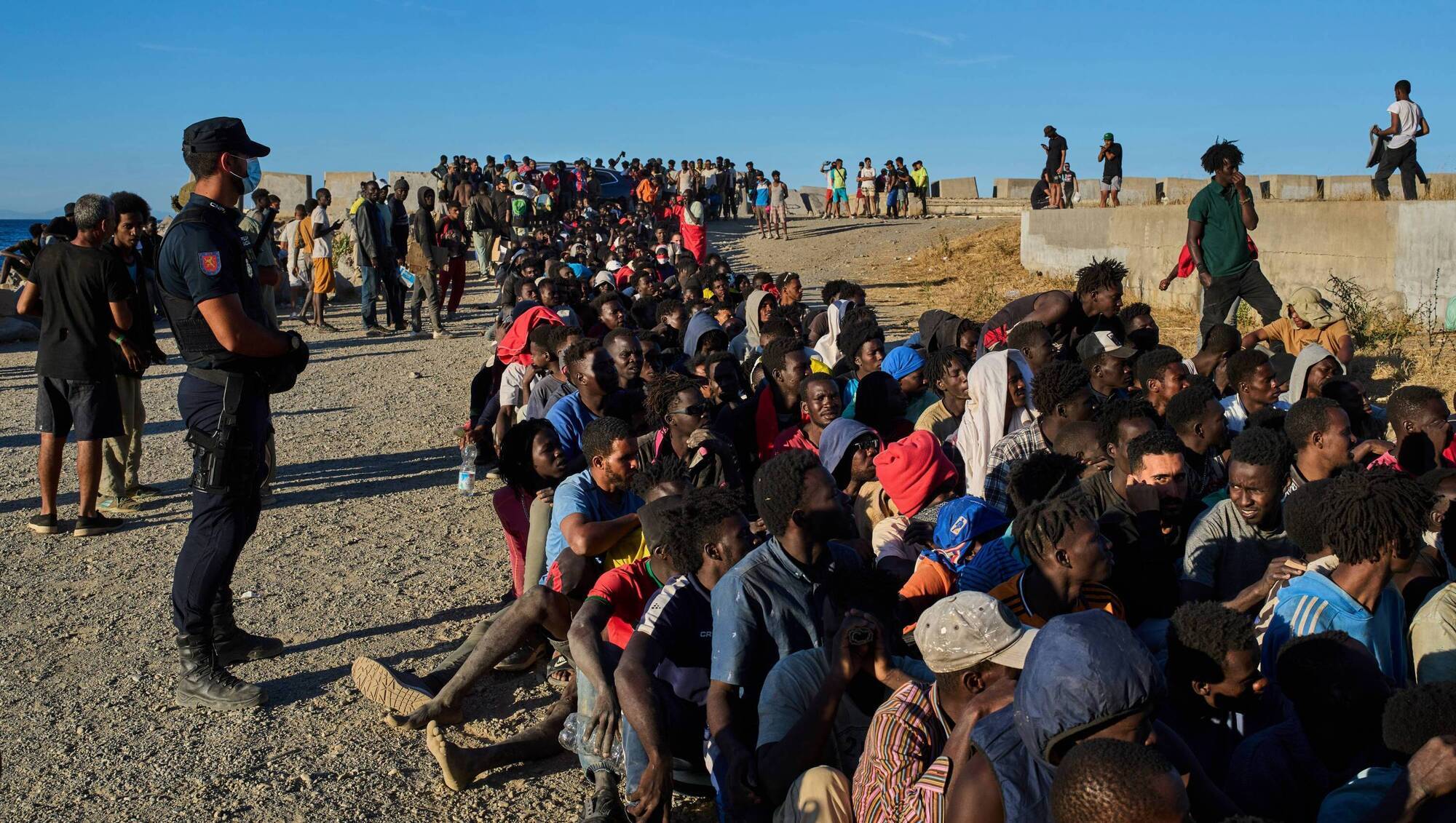
Migrants who crossed from Morocco into the Spanish territory of Ceuta line up for food distribution on a beach on Monday. Picture: Bernat Armangue/AP
The extraordinary scenes in Ceuta have introduced millions of people to a place they scarcely knew existed.
Attention has focused, understandably, on the migration crisis, the competing narratives surrounding it and the misinformation that inevitably accompanies such events.
Yet once the headlines fade, a more enduring question remains.
Why does Spain still possess sovereign territory on the African mainland? Ceuta and nearby Melilla occupy a unique place in modern geopolitics. They are Spanish cities, protected by the European Union’s external border, yet they sit on the northern coast of Morocco. Spain considers them an integral part of the Spanish state, with the same constitutional status as Madrid, Barcelona, or Seville.
Morocco, meanwhile, has never relinquished its claim to either territory, viewing them as the last vestiges of European colonialism on African soil.
Their existence is so unusual that it is rarely discussed until a crisis erupts. Then, suddenly, they become symbols of migration, border security, nationalism, or international law, depending on the political argument of the day.
Once the immediate controversy subsides, however, the broader historical questions are quietly set aside.
Europe has rightly spent decades encouraging nations elsewhere to confront the legacies of empire, disputed borders, and historical injustice. Yet Ceuta and Melilla remind us that colonial history is not simply something that happened overseas generations ago. In some places, it remains visible on the map today.
That does not mean the solution is straightforward. The overwhelming majority of residents in both cities identify as Spanish and have repeatedly expressed their wish to remain under Spanish sovereignty.
International law, democratic self-determination, historical claims, and territorial integrity do not always point neatly in the same direction. This is precisely why the issue has endured for so long.
Nor can the strategic importance of the enclaves be ignored. Sitting astride the entrance to the Mediterranean, Ceuta and Melilla occupy one of the world’s most significant maritime crossroads. They are economically valuable, militarily sensitive, and central to Spain’s management of migration into Europe. It is easy to see why Madrid is unwilling to contemplate any change to their status.
Yet crises such as this week’s migration surge expose how fragile these arrangements remain. Borders inherited from empire have an extraordinary capacity to shape contemporary politics long after the empires themselves have disappeared. They become pressure points through which migration, diplomacy, and domestic politics intersect.
The debate over Ceuta should therefore extend beyond the latest headlines or social media arguments. It should prompt Europeans to ask whether they fully understand the historical frontiers that continue to define their continent’s relationship with Africa.
For, while Europe often speaks of colonialism as history, Ceuta and Melilla demonstrate that history is sometimes still very much a matter of geography.
The sight of 112 coffins laid side by side has become another image from Gaza that risks being absorbed into the endless cycle of conflict, outrage, and exhaustion.
The remains belonged to members of two extended families killed in an Israeli airstrike in 2023, only now recovered from beneath the rubble and finally afforded the dignity of burial.
There is a danger in prolonged conflicts that the exceptional becomes ordinary. The statistics continue to climb, the images become more familiar and the world, almost without noticing, begins to treat the intolerable as inevitable. Yet no society should ever become accustomed to the sight of entire families being wiped from existence, nor to the reality that loved ones can remain buried beneath collapsed buildings for years before they are found.
This is not simply a question for Israel, whose military actions continue to draw intense international scrutiny and condemnation. It is also a question for the wider international community. What diplomatic pressure remains to be exerted? What legal mechanisms remain to be pursued? What humanitarian protections can still be strengthened?
These are not abstract questions but urgent ones, because every day that passes without a durable political solution carries the risk of more funerals, more grieving families, and more irreversible loss.
History will judge not only those who prosecuted this war, but those who watched it unfold. Future generations will ask what was done to halt the suffering once its scale was understood. That is why these images matter. They resist the numbing effect of repetition. They remind us that behind every casualty figure lies a name, a family, and a future that has been extinguished.
Some images should never become normal. Gaza continues to produce them. The world’s responsibility is to ensure they do not simply become routine.
Ireland has long regarded plentiful rainfall as one of its few certainties. It has shaped everything from our farming practices to our water infrastructure and our assumptions about the landscape itself. But the weather statistics from July should give us pause.
The month was the driest July on record, continuing a pattern of unusually warm and dry conditions that has become increasingly difficult to dismiss as an anomaly. The debate can no longer stop at whether climate change is happening. That question has been answered by the evidence. The more pressing question is whether Ireland is adapting quickly enough to the climate it is already experiencing.
Successive governments have spoken at length about emissions targets, renewable energy, and long-term climate ambitions. These remain essential. But adaptation deserves equal urgency. Is our water network resilient enough to withstand prolonged dry spells? Are we investing sufficiently in wildfire prevention, forestry management, and drought planning? Can our agricultural sector adapt to weather patterns that are becoming less predictable?
Climate policy cannot simply be about preventing future change. It must also be about preparing for the changes already under way. Ireland cannot continue planning for yesterday’s climate while living through tomorrow’s weather.

CONNECT WITH US TODAY



Be the first to know the latest news and updates