Irish Examiner view: If done right, alerts could mean great savings
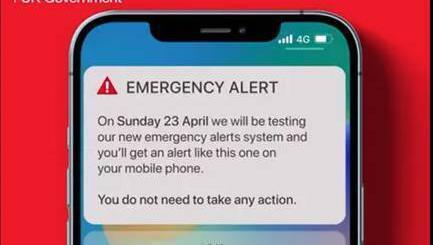
An example of an emergency text of the type used by countries around the world. Ireland is expected to launch such an emergency alert system. File picture
The climate crisis makes its presence felt in many different ways, and a proposal being brought to Cabinet this week is yet another example of its impact.
As reported here by Paul Hosford, communications minister Patrick O’Donovan is to seek approval to procure the services to establish a cell broadcast public warning system. It will be managed by the Office of Emergency Planning, and will be used to notify the public of extreme weather events.
Given the severity of some of our recent storms, this looks a sensible measure. Warning systems such as the one proposed are specialised and focused, providing localised alerts which are based on mast locations and not affected by network capacity or congestion, thus avoiding the danger of outages or other network challenges.
Such systems are used in many other countries. Readers may recall that, last September, a nationwide test of Britain’s system brought the women’s Rugby World Cup match between Ireland and New Zealand in Brighton to a temporary halt. The British warning system was used successfully to alert people to the threat posed by Storm Éowyn in January 2025, while a more localised warning was issued to residents of Plymouth when an unexploded bomb was found in the area last year.
Read More
While one hopes that bomb warnings will not have to be issued here, it is worth noting that this new system comes after strong criticism of Met Éireann earlier this year for failing to alert Wexford residents of a flood risk. Housing minister James Browne said Met Éireann was “guarding” information after his home town of Enniscorthy was flooded during Storm Chandra.
On that basis, this new warning system is welcome — though with the usual caveats about runaway costs. Our past experience with overruns — in both time and money — when it comes to national facilities and services means oversight is critically important here. One hopes the Office of Emergency Planning will be alert to that danger.
Last week, Ireland received disappointing news about climate targets when an Environmental Protection Agency (EPA) report suggested we would not hit our European and domestic emissions targets for 2030 — and by a considerable margin at that.
As a result, it is incumbent on all of us to improve when it comes to combating climate change both collectively and individually. In that context, the government plan to encourage drivers to switch to electric vehicles is welcome.
Transport minister Darragh O’Brien briefed the Cabinet this week on the new scheme — those with petrol and diesel cars over 13 years old will be eligible for grants of €8,500 to purchase a new electric vehicle: €5,000 for scrappage and a further €3,500 towards a new EV. It will operate on a first-come, first-served basis until the funds allocated, some €10m, run out.
An existing scheme provides a €3,500 grant to those purchasing an EV, but the new €8,500 grant scheme is different — it is intended to focus on rural areas specifically, for instance, on the basis that those in such areas are more reliant on cars because of the lack of public transport.
However, this logic is open to challenge immediately. If there were more public transport options in such rural areas it would be far better for the environment: A widespread, dependable bus service would remove many cars from the roads. The relatively high cost of EVs in comparison to petrol and diesel cars is another disincentive to purchasers.
However, progress is being made in this sector. EVs are becoming cheaper — it is surely significant that the threshold for qualifying for the existing €3,500 EV grant is to fall from €60,000 to €50,000 this year.
Irish drivers are adopting EVs in larger numbers as well. The national climate action plan targeted a total of 195,000 EVs on Irish roads by the end of 2025, and that target was reached two months ahead of schedule.
If this scrappage scheme maintains or improves on those figures then it will be well worthwhile.
The Junior, Leaving, and Leaving Certificate Applied examinations began yesterday with a record 146,000 students facing English, the traditional opener.
It is a long-standing tradition to wish those sitting in exam halls all over the country the very best, particularly those who are sitting the Leaving Certificate and edging ever closer to the end of their school days. We echo those wishes and hope the experience is not too trying for the students themselves and for their families and loved ones.
It is important for those students to rest well for these tests, to get some fresh air and relax when they can, and to eat well so that they are properly fuelled for the exams.
The latter is not boilerplate encouragement, either, given the very real problem with hunger in our schools.
A pilot project which ran last summer highlighted the importance of providing meals during the school holidays, and social protection minister Dara Calleary is now looking to extend that scheme. It is expected to support more than 42,000 children at high risk of educational disadvantage.
At a time of year when we encourage teenagers to do their best, it is heartbreaking to consider that there are so many children deprived of food. Talk of schoolchildren reaching their full potential sounds hollow when some of those children simply do not have enough to eat.
CONNECT WITH US TODAY



Be the first to know the latest news and updates