Irish Examiner view: No red lines left to cross 
Irish journalism, in particular, should not look away from this crime
Irish Examiner view: No red lines left to cross 

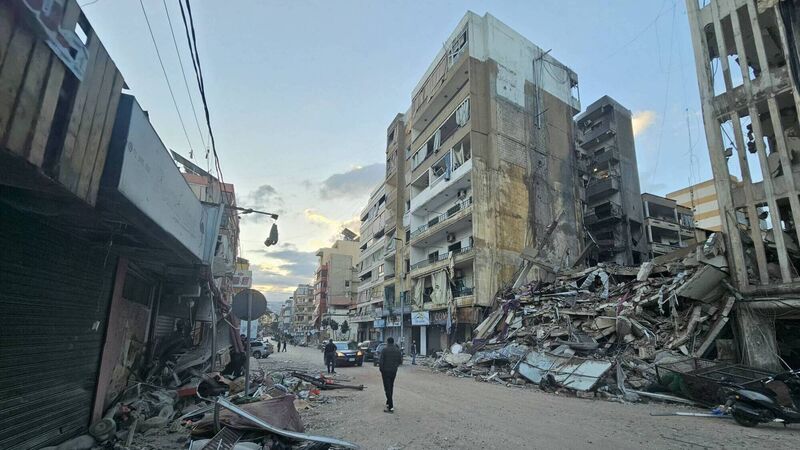
Amal Khalil’s death is not just another entry in a grim tally. She is reported to be the ninth journalist killed in Lebanon this year. File picture: Getty/AFP

The killing of Lebanese journalist Amal Khalil in southern Lebanon on Wednesday should have been a red line. Instead, it feels like just another line crossed and forgotten. 

Khalil, a reporter for Al-Akhbar, was killed in an Israeli airstrike while covering the conflict, which is currently subject to a supposed ceasefire. She had reportedly received threats beforehand. She was struck once, sought shelter, and then struck again. Rescue teams were delayed for hours amid reported fire and obstruction.

None of this happened in a vacuum. It happened in a war where the list of the dead already includes women, children, medics, and aid workers. Schools and hospitals have been hit. Churches and mosques damaged. Peacekeepers targeted. And now, again, a journalist. How many categories of the protected must be erased before the words “red line” regain meaning?

The details matter. Reports describe what appears to have been a “double-tap” strike — an initial attack followed by a second after people sought safety. This tactic, if confirmed, raises grave questions under international humanitarian law. It also raises a simpler moral question: What exactly is left that is off-limits?

The Committee to Protect Journalists did not mince its words. In its response, it condemned the attack and the obstruction of rescue efforts, calling for urgent action and accountability. The organisation had been in contact with Khalil after the first strike; she was alive, trapped, waiting.

Waiting for help that did not come in time. This is not just a story about Lebanon and Israel, it is a test of journalism itself. If the killing of a journalist, in the course of her work, amid prior threats, in circumstances that demand urgent investigation, does not trigger unified outrage from the global press, what will?

There is a tendency, now familiar, to parse, to qualify, to contextualise. To ask what affiliations a journalist had, what they believed, who they worked for. As though any of that places them outside the protections owed to those who document war.

It does not. Journalists are not legitimate targets. Not when they are sympathetic, not when they are critical, not when they are inconvenient. And yet, the reaction has been muted. Where are the front pages? Where are the editorials? Where is the collective voice of a profession that insists it matters?

Irish journalism, in particular, should not look away. This is a country that prides itself on a tradition of independent reporting, on speaking uncomfortable truths, on understanding the value of international law. Because if the press cannot stand up when one of its own is killed — when the act strikes at the very possibility of bearing witness — then its claims to solidarity, to principle, to purpose, begin to ring hollow.

Khalil’s death is not just another entry in a grim tally. She is reported to be the ninth journalist killed in Lebanon this year. At some point, repetition becomes normalisation. And normalisation is how red lines disappear entirely. If this is not the moment to speak, then when?

Prevention now saves later

There is a quiet but potentially transformative shift underway in how we think about vaccines. No longer confined to childhood illnesses or seasonal flu, emerging evidence suggests they may play a far broader role in how we age — and how well.

Irish health experts have pointed to growing data that vaccines can reduce the risk of dementia, lower the incidence of stroke, and improve cardiovascular health. Some studies even suggest they may contribute to healthier ageing overall.

This is not marginal science. It is vaccination reframed as preventative medicine in its most expansive sense — not just protection against infection, but against long-term decline.

And yet, in Ireland, access to some of these vaccines remains determined not by need, but by means.

The recombinant shingles vaccine — one of the most discussed in this context — is not routinely provided by the State. Instead, it is available privately at a cost of roughly €450 to €487 for the required two-dose course. That price places it out of reach for many older people — the very cohort most likely to benefit.

This creates a striking contradiction. On the one hand, the State recognises the importance of preventative healthcare. On the other, it leaves a potentially powerful preventative tool sitting behind a paywall.

It is difficult to reconcile that gap. The argument against state support has, until now, largely been framed in terms of cost-effectiveness. Public health budgets are finite, and not every intervention can be funded. But that calculation may be changing. If vaccination can reduce dementia risk by even a modest margin, the long-term savings — in medical costs, in social care, in human suffering — could be substantial. The same is true for stroke and heart disease.

Prevention, as ever, is cheaper than cure.

Public money, private party

The Ryder Cup coming to Ireland should be a celebration. But at €499 a day, it risks becoming something else entirely: A spectacle priced beyond the reach of the public it claims to represent. This is not just inflation at work. 

Ticket prices have nearly doubled from the last European edition in Rome, where a day cost €260.

Organisers speak of “global sporting events” and enhanced experiences. But there is a word missing from that pitch: Access. Because €499 is not just a number. It is a barrier. 

It tells ordinary Irish fans that this is no longer their event. And this matters, because the State is not a bystander. Hosting an event of this scale involves public investment, infrastructure, and political backing.

When the public helps pay, the public should not be priced out. What emerges is something less like a sporting occasion and more like a curated experience for those who can afford it — a wealth pageant dressed up as golf.

So the question is simple: Is this really the best we can do? Because if one of the biggest sporting events ever held on this island becomes inaccessible to most who live here, then something essential has been lost. This is no longer just about golf. It is about what kind of country we want to be.

x

More in this section

Revoiced

Newsletter

Sign up to the best reads of the week from irishexaminer.com selected just for you.

Cookie Policy Privacy Policy Brand Safety FAQ Help Contact Us Terms and Conditions

© Examiner Echo Group Limited