Irish Examiner view: St Patrick’s Day visit may be a poisoned chalice
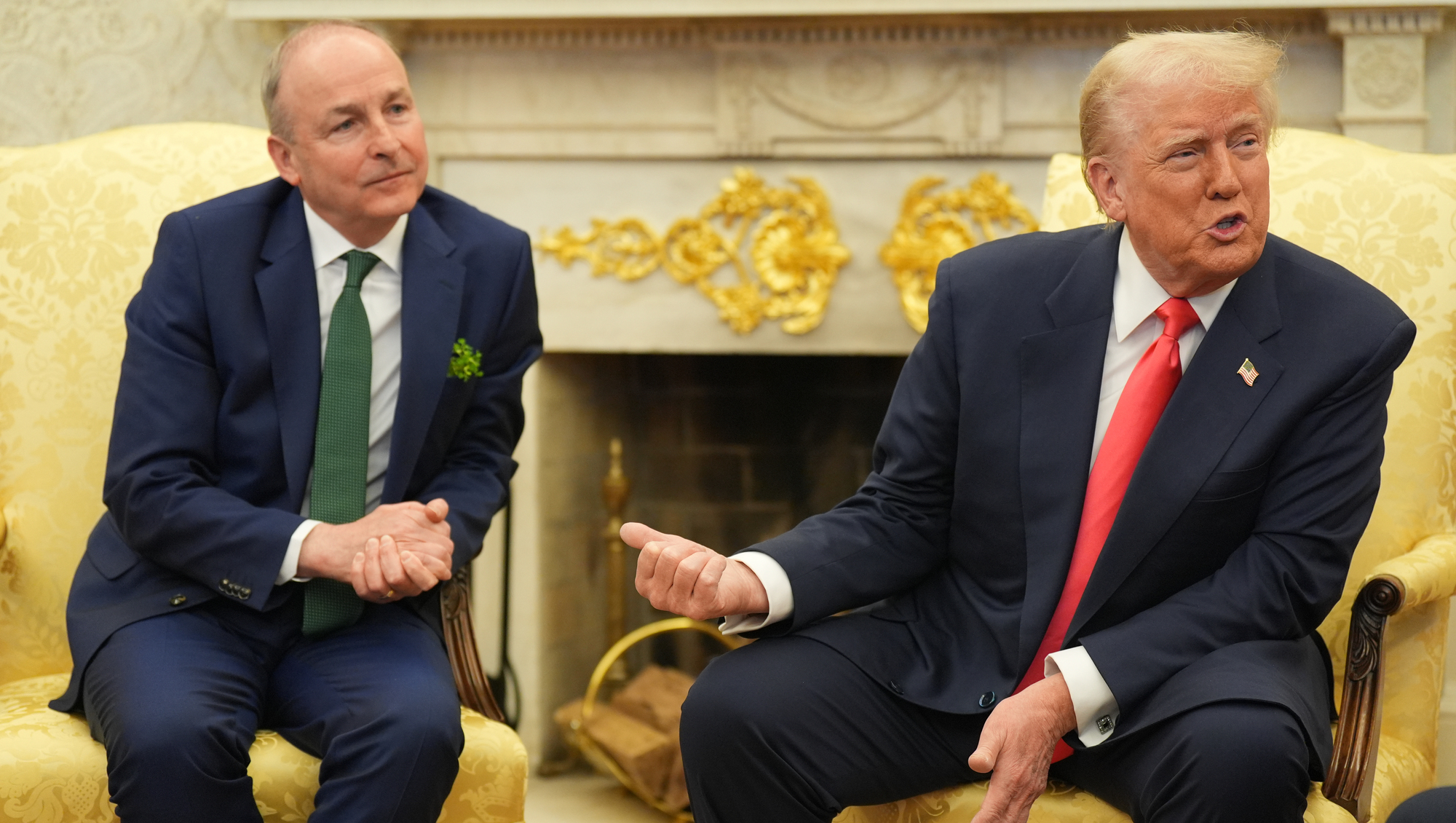
Taoiseach Micheal Martin with US President Donald Trump. File picture
The conflict in the Middle East continues to escalate, though the geographical description may not be strictly accurate.
On Wednesday, we learned that the US claimed to have sunk an Iranian naval craft off the coast of Sri Lanka, for instance.
Already US president Donald Trump is viewing relationships with other countries through the prism of this war.
Because Britain would not at first allow the US to use some of its air bases to launch strikes against Iran, Mr Trump attacked British prime minister Keir Starmer earlier this week.
“It would have been much more convenient landing there as opposed to flying many extra hours. So we are very surprised,” said Mr Trump.
“This is not Winston Churchill that we’re dealing with.”
Mr Starmer has been measured in his response, but he is not the only European leader facing criticism from the White House.
Having described Spain as “terrible” this week because that country has also refused to let the US use air bases, Mr Trump has threatened to impose a full trade embargo on Spain in retaliation.
In that context, it was perhaps understandable that German chancellor Friedrich Merz looked uncomfortable during his White House visit this week — his host was criticising some of Germany’s closest allies in Europe, though Mr Merz claimed later that he had defended Spain and Britain in private discussions with Mr Trump.
This is a concerning preamble to another Washington visit in a couple of weeks — the Taoiseach’s annual St Patrick’s Day trip to the White House.
Already a tricky proposition, Mr Trump’s volatility and the war against Iran make it an even more complicated assignment, as strategising to deal with the president’s comments is very difficult when he is capable of saying almost anything.
That is without considering the calculated insult last year, when the White House invited Conor McGregor to meet Mr Trump after the Taoiseach’s visit.
Abandoning the practice of Irish leaders visiting the White House would be a considerable own goal, as that privilege is the envy of many nations.
Uncertainty about the Taoiseach’s reception makes it something of a poisoned chalice, however.
The tentacles of the housing crisis can be seen everywhere — from the traffic jams and parking issues near colleges because students cannot find accommodation, to the difficulties firms experience in retaining staff in our larger towns and cities.
Is an existential threat to the Irish language another aspect of this problem?
This week, a protest took place outside Leinster House as several different pressure groups, such as Tintéain and Banú, came together to raise awareness about housing challenges in the Gaeltachtaí.
One obvious complication is the main industry in many of our Gaeltacht areas, particularly those in relatively remote coastal locations: Tourism often provides significant employment in those areas, but that means short-term lets distort the housing market.
One of the protesters at Leinster House stated that the rate of growth in Airbnbs in Gaeltacht areas was at twice the national average over the past six years, for instance, and offered stark statistics to support that claim: “There’s 112 places in and around West Kerry available on Airbnb, and there’s zero to rent on daft.ie.”

Clearly if housing stock is not available either to buy, or to rent long-term, then those who have grown up in Gaeltachtaí will be unable to settle in those areas.
If they have to leave, then that will have a predictable impact on the number of Irish speakers in general, and in those Gaeltacht areas specifically.
It was notable that Tintéain, one of the groups which organised the protest, made specific recommendations to deal with this issue — from bespoke strategies and housing and planning guidelines to reinstating a grant scheme to support building or renovating buildings in the Gaeltacht.
These are laudable aims which should be within the capabilities of the Government.
The fact that Gaeltacht areas have long been marginalised and under-resourced should strengthen consideration of these recommendations.
Readers with a taste for surreal humour will surely recall with pleasure Flann O’Brien’s .
If he were still with us, he would surely have given a stirring account of a recent case involving a bicycle.
Surreal though it may be, however, the case is not in the least bit humorous.
During the pandemic, a garda in a rural Garda station loaned an isolated farmer a bicycle from that station’s ‘lost and found’ department, but instead of being praised for exercising common sense, the officer was investigated by the National Bureau of Criminal Investigation, with his home raided one morning while his family was still in bed.
He was suspended from duty for three years and a file was sent to the DPP, which directed not to press charges.
The garda was recently awarded over €250,000 in damages, having taken a personal injury claim against the Garda commissioner, the minister for justice, and the attorney general, which was settled in the High Court.
It is difficult to do justice to the overreaction involved in this investigation; to the baffling waste of time, energy, and resources; or to the damage done to a garda with almost three decades of unblemished service.
Readers will be aware of difficulties across the public service with recruitment and retention of staff.
Stories like this help explain those difficulties.

CONNECT WITH US TODAY



Be the first to know the latest news and updates