Irish Examiner view: Parents' heartbreaking plea for their daughter's care when they are no longer there
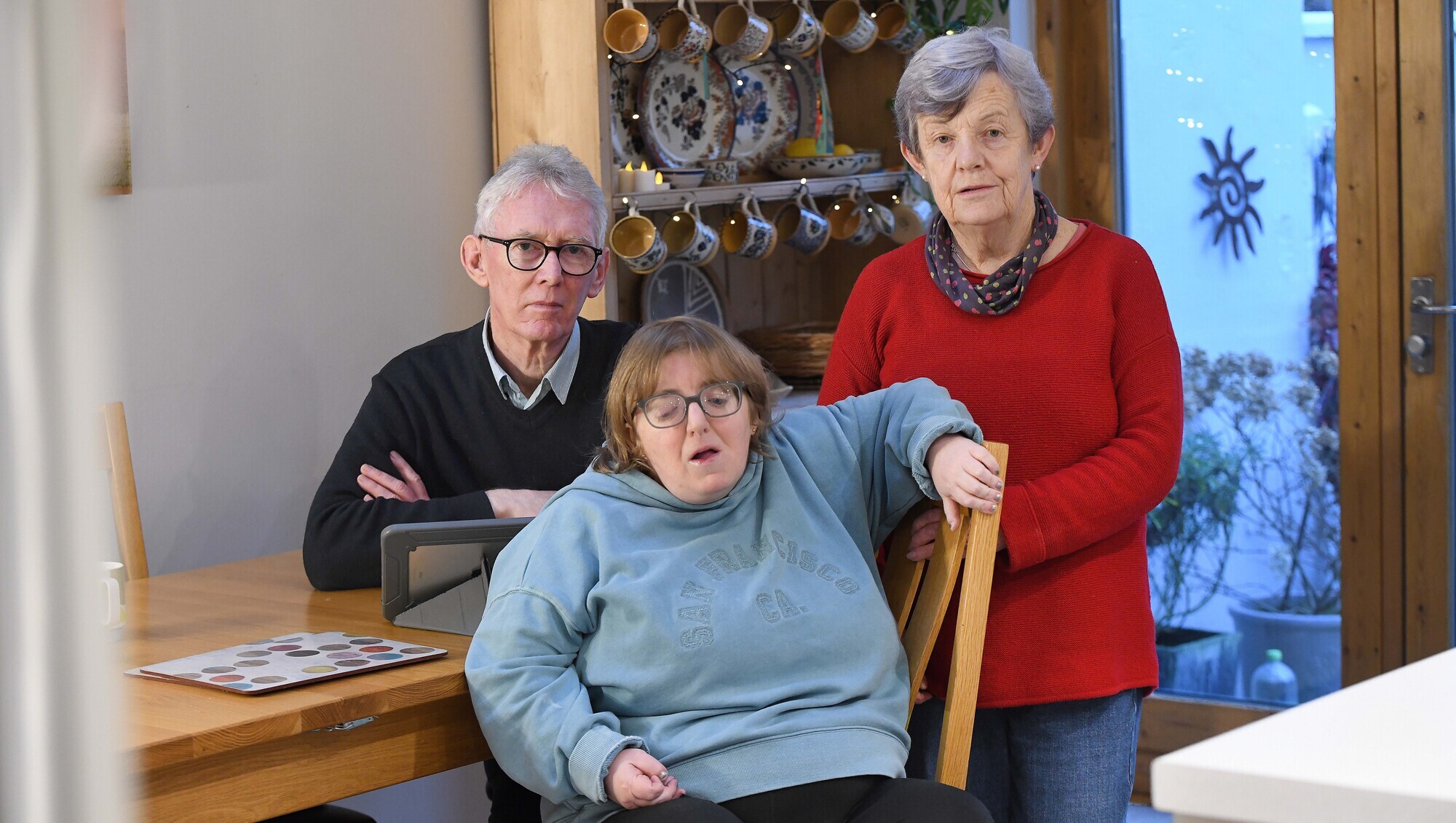
Tony and Susan Murray and their 42-year-old daughter Aoife. In the 'Irish Examiner' today (print and online) you can read why Tony has set up Before We Die which aims to ensure that plans are in place for the care of people like Aoife whose parents may soon not be in a position to continue to care for them. Picture: Moya Nolan
Our report in Monday's Irish Examiner, in print and online, on the provision of services for people with intellectual disabilities makes for uncomfortable reading.
It paints a picture of a system that is failing thousands of families who are living with the constant fear of how their loved ones will be cared for when they are no longer able to provide that care.
At least 2,000 adults with intellectual disabilities are living with parents or other primary carers who are over the age of 70. An estimated 500 of the carers are in their 80s or older.
These are families living with uncertainty about what help they will get when unexpected emergencies arise.
Even worse must be the grinding worry of not knowing what will happen when the foreseeable event of their own failing health or death comes to pass.
They are experiencing these fears at a time when public spending on residential services has soared. The HSE’s budget for disability residential services rose by €500m, a 32% jump, since 2024. The increased funding is not the problem — it is much needed, particularly as it follows years of underinvestment. The issue is how that money is being used.
A growing portion is going to for-profit companies, often for emergency accommodation and this raises many questions.
Is this growing reliance on commercial providers some part of an intentional plan for the increased privatisation of the sector? If so, how was this decision arrived at, and who made it? In addition, what safeguards have been put in place to ensure appropriate standards are set and maintained for the care of vulnerable people?
We have been down this privatisation road before. Many of our nursing homes are run as for-profit ventures and, while a large number provide excellent care, commercial pressures have brought about some unhappy outcomes. Rising costs, staff shortages, and funding shortfalls cannot be sustained by any business. Several thousand beds have been lost through nursing-home closures, forcing many older people into homes far from their communities. And there is the ever-present fear that when costs are cut, standards slip.
We need to learn from those experiences.
Today’s report describes a system that appears to be in constant emergency mode. Too many people are at crisis point before they get the support they need. Emergency placements result in people having to move far from their families and communities, with no indication of when or if they will be moved closer to home. Carers are forced to add lobbying for better services to their already heavy burden.
What is required now is a coherent overarching strategy for the provision of services to people with intellectual disabilities. The strategy should be grounded on a rigorous assessment of current and projected needs in all communities, and on engagement with families, and the services provided accordingly.
It is difficult to disagree with Liam Quaide, the Social Democrats’ spokesperson on disabilities, when he says that the current approach appears “haphazard and disjointed”.
This has to change. A huge sum of public money — €3.8bn is provided for disabilities services in 2026 — is being spent.
For this, we expect that people with intellectual disabilities, and their families, should be able to live with the dignity, support, and security to which they are entitled.
The bank holiday weekend provided a welcome break at the end of what, for many, is the longest, dreariest month of the year. Poor weather, the return to work and school routines after Christmas, and the necessity of dealing with bills racked up in December make January something of an ordeal.
No wonder the St Brigid’s Day holiday has been so warmly embraced. The day was chosen as a public holiday because of its roots in Imbolc, the Celtic spring festival associated with the goddess Brigid, and later, St Brigid.
With the revival of one aspect of our heritage, it is a good time to reflect on the current revival of another important aspect — that of the Irish language.
One cannot fail to notice the increased use of the language all around us — in popular culture, on social media, in public spaces and workplaces.
Where once Irish was seldom heard beyond the Gaeltacht and the school gates, now we have Irish-language cafes, pop-up Gaeltachts, and Irish-conversation sessions in libraries and community centres around the country. It is not uncommon to hear snatches of conversation ‘as Gaeilge’ on the street, on the bus, or in shops.
Many young people are embracing the language with an enthusiasm and joy alien to previous generations who may have had a more complicated relationship with Irish. It seems that it has become cool to speak Irish — witness the success of the bilingual Belfast hip-hop group Kneecap, the proliferation of social media content creators sharing their love of the language, and a significant increase in the number of students doing summer courses in the Gaeltacht.
So why this resurgence of the language? Almost certainly, a sense of confidence among younger generations about their place in the world, and an ongoing conversation about what it means to be Irish offer a partial explanation.
But it is also likely that policy decisions relating to the teaching and use of the language are bearing fruit.
A paper prepared for the business organisation, Ibec, in 2024 identified three distinct drivers of the trend. The first is the dramatic growth in Gaelscoileanna — in 1991, just under 16,000 children were attending these schools but, by 2023, that figure had risen to almost 58,000 children.
The change in the teaching of Irish in English-medium schools, with a greater emphasis on spoken Irish, is also credited with increasing enthusiasm.
The third driver, clearly unrelated to any State policy, was the launch of Irish courses on Duolingo, the language-learning app. Within two years of the 2014 launch, more than 2m people were learning Irish with the app, a number that had risen to 5m a few years later.
Trends come and go, but there is reason to be confident that the increased use of our native language has a solid foundation.
CONNECT WITH US TODAY



Be the first to know the latest news and updates