Irish Examiner view: Paralympics finale brings curtain down on six great weeks for Team Ireland
Ireland’s team of 35 paralympians should be proud of their part in a memorable summer of sporting endeavour in Paris
Irish Examiner view: Paralympics finale brings curtain down on six great weeks for Team Ireland

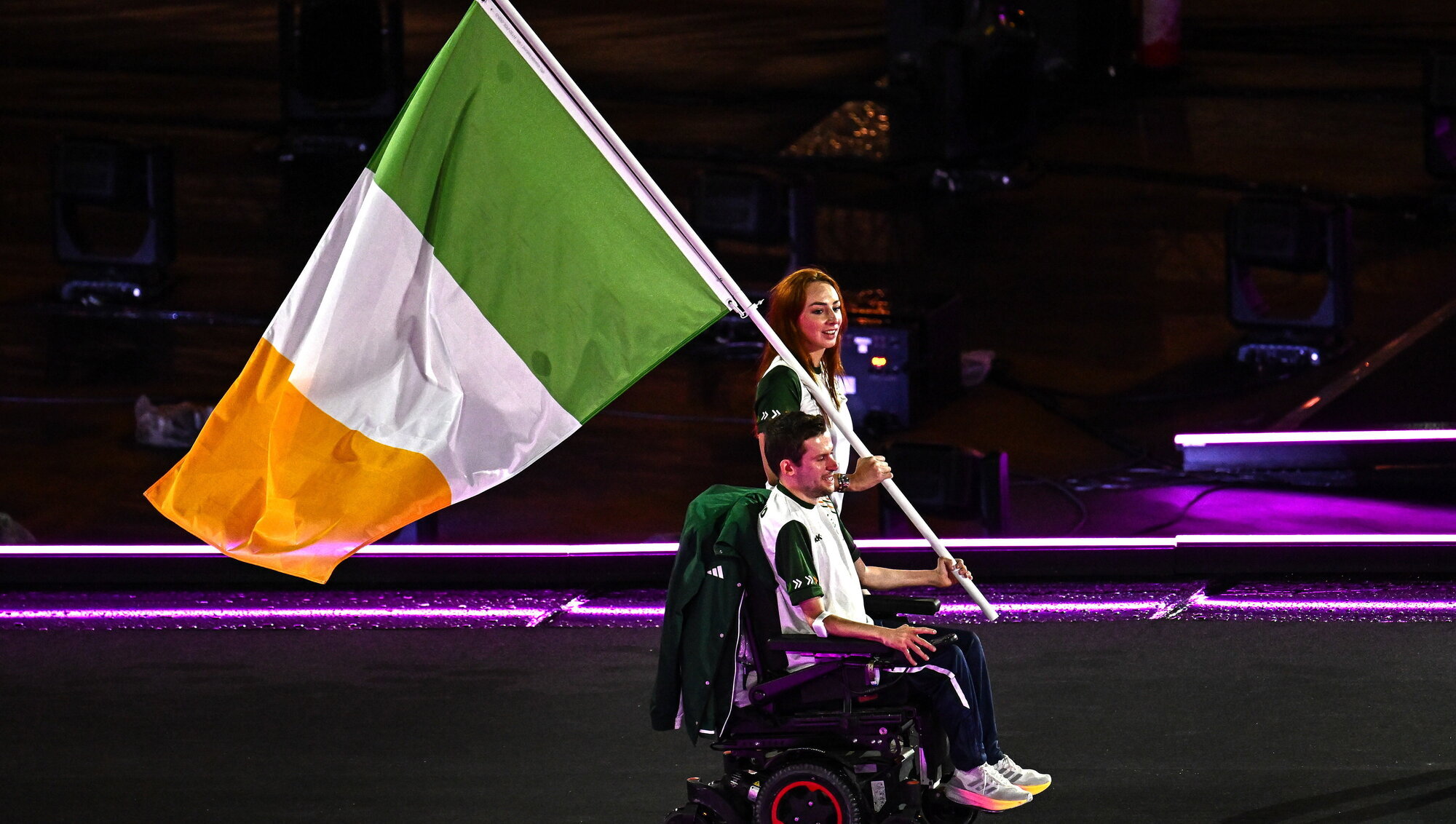
Team Ireland flagbearers Ellen Keane and Michael Murphy carrying the tricolour during the closing ceremony of the Paris 2024 Paralympic Games.  Picture: Harry Murphy/Sportsfile

As the lights went down on the closing ceremony of the 2024 Paralympics at the Stade de France, bringing to a conclusion a glorious and memorable six weeks of sporting endeavour in Paris, Ireland’s team of 35 can reflect on a noble effort.

Gold, silver, and bronze were brought home in cycling, swimming, and athletics. The fascinating battle between Katie-George Dunlevy and Linda Kelly and the British pair, Sophie Unwin and Jenny Holl — which came down to a sprint finish after a 100km road race — proved to be one of the epic struggles of this summer. 

The two medals won by sprinter Orla Comerford and swimmer Róisín Ní Ríain within minutes of each other means that they will be eternally paired in the public imagination as the “Bronze Sisters”. 

Overall, this seemed to be a happier occasion for Irish athletes than the stressful, pandemic-influenced Tokyo games, a view acknowledged by some competitors. Their TV appeal has also grown, much to the satisfaction of Channel 4 which has worked hard to spread the inclusiveness of coverage.

Channel 4’s streaming views is double that achieved across the same period of the Tokyo 2020 Paralympic Games — up 97%. The broadcaster has achieved its biggest ever share of 16 to 34-year-olds for the competition. Total viewer minutes across all services have topped 4.5bn, compared to circa 3bn for Tokyo three years ago. TikTok and Instagram have proved particularly popular with more than 560,000 views alone for presenter Rose Ayling-Ellis’s explanation of how she presents live sport as a deaf person.

This is all good news for para sports because sponsorship and funding follow audience. Given that the next competition is in Los Angeles in 2028 the trajectory is likely to continue upwards.

On the eve of the opening, we commented on the inspiring narratives which accompanied the arrival of more than 4,000 athletes in the City of Light to compete in 549 medal events.

Among the most eye-catching back stories was that of Fadi Aldeeb, a 38-year-old wheelchair basketball player. He was the only athlete born in Gaza to compete in either the Olympics — for which Palestine sent an eight-strong team — or Paralympics. Many of his compatriots have faced formidable obstructions to training and travel. And survival.

Aldeeb received a request to return to the shot put — an event in which he had not competed for years — just one month before the Paralympics opened.

“When they asked me, of course I said yes because this is my country,” he said. “This experience isn’t about me, I am the voice of millions of people, to show their goals, their hopes and their successes. This is my opportunity to show the world who we are.” Aldeeb has lost 17 members of his family, including his brother and his nephew, in the conflict. His own disability stems from being shot in the spine in 2001 during the uprising known as the second intifada.

He finished 10th. There is a cliché in sport that it is not about winning, but about taking part. In the case of the only person from Gaza representing Palestine, we can see just how true that statement is.

Finding the right word

Holding back the surging tide of misused language may be akin to the parable of the little Dutch boy sticking his finger into the leaking dam.

But, as the happy end to that tale indicates, futility is not an argument against doing the right thing. A new book by the author Simon Heffer tries to stanch the flow of an increasingly homogenous language whose motherlode runs through digital communications and social media.

In Ireland, we have long been aware that altering the roots of local language is a form of cultural colonialism. One of Brian Friel’s most famous plays, Translations, mines that seam with profound insight. It has been reinterpreted in myriad locations where identity matters — Belarus, Ukraine, Catalunya, Aotearoa/New Zealand — and is regarded as a seminal work.

The darkly comic film Kneecap, about a hip-hop group performing in Irish, makes a clear connection between retaining original language and a nation’s sense of itself.

“Every word of Irish spoken is a bullet fired for Irish freedom,” says the paramilitary Arló Ó Cairealláin, played by Michael Fassbender.

Readers will have their own lists of overused, everywhere-all-at-once phrases and words that have become a deadening lingua franca with all the diversity-destroying charms of a crown-of-thorns starfish. 

Heffer has his own bugbears: Back in the day; calling out; doubling down; stepping up to the plate; thinking outside the box; different than; enormity; I’m good; starting over; obligated. It’s a long list, and you may find some of your favourite dislikes on there.

Thankfully, we appear to have passed through the period of peak “perfect storm” where every conceivable setback could be explained by a catastrophic combination of circumstances beyond the control of mortal people. 

It never was true, although Google records its use more than 24bn times in 10 years. To some, railing against such solecisms will be the observations of a pedant. To others, they indicate an inability to think creatively and with originality. We must each decide what we are the next time we are tempted to slip in a cliché.

Tiktok prank 

On Saturday, we wondered why more influencers were not imbued with a crusading spirit to help their fellow citizens caught in the consumer squeeze. “Where are the equivalents of Ralph Nader and Erin Brockovich?” we asked.

Now we know. The list of locations that have been overwhelmed by the Instagram and TikTok generation is long, but novelty is difficult to find. When the world is sated with pictures of the Grand Canal in Venice, or Santorini in the Greek Cyclades, or Bixby Creek Bridge on the Big Sur, then any self-respecting influencer has to up their game.

And how about taking the photo op somewhere few people know about and are unlikely to want to visit? Genius!

Presumably the TikTokkers who used ladders and ropes to break into the abandoned Cork Prison for a video stunt felt the enterprise was worthwhile. It was, said one of them on social media, “the best abandoned building I was ever in”.

Videos showed paint peeling from walls while items scattered around the cell-block corridors included food wrappers and clothing. “Amazing”, said another of the thrill seekers.

People’s pleasure thresholds can vary. But this sounds like one experience that won’t make it onto the bucket list.

More in this section

Revoiced

Newsletter

Sign up to the best reads of the week from irishexaminer.com selected just for you.

Cookie Policy Privacy Policy Brand Safety FAQ Help Contact Us Terms and Conditions

© Examiner Echo Group Limited