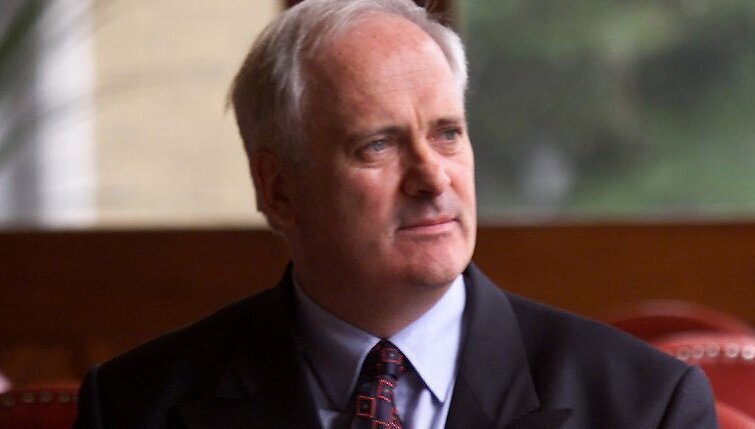
In his DĂĄil speech congratulating Bertie Ahern on becoming taoiseach in 1997, John Bruton pointed to the economic boom which the new government would inherit from his administration.
Bruton, who died on Tuesday at the age of 76, would have been forgiven a few regrets that he would not remain as taoiseach when the Celtic Tiger began to roar at the turn of the century.
A lengthy political career will have helped him to put that disappointment in context, however.Â
When he was first elected to the DĂĄil for Fine Gael in 1969, representing Meath, Neil Armstrong had not yet landed on the moon; he stepped down as a TD three years after the events of 9/11.
In the course of that career, Bruton saw at first hand the swings and arrows of political fortune.
Under his leadership, Fine Gael suffered a significant loss of seats in the 1992 general election, for instance, and were then outflanked by Fianna FĂĄil, who forged a surprise coalition with the Labour Party.
Brutonâs leadership of the party was subsequently challenged by front bench colleagues, though he survived the heave.
By 1994, Bruton was taoiseach, an elevation which came in the aftermath of the dramatic collapse of Albert Reynoldsâs administration.
In two years, he had gone from bruised leader of a defeated party to the highest of State offices: He was 47, then the youngest taoiseach in Irish history.
However, the Meath native had a distinct public image dating back to a stint as minister for finance in the challenging period of the early 1980s, when he had been trying to balance the nationâs books during a dismal period of high inflation and mass unemployment.
One of the measures proposed for the 1982 budget haunted his reputation afterwards: A move to introduce Vat on childrenâs shoes was seen as particularly heartless and would always be associated with Bruton though, contrary to popular belief, it did not bring down that government (and was proposed by a senior civil servant rather than Bruton himself).
In his time as taoiseach, Bruton worked hard on the evolving peace process in Northern Ireland, continuing the work begun by Reynolds.Â
In retrospect, his commitment to that process deserves particular praise: It would have been all too easy to lose the momentum for peace which had been built up before he came into office, and the fact that Reynolds once referred to Bruton as âJohn Unionistâ, while unfair, underlined a widely-held view that Bruton was not sufficiently âgreenâ on the national question.

A portrait of John Redmond, leader of the old Irish Parliamentary Party in Westminster, which hung in Brutonâs office, was usually cited in support of that view, though another portrait in the office didnât fit that particular narrative.
The latter painting was of SeĂĄn Lemass, Fianna FĂĄil taoiseach and veteran of the 1916 Rising.
An example of a politicianâs contradictions, or evidence of an evolving outlook?
Those who worked with him in both the ill-fated coalition of 1982 and the government formed in 1994 remarked upon the change in Bruton: They pointed to a taoiseach who could accommodate different personalities at the Cabinet table and accept frank discussions in a way that the minister for finance of the previous decade did not.
There can be no doubting John Brutonâs commitment to Ireland and its people.
John Major, who, as British prime minister, worked with him to sustain the peace process, paid this tribute: âIn testing circumstances, he put peace above political self-interest to progress the path towards the end of violence.
âHe was a formidable servant of the Irish nation and of peace, and I am deeply saddened at his passing.â
Few would disagree.
Fear does not lead to good public policy
As reported by Ciara Phelan yesterday, Ireland could pay almost âŹ13m instead of taking in 648 asylum seekers every year if the Government agrees to join the new EU migration pact.
The pact aims to resolve the challenge of asylum applications across the EU, and Taoiseach Leo Varadkar has said the Government will âlikelyâ opt to sign up to it.
Such a move may help to ease tensions in an area of public life where there are loud and often tone-deaf complaints that the Government has âlost controlâ.Â
What is clear is that asylum seekers, human beings each of them, are now being used as political footballs in an election year, and that should give us all pause for thought when accepting would-be elected representativesâ bona fides.
More than once in recent weeks, plans to house asylum seekers have been significantly altered in the face of mass protests, while there have been repeated instances of arson targeting proposed accommodation.
The Government has now hardened its approach, an approach which thus far has been marked by poor communication and a lack of forward planning, playing into racistsâ hands and whipping up fears among ordinary citizens.
Fear doesnât lead to good public policy.Â
But fairness and justice arenât the inspiration for those who would torch empty buildings, rather than see them house refugees.

Subscribe to access all of the Irish Examiner.
Try unlimited access from only âŹ1.50 a week
Already a subscriber? Sign in
CONNECT WITH US TODAY
Be the first to know the latest news and updates