Irish Examiner view: Hope will require leadership change
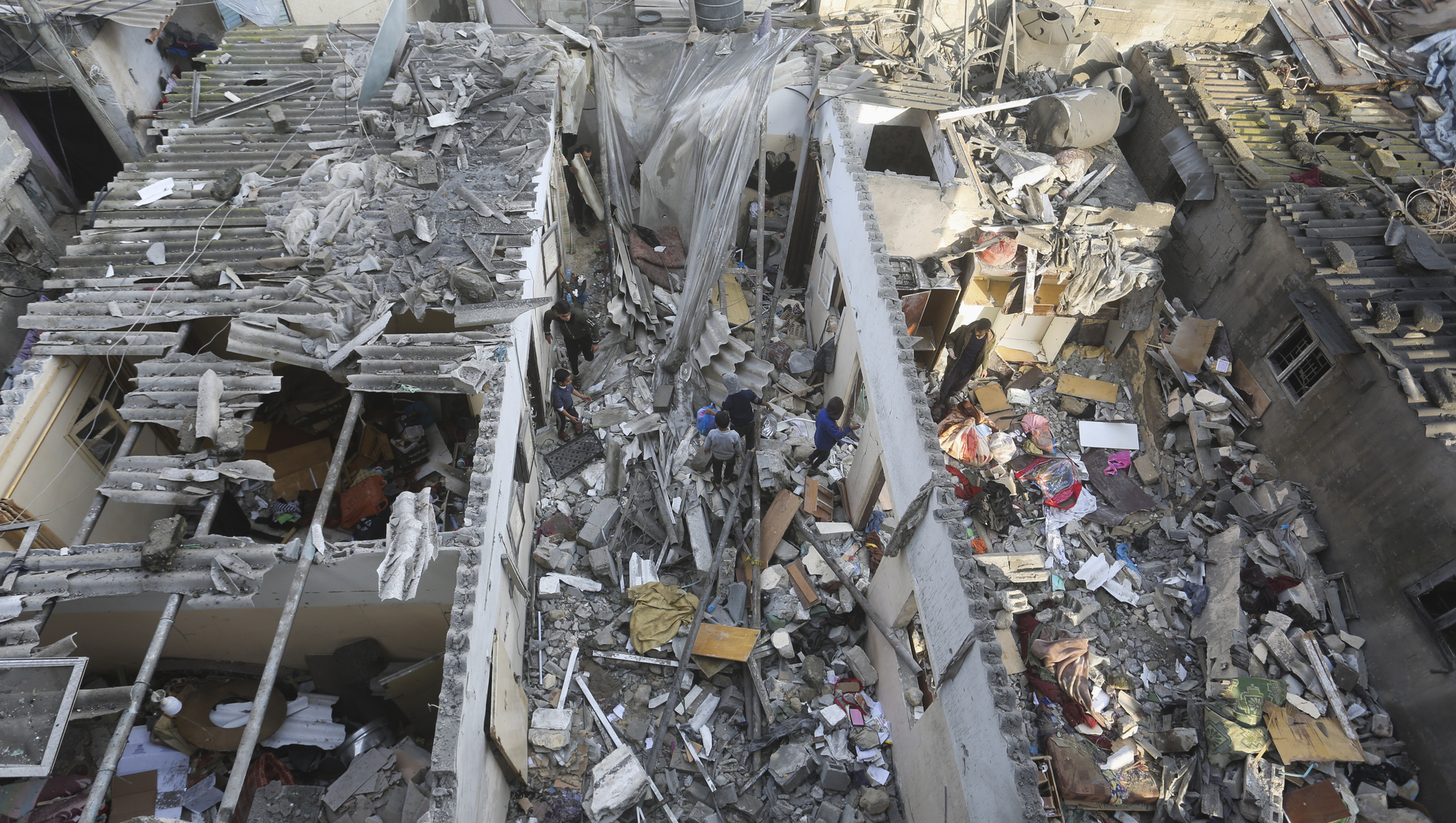
Palestinians salvage belongings after an Israeli strike on residential buildings in Rafah, Gaza Strip, on Thursday, December 14. Picture: Hatem Ali/AP

Palestinians salvage belongings after an Israeli strike on residential buildings in Rafah, Gaza Strip, on Thursday, December 14. Picture: Hatem Ali/AP

In an evocative article in this newspaper, Mary Lawlor, human rights expert, UN representative, and former director of Amnesty International in Ireland, asked a question which has resonated through the week.

“It is time to choose what we believe in and I choose to believe in the promise of the UN Declaration of Human Rights” she wrote. “What future will we build on the stones of Gaza, Mariupol, or Aleppo?”

In the charnel house of Gaza, it is difficult to believe in the principles of the UNDHR 75 years after it was created at the end of a global conflict which claimed the lives of some 75m people. The world was unrecognisably different.

Security was provided by the Pax Americana. Although it is difficult to imagine similar circumstances occurring now, the drafting committee for the human rights declaration was chaired by Eleanor Roosevelt, the widow of the US president, Franklin D, who had died nearly three years earlier. Israel had just come into being as a nation-state. The Cold War, which was to keep Eastern Europeans behind the Iron Curtain for more than 45 years, was in its earliest iteration. The “Wind of Change” had yet to blow through Africa.

While our political leaders worry that the EU has “lost credibility” over Gaza, they fall short of saying what solutions are currently available. Everyone hopes for a lasting humanitarian ceasefire. Many people, including some in Israel, favour a “two-nation” solution.

The problem is the belligerents do not. From the perspective of the Israeli government, there is no place for the terrorists of Hamas in that arrangement and its war aims appear to rule out any form of power sharing.

Taoiseach Leo Varadkar is probably correct to say he detects a “significant change” among young people possessing more sympathy with Palestinians than Israelis.

The sands of time have diminished somewhat the large reservoirs of goodwill towards the Israel of David Ben-Gurion, Shimon Peres, and Yitzhak Rabin or the collective guilt felt over the experience of Jewish people in such as Leopoldstadt, Warsaw, or Prague.

Some readers may have watched Golda, Helen Mirren’s contemporary portrayal of Israel’s fourth premier. Golda Meir was born in another of the world’s now dangerous troublespots, Kyiv, into a Jewish Ukrainian family before migrating to the US. She subsequently moved with her husband in 1921 to the League of Nations Mandate of Palestine.

While Golda Meir is projected as a historic leader, becoming the first woman to hold high office in the Middle East, she would have been no more accommodating on the issue of separate Palestinian sovereignty than Benjamin Netanyahu.

While she acknowledged that she carried a Palestinian passport for 27 years, Golda Meir never recognised that there was a separate state or people with a remit from the River Jordan to the Mediterranean.

She may, however, have possessed the pragmatism which will be necessary to find a route forward.

After visiting a refugee centre in Arab Haifa, she drew a parallel with her people’s experience of pogroms: “I found children, women, the old, waiting for a way to leave ... I could not avoid that this, indeed, had been the picture in many Jewish towns.” Shared humanity is a precondition for progress. And it may require a change of leadership in Jerusalem.

The gift that keeps on giving 

When it comes to music, age is no barrier, although success can take longer for some to achieve than others. But congratulations to Brenda Lee for becoming the oldest person to top the US singles chart at the age of 78, and to the apparently evergreen ‘Rockin’ Around The Christmas Tree’ for helping her achieve that honour.

You would need to be a reader of a certain vintage to remember Brenda in her prime with a series of classic hits including ‘Sweet Nothin’s’, ‘I’m Sorry’, and ‘I Want To Be Wanted’.

She achieved her first chart hit at the age of 12 and went on to sell more than 100mn records and became one of four artists to achieve the most singles after Elvis Presley, The Beatles, and Ray Charles. The previous oldest person to top the hit parade was Louis ‘Satchmo’ Armstrong in 1964 when he dislodged John, Paul, George, and Ringo with his version of ‘Hello Dolly’.

Brenda Lee performed in Belfast in 1962 and Dublin and Cork in 1963. But the record that has taken her to top place can be said to be a slow burner. It was originally released in 1958 and was recorded by the artist when she was 13.

While it has had several covers, including one by Justin Bieber, it gained a significant boost to longevity when it appeared in the annual Christmas favourite Home Alone in 1990.

Refugee protocols should be reviewed

While the anniversary of the Universal Declaration of Human Rights was being marked last week-end, and politicians faced a testing Thursday and Friday in Brussels at the last European Council meeting of 2023, yet a third convention was meeting that has great relevance to both.

The Global Refugee Forum takes place every four years and is the largest international gathering to consider the increasing pressures created by forced international migrations.

It is overseen by the UN Refugee Agency which was established in 1945 to help millions of Europeans who had fled or lost their homes. It was given three years to complete the work and disband. That never happened.

Today it has 20,739 personnel working in 135 countries and has helped more than 50m refugees to successfully restart their lives and continues to support the 109 million people who are currently displaced.

This huge growth since the Norwegian explorer, Fridtjof Nansen, became the first High Commissioner for Refugees in 1920 underlines the scope of what has become a challenging issue for all European governments, including Ireland, irrespective of how generous they wish to be.

The senator and former justice minister Michael McDowell called for a more realistic debate about migration policy in Ireland and said politicians need to appreciate that they are losing touch with popular sentiment.

He asked whether existing practice in relation to asylum-seeking is still sustainable when the process is being used as a means of mass migration for largely economic reasons. Given the scale of turmoil in the world, and this is evidenced by the statistics provided by the UN Refugee Agency, those conventions, he said, should be rethought.

This contribution to public debate came while the Cabinet approved new measures to manage refugees from the war in Ukraine early in the New Year. These changes included a reduction in social welfare for new arrivals above the 100,000 who have already found refuge within our shores since Vladimir Putin launched his invasion nearly 22 months ago.

This is likely to be an increasingly difficult time for Ukrainians with deadlock in their attritional war against the illegal occupants of their country and support among Western nations appearing to waver, symbolised by the United States’ reluctance over funding and the EU’s problems with Hungarian prime minister Viktor Orbán. They need help and encouragement. Irish citizens have been generous with this to date and we expect that this will continue.

But it seems a poor response to be handing out tents in the middle of winter to would-be asylum seekers, and the news more than 500 bed spaces for international protection applicants are lying unused because they await sign-off by a fire safety officer implies a lack of urgency and joined-up processes.

More in this section

Revoiced

Newsletter

Had a busy week? Sign up for some of the best reads from the week gone by. Selected just for you.

Cookie Policy Privacy Policy Brand Safety FAQ Help Contact Us Terms and Conditions

© Examiner Echo Group Limited