John Gibbons: Even rainy Ireland is not immune to water shortages
We use expensively treated drinking water to flush our toilets and water our plants — but our infrastructure is creaking under the load, writes John Gibbons
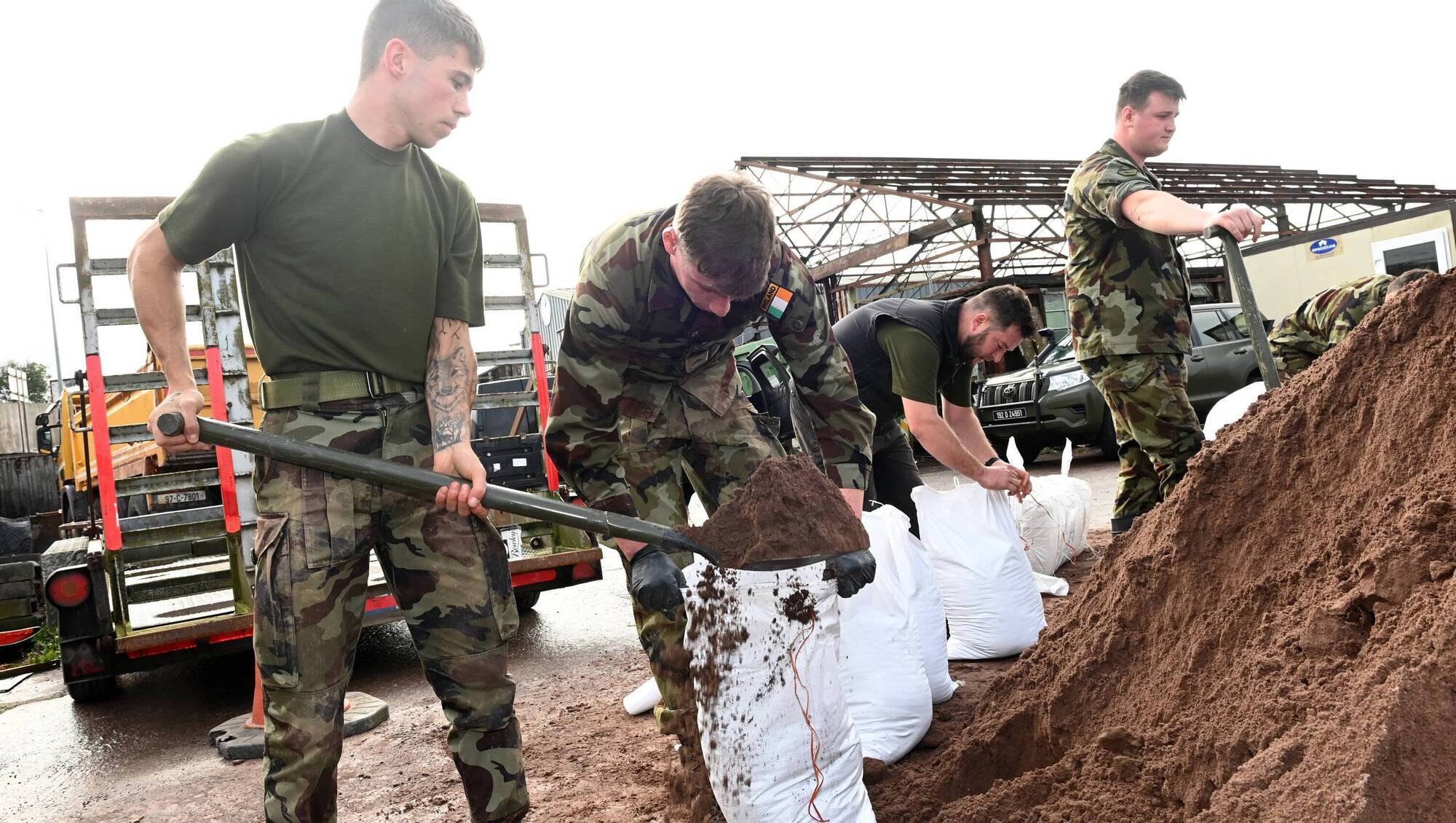
Soldiers from 1 Brigade Signals at the Cork County Council depot filling and delivering sandbags to protect against further flooding in Midleton Co. Cork on October 20, 2023. Picture: Larry Cummins

Soldiers from 1 Brigade Signals at the Cork County Council depot filling and delivering sandbags to protect against further flooding in Midleton Co. Cork on October 20, 2023. Picture: Larry Cummins

Weather whiplash is a term coined by scientists to describe the rapid see-sawing now being experienced as periods of extreme drought followed by torrential downpours, followed by droughts, heatwaves and so on.

As the climate system heats up, the global water cycle has become more intense, and this is playing out here too. In just the last 30 years, Ireland has become markedly warmer and wetter: average air temperatures have risen by almost 1C, and there has been an overall increase in rainfall of about 7%.


In such a short time frame, these are astonishingly rapid changes, and we are already feeling the impacts in real time. Last Thursday evening, Dublin’s Phoenix Park recorded 40mm of rainfall in just one hour, which is more than fell in the previous two months. On the same evening, Killarney was hit with an intense but localised downpour, described as “the worst flooding in a lifetime” by Killarney mayor, John O’Donoghue.

This is what weather whiplash looks and feels like, and in our rapidly warming climate, we can only expect these incidents to become more severe, more unpredictable, and more destructive over time.

Ireland is a wet country, our temperate climate dominated by proximity to the Atlantic Ocean, but even on this small island, there are sharp differences in local climates. The west coast of Kerry, for instance, typically receives about 1,400mm of rainfall annually, twice the rainfall in the Dublin area.

Rainfall is not, however, drinkable water, nor is water from rivers, lakes or aquifers, no matter how plentiful it may be. This is known as ‘raw’ water, and must undergo extensive — and expensive — treatment to be made safe for human consumption as treated water.

The average daily consumption of treated water in Ireland is 133 litres per person, which means we use about 730 million litres a day, or more than a quarter of a billion tonnes annually, all of which has to be treated and transported through 65,000km of ageing and often porous underground pipework, with 38% of treated water lost along the way through leaks.

Tim Casey, founder and chief executive of Cork Grassland Services, checks the condition of the grass on Brian Duncan’s farm in East Cork following weeks of drought. Picture: Chani Anderson

Managing and maintaining this vast network is the job of Uisce Éireann, and its budget last year was over €1.8bn, of which more than two thirds was paid as a Government subvention.

No incentive to conserve 'free' water

Uniquely in the OECD, Ireland does not impose water charges on the public, choosing instead to fund it from general taxation. This means there is no incentive whatever on water users to conserve. It is also fundamentally unfair in that more affluent households with larger houses and gardens, heavy water usage is being subsidised by taxpayers living in apartments or smaller homes.

In late 2024, Uisce Éireann said excess usage fees of €1.85 per 1,000 litres would be levied on households using far above the national average consumption of 125,000 litres.

However, it is clear neither the Government nor Sinn Féin are willing to support any kind of water charges, even for excessive and wasteful usage, seeing them as a political hot potato no one is prepared to grasp.

In 2009, the programme for government included a commitment to introducing water charges, and on that basis, I installed a rainwater recovery system in my Dublin home during renovations that year, consisting of an underground water tank, electric pumps and UV and charcoal filters.

A few years later, the government abandoned planned water charges, and I too gave up on my water recovery system: after all, it made no sense to pay to purify water while also paying taxes that subsidise free water nationally.

The population of Ireland is growing rapidly, rising by 45% since 2000 to more than 5.5 million today — with a commensurate rise in water demand of about 225 million litres a day. Population is growing fastest in the areas most prone to prolonged droughts and heatwaves.

Water demand will continue to spiral

In the next two decades, demand will continue to spiral, with up to 40% more treated water needed by 2044. The big pressure is along the eastern seaboard, including the 1.7 million people living in the greater Dublin area.

A single source — the river Liffey — supplies 85% of the entire water needs of this huge catchment, making our capital city uniquely vulnerable to a catastrophic weather or contamination event affecting the Liffey.

The recent clustering of data centres in the Dublin region is not helping either. During the hot, water-stressed summer months from May to July this year, as the public faced a hosepipe ban, thirsty data centres swallowed over half a billion litres of water for cooling.

Jim Harding examines river stones for signs of aquatic life on a tributary of the River Barrow near Gowran, Co Kilkenny. Harding says species that once thrived on the riverbed have become increasingly scarce as sediment, which he attributes to run-off from roadworks and construction activity, accumulates in spawning grounds and habitats. Picture: Chani Anderson

While the summer of 2026 will be remembered for its exceptional heat and prolonged drought conditions, it would be a grave mistake to see it as a one-off. Detailed supercomputer climate modelling for Ireland projects sharp temperature rises in the east of the country by mid-century, averaging 1.8C above the 1981-2000 average.

This rate of climatic change is without precedent, and will have profound impacts on agriculture in particular, as well as greatly increasing stress on our water supplies — at the very time that demand is spiking.

With this in mind, Uisce Éireann last December lodged planning permission for what would be the biggest water project ever undertaken in Ireland — a multi-billion euro plan to build a controversial 170km pipeline to transfer 300 million litres of water a day from the Parteen Basin on the River Shannon. This is the equivalent of about 2% of the flow of the river at Parteen. If approved, construction work will likely begin in 2028.

How we use water matters

Building more infrastructure clearly has a role to play in keeping up with demand for treated water as the world heats up and the east coast of Ireland gets increasingly hot and dry. How we use water also matters: incredibly, we flush our toilets, water lawns and wash our cars with pristine drinking water.

Rainwater recovery and gray water systems that re-use waste water from sinks, showers and washing machines to flush toilets would greatly reduce household water consumption, but are almost unheard of in Ireland. And, since our treated water is “free”, there is no financial incentive for homeowners to install these systems.

What we use for immediate personal consumption is just a drop in the ocean compared with the ‘virtual’ water embedded in the food we eat, clothes we wear and items we buy — much of which is imported from water-stressed regions.

A kilo of beef requires over 13,000 litres of water, a kilo of coffee uses 19,000 litres, while a cotton t-shirt typically requires about 2,700 litres to make. Producing a smartphone uses about 13,000 litres of water — at the very time that more and more countries are facing intractable and deepening water shortages.

Many of the wars of the 20th century were fought over oil. In the 21st century, they are more likely to be about access to humanity’s most precious commodity — drinkable water.

  • John Gibbons is an environmental journalist and author of The Lie of the Land: The Truth About Farming, Climate & Power in Ireland

CLIMATE & SUSTAINABILITY HUB

More in this section

Revoiced

Newsletter

Had a busy week? Sign up for some of the best reads from the week gone by. Selected just for you.

Cookie Policy Privacy Policy Brand Safety FAQ Help Contact Us Terms and Conditions

© Examiner Echo Group Limited