The pain of infertility has always been part of life and how we make sense of ourselves

Infertility was often an experience associated with sadness and stigma, particularly in societies which prioritised and privileged the family above all else. File picture
Last month, new laws were passed in Northern Ireland which granted paid leave to parents following a miscarriage.
This was welcomed by campaigners as an important step forward, moving away from a culture of silence or the pressure to simply ‘move on’ from pregnancy loss.
Read More
In 2025, UCC introduced a Pregnancy Loss Support Policy for staff, recognising the impact of losses under 23 weeks. Miscarriage impacts one in four pregnancies, and these policies and practices have the potential to make a very meaningful difference to people’s lives.
These are very recent changes, but pregnancy loss and infertility have always been part of human life. While we can often trace ancestors through a family tree, the history of infertility is much harder to research.
Sometimes it is visible in documents and census records, and sometimes it may be hidden through histories of adoption or through different kinds of family units being formed in a household. It was often an experience associated with sadness and stigma, particularly in societies which prioritised and privileged the family above all else.
Historical archives tend to hold sources on high-profile and high-status cases — where a royal couple could not produce an heir, for example. Literate women sometimes recorded their experiences of miscarriage in their diaries and reflections.
Nineteenth-century newspapers carried advertisements for cures and solutions of different sorts, aimed at both men and women. On January 2, 1850, the advertised ‘The Cordial Balm of Syriagum’, which promised to be "a renovator of the impaired functions of life", including "total impotence, barrenness, or sterility".
On 12 August 1876, the let people know how to obtain a guide to ladies’ health from Dr Val Mulvaney of Christ Church Place in Dublin, which included "instruction for both single and married life, explains the cause of weakness, hysteria, irregularities, sterility, &c. &c. and the names of medicine in each case required to effect a cure".
People also turned to folk medicines, cures, and practices to try to find help and support.
In early 20th-century Ireland, the family unit comprised of parents and children living together was held up as the ideal. This was evident across legal systems, in the media, and in cultural representations.
On 9 February, 1928, the newspaper reported approvingly on a series of pro-natalist measures taken in Hungary. This article noted that "super-taxes" would be imposed on "bachelors capable of founding families", that children would be "taught at school that childlessness is tantamount to treason to the country".

A series of stained-glass windows from the 1950s in All Saints’ Church in Drimoleague, Co. Cork, clearly visualised the family ideal. A group of young people stand underneath a signpost which has three options — marriage, religious life, or the priesthood. In the next panel, it is made clear that marriage will result in children, with the mother and father seated at the table surrounded by their three sons and two daughters.
The negative impacts of restrictions on birth control in Ireland have been well documented, but for couples experiencing infertility and miscarriage, this ideal of the family must have also been challenging to see. The pressure to have children regardless of whether a couple wished to have them or not was even represented in , with Dinny Byrne’s famous line — "anything stirring" — to his daughter-in-law, Biddy.
Before the arrival of Assisted Reproductive Technologies like IVF, people turned to a range of medical and social practices to try to find solutions. For many Catholics living in Ireland, prayer, intercession, and pilgrimage were very important ways of coping.
Certain saints were associated with infertility – St Anne, St Philomena, St Anthony of Padua, and by the beginning of the twentieth century, St Gerard Majella (among others). People often named their children after one of these saints as a gesture of thanksgiving.
Infertility was one of the reasons that people visited Lourdes, evident in the prayer cards which could be purchased there specifically including prayers to aid conception.
In the 1930s and 40s, the Irish newspapers often included short notices under the heading "publication promised".
The included one on October 4, 1930: "Thanksgiving to Our Heavenly Father, the Sacred Heart of Jesus, Our Blessed Lady under the titles of Our Lady of Perpetual Succour, Our Lady of Lourdes, St Gerard Majella, St Philomena, St Joseph, St Anne, for safe confinement, long delayed." While it is not explicitly mentioned, the list of saints makes it clear that this individual had struggled with infertility.
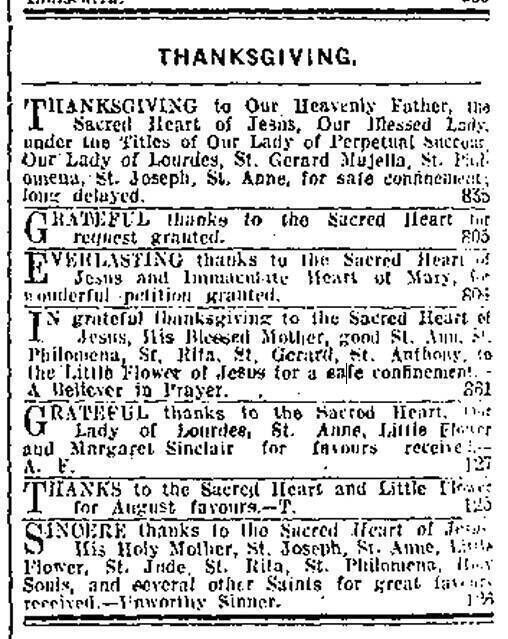
These lists of saints featured frequently in the "publication promised" sections. Indeed, many Catholics still turn to prayer in response to infertility, with the Novena to St Gerard Majella in the Dundalk Redemptorist church still a very popular event each year.
These histories are important because infertility and pregnancy loss are part of human history, and part of how we make sense of ourselves in the present. On 27 May, the University of Limerick will host a conference on the histories of infertility, titled ‘Locating Loss: histories of infertility in landscapes and spaces’.
This conference, funded by Research Ireland, will feature historians, curators, and writers who have examined the histories of infertility and miscarriage in their research and work. While infertility can be a very private and personal experience, it is one that has been shared by communities of individuals across the world.
Ultimately, the Locating Loss project aims to highlight aspects of this shared history and to make this research available to the public in an accessible way.
- The conference is free to attend, but booking is required here as places are limited
- Niamh NicGhabhann Coleman is an associate professor at the School of History and Geography, University of Limerick

CONNECT WITH US TODAY



Be the first to know the latest news and updates