Returning to a country shaped by conflict and resilience
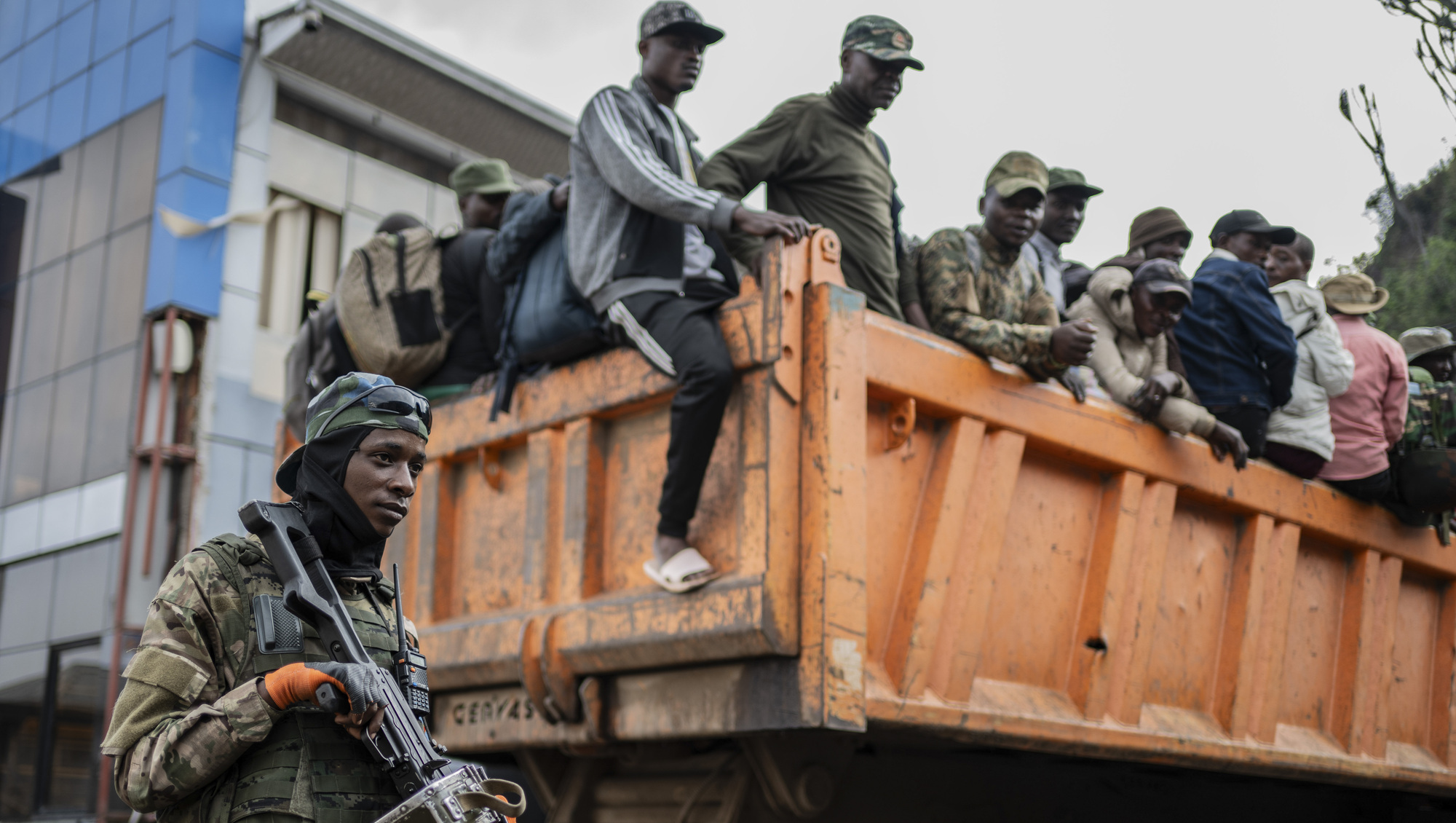
Former members of the Armed Forces of the Democratic Republic of Congo and police officers who allegedly surrendered to M23 rebels in Goma, Congo, last year. Since the March 23 Movement (M23) captured Goma in January 2025 and the airport closed, visits to Irish Aid-funded programmes in the province have required a more circuitous route. File photo: AP/Moses Sawasawa
The last time I landed in Kinshasa, the capital of the Democratic Republic of Congo (DRC), almost 20 years ago, I managed to lose my yellow fever certificate somewhere between Nairobi and Kinshasa, despite repeated warnings from a colleague that it was essential for entry. I was “offered” a replacement vaccination on the spot and, after some discussion, negotiation and a fine, was allowed through.
This time, I held on to my certificate and presented it with quiet triumph, only to be waved past without interest. The colour yellow followed us into the city. Kinshasa’s taxis and buses are required to be painted yellow, a simple visual rule imposed in the name of order, safety and control. Allegedly.
Read More
Progress through traffic was painfully slow, taking two hours to cover the roughly 20km from the airport to the hotel. I wondered whether panel beaters were either extremely rich or entirely absent, the number of battered vehicles suggesting one or the other. Kinshasa, a city of an estimated 17 million people, is exactly as you would expect, chaotic, noisy and oddly exhilarating.
I have returned to the DRC many times since that first visit, but almost always through the east of the country, via Goma, the capital of North Kivu. Since the March 23 Movement (M23) captured Goma in January 2025 and the airport closed, visits to Irish Aid-funded programmes in the province have required a more circuitous route.
This time, reaching Beni in northern North Kivu involved landing in Kinshasa, followed by a two-and-a-half hour UN humanitarian flight to Bunia and a further 25-minute hop south to Beni. The closure of Goma airport has wide logistical consequences, particularly for humanitarian actors.
Checking into a hotel in Kinshasa, we met a colleague usually based in Goma. To visit a project in a neighbouring province, he had driven to Kigali, flown to Addis Ababa and then back to Kinshasa to catch an onward flight the following morning. No wonder he looked exhausted.
Our own route to Goma from Beni required crossing six border posts, travelling into Uganda, driving south, an overnight stop in Kisoro, before crossing into Rwanda and continuing to the Gisenyi–Goma border crossing to re enter the DRC. In the Great Lakes region, borders are fixed on maps but provisional in practice, reshaped daily by conflict and diplomacy.
Since my last visit in 2023, Beni is visibly busier. Security briefings noted that, following the fall of Goma, its population has grown, along with levels of petty crime. My notebook records that the “pups” had moved out of Goma and into Beni. Parts of the provincial administration and related security functions have also been temporarily based there.
Outside the urban centres of Goma, Beni and Butembo there are few tarred roads, making travel across North Kivu slow and uncomfortable. My phone logged between 15,000 and 20,000 steps a day, a gross overestimation, I assure you. At one point, a colleague’s fitness app suggested she had completed two-and-a-half hours of horse riding.
Reaching communities where projects supported by the Government of Ireland are being implemented typically required a drive of at least two hours, meaning we spent a fair amount of time on the back roads of North Kivu.
Armed conflict in North Kivu has been largely continuous since the mid-1990s, following the aftermath of the 1994 Rwandan genocide and the wars that reshaped eastern Congo.
While the actors and intensity have shifted, violence, displacement and militia activity have endured for more than three decades. Official estimates suggest the province hosts dozens of armed groups, part of a wider eastern Congolese conflict involving more than 100 militias nationwide, many fluid, localised and opportunistic.
Travelling to project sites, we passed a succession of checkpoints, some operated by local authorities, others by Mai Mai groups now often referred to collectively as the Wazalendo, self-styled “patriotic” militias operating alongside the Congolese army against the M23.
Truckloads of Congolese and Ugandan soldiers also travelled the roads. As humanitarian actors, we were usually waved through and allowed to continue.
The landscape around Beni is fertile and striking, densely wooded, with forest pressing in on roads and settlements, broken only by rivers and the rising foothills of the Rwenzoris. That same density also complicates security, offering cover and mobility to armed groups where state presence is thin.
At one school supported by our programmes, the principal gestured towards hills roughly three kilometres away, pointing out the base of a local militia group, a quiet but persistent presence in the lives of the community.
The last major outbreak of fighting had been three months earlier. When violence flares, families flee if they can; those who cannot, keep their children indoors. Either way, education is disrupted.
In February 2025, fighting between two armed groups spilled into a nearby town centre, forcing civilians to flee as gunfire broke out in broad daylight. Nine children drowned while trying to cross a river to escape, and three others were injured.
The presence of armed groups was repeatedly cited as a driver of gender-based violence. Violence against women has long been a defining feature of conflict in the Democratic Republic of Congo and was raised in every meeting we held.
In North Kivu alone, tens of thousands of survivors have sought medical care in recent years. Health centre staff stressed that these figures are grossly underreported and already rising again this year.
Driving along the roads of North Kivu, I wondered whether I could tell the average height of a Congolese woman if asked. For the most part, I saw them bent double.
Bent double carrying water.
Bent double carrying tools and seeds to the field.
Bent double digging in the field.
Bent double carrying firewood.
Bent double carrying food home.
Bent double starting the fire.
Bent double cooking for the family.
Congolese women are the backbone of their communities, even as they carry the weight of profound and persistent inequality.
Despite conflict, displacement and neglect, the Congolese people I have met continue to show a quiet resilience, rebuilding lives and sustaining families in conditions that would overwhelm many societies far better resourced.
- Maurice Sadlier is director of Programmes & Policy at World Vision Ireland

CONNECT WITH US TODAY



Be the first to know the latest news and updates