Government playbook in Air Corps scandal copies all the others
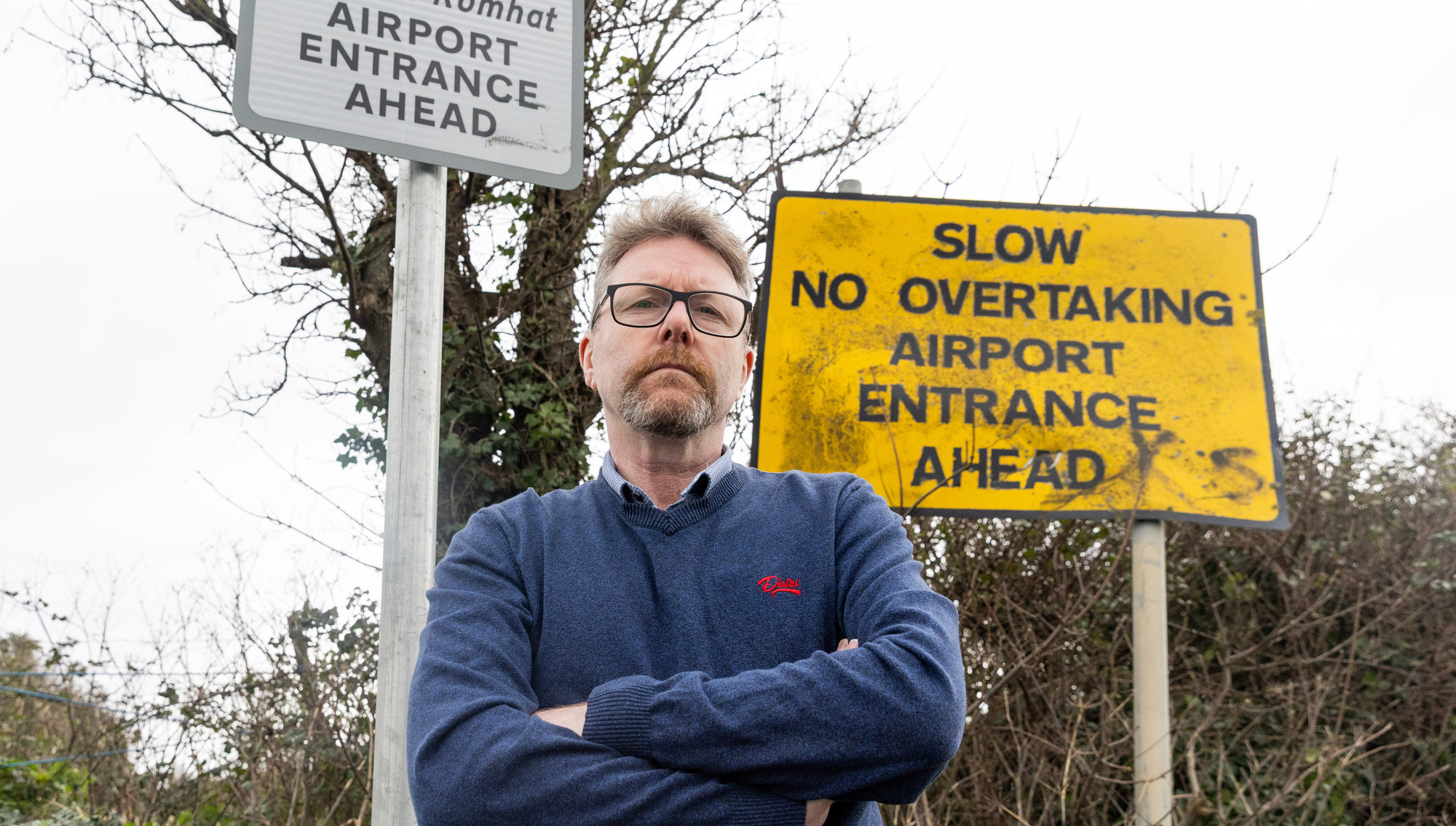
Gavin Tobin beside Casement Aerodrome in Baldonnell, Co Dublin; it has been over a decade since he, one of the whistleblowers, first took legal action against the State. File picture: Gareth Chaney
I have a personal yardstick by which to measure how long it has been since the Irish Examiner broke news of the scandal of the chemical exposures suffered by Air Corps personnel.
I will always know my first story on this was published in January 2017.
I remember because a couple of weeks or so after a series of revelations in this newspaper, I was coming out of a maternity ward buzzing from the high of becoming a father for the first time.
Leaving the hospital, I checked my voicemail, assuming the missed call from a private number was a well-wisher leaving a quick note of congratulations.
The curt tone that greeted me made it apparent this was not the case. Instead, a senior member of the government of the day was letting me know, in a very diplomatic “I’m not angry, just disappointed” manner, what he thought of our coverage of the Air Corps scandal.
For obvious reasons I can’t recall verbatim a voicemail from over nine years ago, but the word that stood out then and still does now was “unfair”.
We had revealed that Air Corps personnel were not properly protected from the dangerous, carcinogenic, chemicals with which they worked in Casement Aerodrome.
We highlighted how whistleblowers raising the alarm felt they were not being heard by the Defence Forces, the State, or senior politicians.
After public pronouncements from one minister to say they were not aware of any issues whistleblowers had with contacting them, we published a series of messages between whistleblowers and politicians that showed they had unsuccessfully tried to speak with the cabinet member on the matter.
On one story the response we received from the government did nothing to address the questions we asked, so we delayed publication to ask again.
And again. When it became apparent that no further reply would be forthcoming, we published our story with their evasive response.
This, apparently, was “unfair” according to my caller who felt the side who wouldn’t answer questions wasn’t getting a fair hearing.
I did not call him back. Aside from being on leave, I was stunned at his abundance of self-pity and dearth of self-awareness.
At the time, those campaigning for better health and safety in the Air Corps stated they believe several deaths of former personnel may possibly be attributed to a lack of protection for staff.
Scores of workers who served in the Defence Forces were fearing for their physical and mental health due to toxic exposure.
The response from the Defence Forces and government was to evade questions, delegate responsibility, and ultimately shrug their shoulders.
And yet despite the genuine hardship being endured by servants of the State, calling out the lack of action to aid them was “unfair”?
Not one word of the reportage on this issue in the past nine years has been subject to any contradiction from the State or Defence Forces.
None of the facts presented by this outlet or others in all those years have been disputed.
The recent RTÉ report again documented all the allegations, and again questions to senior politicians and apparatuses of the State have gone unanswered.
The whistleblowers went public via the in 2017, having felt like they had exhausted the official channels through which they were encouraged to raise their concerns.
They have been in this battle for over a decade now.
At the core of the issue is the byzantine system established to inoculate our senior leaders from responsibility.
They’ll defer to the State Claims Agency (SCA), or the Health and Safety Authority, or outside experts they’ve appointed to come to pre-determined solutions, and claim they are powerless until those bodies’ interminable processes are complete.
It has been over a decade since Gavin Tobin, one of the whistleblowers, first took legal action against the State.
His case still hasn’t had a hearing on its own merits as he has battled the SCA through the High Court and Supreme Court just to get access to health and safety records.
To give an example of how the State has handled such requests, years ago I submitted a Freedom of Information request seeking a copy of a specific health and safety report on Baldonnel compiled by outside experts.
The Defence Forces told me they didn’t have the report or its findings anymore, but if it was of any use still had the invoice to show how much they paid for the inspection.
The incumbent in the office of taoiseach has changed five times since we broke the story. All the men who have held that title — including Enda Kenny, Leo Varadkar, and Simon Harris — have delegated responsibility to others.
Micheál Martin was vocal about this issue in opposition, but has followed the same script as his predecessors.
Ultimately, everyone is to blame for these delays — which is a roundabout way of saying no one is to blame.
So, by our leaders’ thinking, it’s “unfair” to single them out for their inaction. That’s the system, their hands are tied, or so they would have you believe.
However they have also shown that when the public outcry is loud enough, they can act.
When RTÉ broke the story in 2021, detailing abuse suffered by female members of the Defence Forces, an official investigation and tribunal of inquiry swiftly followed.
The Air Corps allegations were added to the terms of reference of this tribunal — but jaded campaigners understandably believe they were only thrown in as an afterthought, benefitting from the larger outcry over a different scandal.
Even then, the tribunal is tasked with probing the handling of complaints about toxic exposure, not the exposure itself.
What is most unforgiveable about the State’s inaction on this issue is that a blueprint was there for them to follow.
The Australian Air Force had similar complaints from its mechanics, and established investigations, health screening, and supports for those affected.
“A precedent has been set by Australia where, in the early 2000s, the issue was identified and acted on by the Australian government,” Micheál Martin told the Dáil in 2017.
“Why was the State so slow to respond to the whistleblowers and to investigate the health conditions at Baldonnel?” the man who is now taoiseach asked.
Meanwhile, the senior politician who left me that voicemail is no longer in public life.
He left office with the usual plaudits and pension dispensed to those who step away from politics regardless of their talent and achievements — or lack thereof.
I left journalism six years ago. The baby who was born just hours before that politician’s call is preparing to make her Communion next month.
The number of deaths campaigners attribute to the Air Corps’ failings has grown to well over one hundred now.
In that time, with the exception of the €2m payout to ex-Air Corp mechanic Gary Coll, no one who was subjected to recklessly dangerous working conditions in Baldonnel has received any support from the State.
Back in 2017 I used to wince at the campaigners’ blunt slogan that the State’s approach to their concerns is ‘Delay, Deny, Die’. Stall the process through endless court appeals. Deny any wrongdoing in the face of mountains of evidence.
And ultimately hope this approach will kick the can down the road long enough that those complainants would just go away and die.
Now after nine years of inaction and deliberate obstruction it is hard to come to any other conclusion.
As he enjoys his political retirement and six-figure pension, I wonder if that politician still believes he and his colleagues are the ones who have been treated unfairly in all of this.


CONNECT WITH US TODAY



Be the first to know the latest news and updates