Leo Callanan: Reading can be fun, I promise
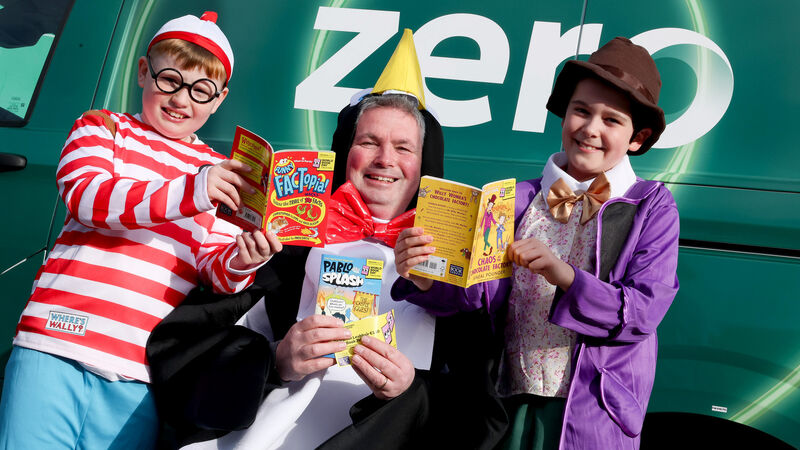
Postman Paul Fitzpatrick with his helpers Joe Elliott and Tadgh Cannon as An Post aims to deliver over 40,000 books to children in hospitals, care settings, and direct provision centres across the country for World Book Day. Picture: Maxwells
Three weeks into the dark of January, I received a text from my best friend. It was five paragraphs long, detailing his thoughts about the book I had got him for Christmas, which he had just finished.
The feeling of being understood and seen in that moment was greater than the dopamine hit someone might feel seeing several tags in the comments of an Instagram reel.
I still haven’t gotten around to the book he gifted me, because I’ve had a few things on my plate.
One of those things has been the experience of being a young judge for the KPMG Children’s Books Ireland Awards.
This has involved reading all the submitted titles — over 151 amazing books by Irish artists published for children and young people in 2025.
The judging panel then met to evaluate each title.

While this may sound like an arduous undertaking, in reality, it reminded me why I had fallen in love with reading as a child: Reading is fun.
I think reading for pleasure is something young men tend to lose as they move into adulthood.
During your teen years, books become associated with schoolwork and free time increasingly gets invested into hobbies and sports clubs, as well as in maintaining active social lives.
Alongside this, the rise in toxic masculinity online portrays reading as an inactive, emasculating activity compared to more physical, ‘manly’ hobbies.
Social media further pushes a certain body type on young men, encouraging them to spend their free time at the gym and work on their physical selves, leaving less time for leisure activities like reading.
The books that are targeted and marketed towards young men are typically self-help guides, motivational books, or sports autobiographies.
While these genres have their place, they contain within them an implied or even overt promise: I can help guide you.
I’ve been reminded during my time as a young judge that children’s literature does not make this promise, although it, of course helps to guide and shape readers' outlook on the world.
The surface promise of children’s books, however, is merely to entertain.
Children’s books are fun, they seek to engage readers, and if guidance is passed on, it is done through a leisurely and pleasurable story.
I don’t mean to say all children’s literature is light; in the past year, I have read stories that explore complex and upsetting themes, in picture books right through to young adult novels.
But in all cases, there was the author’s acknowledgement that the child is coming to the book to be entertained.
There is always some space for fun and enjoyment within these stories.
This is a space that is not always afforded to young men; the pervasiveness of ‘grindset’ discourages activities that are solely centred around pleasure.
Another challenge that young men face today is the reported ‘male loneliness epidemic.’
This is the perception that men are more isolated and lonelier in our current society.
I believe there is an element of truth to this idea, although I would argue that we are all struggling to find meaningful connections in an increasingly busy and overwhelming world.
I find reading books to be a useful way to navigate this issue.
Firstly, on the intellectual level, reading fiction puts you inside the mind of others and deepens emotional intelligence and thus facilitates greater interpersonal relationships.
On a more practical level, I have found reading is often a great source of communal experience and connection.
When I receive a book or a book recommendation, I feel that person is also sharing an insight into their mind and tastes.
By consuming the same story, there is a shared experience, yet the ambiguity of written text allows a person’s own interpretation and personality to come through.
My siblings and I have exchanged books every Christmas for years.
Each of our individual experiences throughout our teenage years can be tracked through the stories we chose to give and our shifting perceptions of each other are captured in the books we each received.
I remember clearly the gratification of watching my brother devour the book I had scrutinised and agonised over.
I don’t want to be another voice in the world putting pressure on young men to be a certain way, nor do I purport to have the one true solution to all their challenges.
All I would recommend to men of my own age is to rediscover reading like a child, reading fiction purely for pleasure.
If additional insights or connections come of it, that’s great. All I can promise is that reading can be fun.


BOOKS & MORE
Check out our Books Hub where you will find the latest news, reviews, features, opinions and analysis on all things books from the Irish Examiner's team of specialist writers, columnists and contributors.
CONNECT WITH US TODAY



Be the first to know the latest news and updates