Students deserve more than a hollowed out college experience
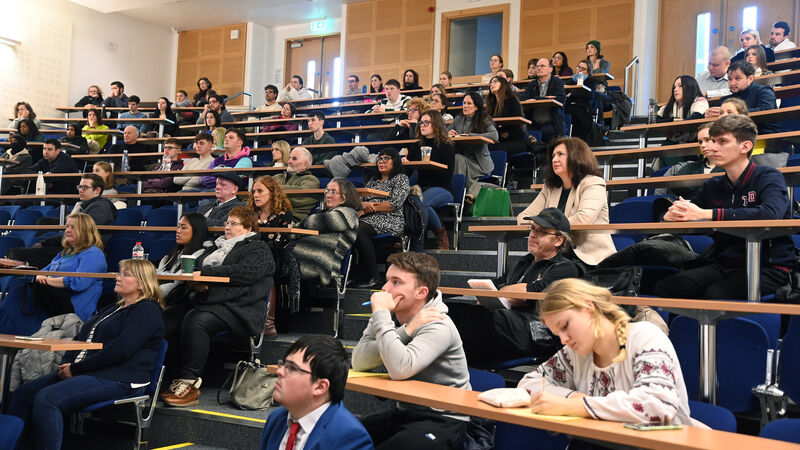
College experience is not simply about lectures or tutorials, although these are very important, it is also about meaningful learning and engagement beyond the classroom. File picture: Denis Minihane
The news broke in recent days that the minister for higher education, James Lawless, intends to ask third-level institutions to compress their lecturing days, to reduce the time that students spend commuting to their colleges.
This, on the face of it, would indicate concern with the many hours that third-level students spend on buses, trains and other public transport rather than in their lecture halls.
This, according to the minister, is to reduce the number of days students have on campus and, therefore, reduce the number of hours they spend in transit. It indicates a minister for higher education who is completely out of touch with how student life, and student learning, works.
There is no doubt that for many of our students long commutes impact on their university experience. This is not because they want to continue living at home but because it has become impossible to find suitable and affordable accommodation in the cities and towns in which our third-level institutions are located.
So the solution, apparently, is not to facilitate the building of more student accommodation but to reduce the student commute to three days a week, from five.
There isn't any lecturer that would deny these long commutes impact on the physical, mental and emotional wellbeing of our students, however, the solution is not compressing their lectures to fewer days per week, rather it should be to ensure that they can live close to where they go to college.
College experience is not simply about lectures or tutorials, although these are very important, it is also about meaningful learning and engagement beyond the classroom.
Students begin their studies as 18-year-olds, just out of secondary school, and end their studies as young adults. In between they do a lot of growing up.
As well as lectures and tutorials, the real college experience should include extracurricular engagement and social development.
By extracurricular engagement I mean joining student societies which allow involvement in a wide range of activities from archaeology, film, dance, science fiction, to overseas volunteering and of courses, sports societies.
In fact, our biggest university at UCD has over 80 different student societies. These allow students to engage with new interests, deepen existing ones, develop social networks, and make friends for life.

There are also the debating societies. TCD has the oldest university debating society in the world, the College Historical Society (the Hist) which was founded in 1770, UCD has the Literary and Historical Society (the L and H), UCC has the Philosophical Society (the Phil), UL has the Philosophy & Debating Society.
Here students hone their critical skills in debate and discussion; it’s where many barristers, journalists and others gain the skills which will benefit their professional careers.
Politicians too, minister Lawless should be reminded, often get their start in the student branches of political parties where they learn the cut and thrust of political debate and organising. Aspiring journalists get their start on student newspapers and websites.
Activism is another aspect of student life that would not thrive in a hollowed out, compressed student experience. LGBTI+, feminist and civil liberties groups organise campaigns on campus, and participate in national campaigns.
Students' unions are central to the student experience. Members campaign for better housing, lower fees, better access to health and childcare for students, safety on campus, as well on issues of national and global concern, including anti-racism campaigns, anti-war campaigns, gender equality and LGBTI+ campaigns.
My first steps as a feminist were taken within the students' union. It was here I learned how to be a feminist activist and that experience had as much impact on my career as my degree in history.
Sometimes students find their life choices/profession choice not in the lecture theatre but in their extracurricular activities.
A compressed, hollowed out experience of university or college, where you only attend to get all your lectures over a curtailed number of days, with no time for other experiences, or long lunches to discuss what you’ve just heard in class, or to attend meetings of your society or club is not the full, holistic, critical experience our students deserve.
Many students already work part time to fund their college career which can take from their ability to fully engage with life on campus; condensing timetables would make this even worse.
So, it’s a no to condensed timetables; rather build more student housing to take the pressure off accommodating students, create spaces for students to learn and thrive, give students the experience previous generations had, not the pastiche of a third-level experience the minister suggests.
- Mary McAuliffe is a historian and lecturer in Gender Studies and Social Justice at UCD.
CONNECT WITH US TODAY



Be the first to know the latest news and updates