Is Ireland drifting from neutrality amid Europe’s €381bn rearmament drive?
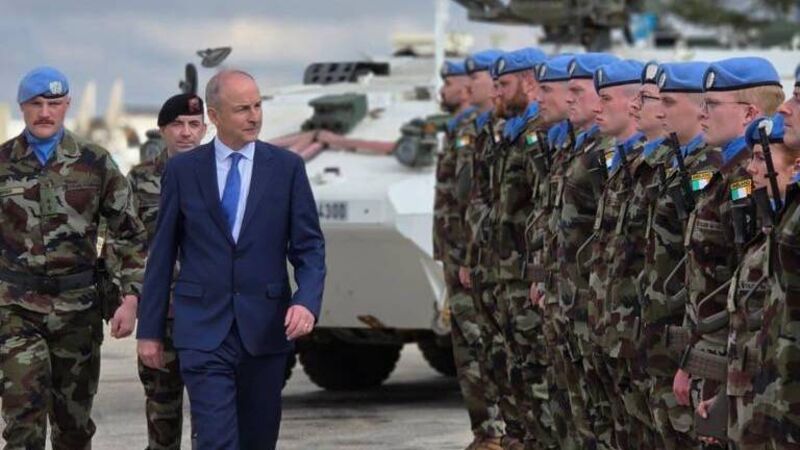
Taoiseach Micheál Martin visiting Camp Shamrock in Lebanon last December. A small country cannot outspend the great powers, but it can decide what kind of politics it wants to import, writes Colin Sheridan. File Picture: Irish Defence Forces
Ireland’s defence debate is always conducted as if Ireland has just been discovered. As if the country has drifted, unnoticed, into a dangerous world, and it must now be briefed, urgently, by those who have been watching the horizon.
The language is increasingly familiar. Neutrality is “outdated”. Ireland is “exposed”. The Defence Forces are “hollowed out”. The State is “falling behind”.
In a world of cyberattacks, undersea cables, and “hybrid threats”, we are told that Ireland must spend or become spent.
There is truth in parts of this — Ireland does have vulnerabilities — but there is also a sleight of hand in the way the argument is made, a tendency to treat every security concern as evidence for the same conclusion: More spending, deeper integration, and a quiet retreat from neutrality.
It is happening at precisely the moment when Europe is embarking on the largest defence build-up in generations — a build-up that is not only changing military doctrine, but building a new economy: One of contracts, procurement pipelines, and corporate profit.
EU member states spent roughly €381bn on defence in 2025, up from €343bn in 2024. It is a scale of expenditure that would have been unthinkable not long ago. It is presented as inevitable, a sober response to a “deteriorating security environment”.
Khem Rogaly, the co-director of the military research organisation Transition Security Project and a senior research fellow at think-tank Common Wealth, describes what’s emerging as something deeper than an emergency response to Russia’s invasion of Ukraine.
“Europe is building the foundations of a more permanent defence-industrial political economy,” he says.
It is a line worth sitting with. A political economy is not a temporary budget line. It is a system: Contracts, factories, lobbyists, think tanks, board appointments, media narratives and, eventually, political dependence.
Once built, it does not quietly dismantle itself.
But Rogaly argues the surge predates the war in Ukraine, and it is being sold in misleading terms.
“Contrary to most political presentation, military spending in Europe has been surging for well over a decade,” he says.
“In central and western Europe, military budgets grew by nearly 60% between 2015 and 2024.”
Europe’s rearmament is also sold as “strategic autonomy” — the idea that the continent must become less dependent on Washington.
Yet, Rogaly notes the contradiction at the heart of the spending surge: Europe has increasingly bought American.
“Despite trillions of euros spent by European Nato countries over this period, they have increasingly imported weapons from the US,” he says.
The arms trade is dominated by a handful of firms whose business models rely almost entirely on government money.
In Europe, the biggest players include BAE Systems in Britain, Rheinmetall in Germany, Thales in France, Leonardo in Italy, Saab in Sweden, and missile consortium MBDA.
In the United States, the giants are even larger: Lockheed Martin, RTX (Raytheon), Northrop Grumman, General Dynamics, and Boeing. They are not peripheral to Europe’s rearmament.
They are central to it. Rogaly points to Germany and Britain as examples of how spending flows.
“In Germany and the UK — two of the continent’s largest military powers — spending has so far been directed to the long-term programmes of large national companies like BAE Systems and Rheinmetall,” he says.
"These companies rely entirely on public money although they are privately owned, with institutional investors benefitting from surging government spending and direct subsidies for research and development."
When the political climate turns anxious, the defence sector becomes a safe harbour for investors. War becomes a growth story.
Andrew Feinstein has spent decades investigating the global arms trade.
His book argues that defence spending is rarely a neutral response to threat, and more often the result of political manipulation and corruption.
“The starting point needs to be: Let’s not forget why the EU was created. It was primarily created to ensure peace in Europe,” he says.
And the deeper problem, Feinstein argues, is not merely strategic but cultural.
“The EU is militarising not just in a material sense, but in the philosophical and moral sense as well,” he says.
“We have to have an enemy. Throughout post-Second World War history, the sort of fears and threats and enemies that have been invoked [are used] to keep this money flowing.”
For Ireland, neutrality has long been a refusal to inherit great-power enemies.
But the language of threat is now arriving as if it were an import, packaged with policy papers, procurement plans, and alliance expectations.
Feinstein argues that the arms trade is structurally corrupt not because it attracts uniquely immoral people, but because it operates behind secrecy, urgency, and nationalism.
“The trading of weapons happens in a very clandestine way,” he says.
“Everything happens behind the veil of national security-imposed secrecy.”
Procurement is hidden behind confidentiality. Critics are accused of naivety or disloyalty.
This matters in Ireland not because Dublin is uniquely corrupt, but because Ireland is uniquely small: A state where policy networks are tight, lobbying is often informal, and where a rapidly expanding defence sector could grow faster than the institutions meant to regulate it.
If the old arms trade was dominated by primes — the companies that build jets, ships, and missiles — the new arms economy has another wing: “Defence tech”.
Rogaly points to firms such as Palantir and Anduril, companies that sell software, surveillance, autonomous systems, and the promise of “AI-enabled warfighting”.
“These companies have grown with the support of US-based venture capital and private equity investors that also stand to profit from the military industrial turn,” he says.
This is where Europe’s rearmament begins to resemble a new techno-military economy: Drones, sensors, predictive targeting, data fusion, automated logistics, battlefield AI.
It moves the war economy deeper into everyday life — into cloud computing, telecoms, data infrastructure. The arms boom is often sold as economic stimulus in jobs, innovation, industrial strategy.
Rogaly warns this is misleading.
“Compared to other forms of public investment, military spending has a very weak relationship with growth and jobs,” he says.
The implication is stark: If governments chase Nato targets and permanent rearmament, the money comes from somewhere. It comes from public services, climate investment, housing, transport, health.
“European countries are at risk of cutting their investments in public services, green industries, and social security to fund military expansion,” Rogaly says.
There is also the climate dimension, often missing entirely from defence debates.
“Modern militaries are inherently sources of carbon emissions,” Rogaly says.
If Europe is serious about decarbonisation, it cannot treat the military as a sacred exemption.
Ireland is not the centre of Europe’s rearmament, but it is a test case for what rearmament does to political identity.
Neutrality, in the Irish sense, has never meant moral indifference. Ireland has often tried — imperfectly — to act as a small-state counterweight to the great powers, whether through peacekeeping, multilateralism, or scepticism toward American militarism.
Feinstein argues that scepticism is not naïve, it is historically justified.
“We have to have an enemy,” he says. “And the reality is that the military analysis, the security analysis of all of these things, never stands up to the fear-mongering.”
Ireland’s proximity to the US — culturally, economically, politically — makes this even more sensitive.
If Europe’s rearmament deepens transatlantic dependence, then Ireland’s drift away from neutrality is not merely a domestic budget question. It is an alignment decision.
Rogaly puts it in practical terms: “Ireland is well-positioned to observe the destabilising effects of militarisation across Europe.
The spending surge is not a neutral response to a measured threat assessment, he argues.
It is a political project: A mixture of fear, alliance politics, industrial strategy, and profit.
The language of “security” has never been louder, yet the greatest threats facing ordinary people are not primarily military.
“Our real threats are things like global and national inequality, climate change, pandemics,” Feinstein says.
“These are amongst the greatest threats to humanity at the moment.”
A small country cannot outspend the great powers, but it can decide what kind of politics it wants to import.
Europe is building a new war economy. The companies are already positioned. The investors are already benefitting.
The only open question is whether Ireland will obediently sign up — and later discover it has purchased not protection, but permanent entanglement.

CONNECT WITH US TODAY



Be the first to know the latest news and updates